
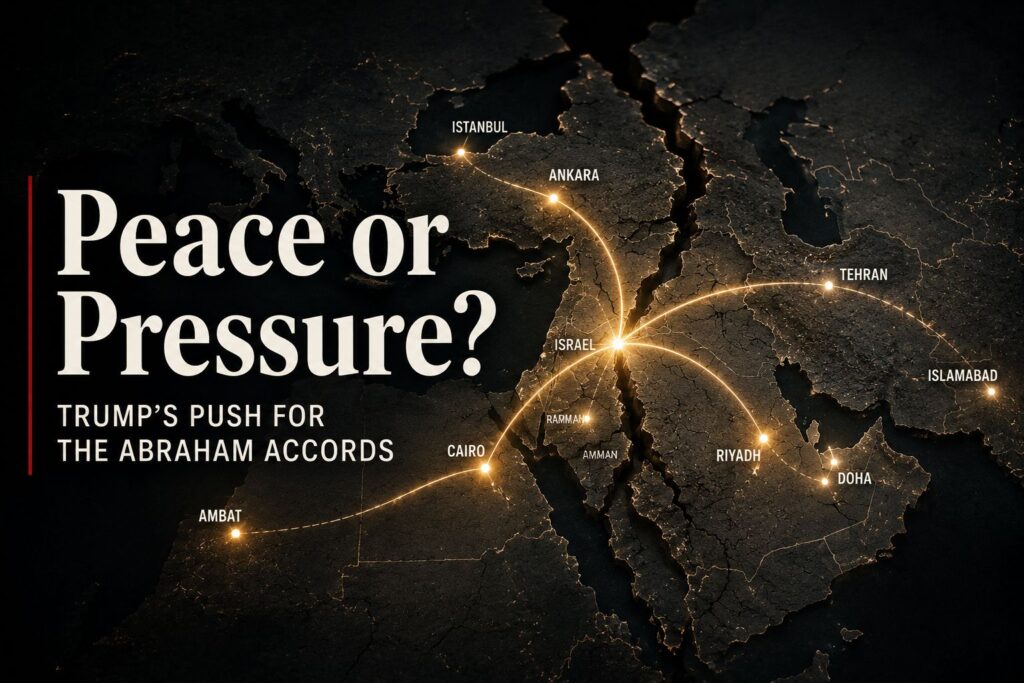
From Rabat to Riyadh, and from Islamabad to Ankara, the pressure to normalize ties with Israel has returned with new urgency. But this time, the push comes wrapped in the language of peace diplomacy with Iran. President Donald Trump, in “mandatory request”, has openly urged major Muslim nations, including Saudi Arabia, Pakistan, Turkey, Qatar, Egypt and Jordan to join the Abraham Accords “en masse.” The timing is revealing. Even as smoke still rises over Gaza and millions across the Muslim world watch the Palestinian tragedy unfold in real time, Washington appears determined to expand normalization before any meaningful settlement of the Palestinian question. The real debate has, therefore, shifted from Iran talks to Abraham accords attached to the ongoing diplomatic efforts. Analysts argue that the Abraham Accords are becoming a shield for Israel’s long-term regional ambitions.
The Abraham Accords were launched in 2020 under the previous Trump administration. It was a series of agreements, presented as a breakthrough for Middle East peace. The agreements normalized relations between Israel and several Arab states, beginning with the UAE and Bahrain, followed later by Morocco and Sudan. Supporters argued that economic cooperation, security coordination and technological exchange would stabilize the region. In return, participating countries received strategic incentives from Washington: advanced weapons sales for the UAE, recognition of Morocco’s claims over Western Sahara, and economic inducements for Sudan.
However, one must note that the critics always maintained that such an accord was geared towards managing the conflict instead of building peace and that it sought to circumvent the Palestinian question instead of addressing it. It is important to remember that, for many years now, the Arab approach to normalizing relations with Israel included the creation of a viable Palestinian state within the boundaries of 1967.
This is where the true strategic endgame of Israel is understood by many analysts. The agreements go beyond mere diplomatic relations, they involve building a new order in which Israel emerges as the hub for security and technology in the Middle East. By forming relationships with the Arab monarchies, Israel secures access to markets, air space, intelligence gathering, and legitimacy, while also easing pressure on its policies towards Gaza and the West Bank.
Nevertheless, the process of normalization has not restrained Israeli policies in any way. Since the signing of the agreements in 2020, there has been an even greater increase in the rate of expansion of Israeli settlements in the occupied Palestinian territory of the West Bank, escalation of violence in Gaza Strip, and an increasingly more outspoken expression of far-right views within Israeli politics. Far from restraining Israel’s expansionist drive, the agreements made it easier for Israel diplomatically.
This situation is what makes Saudi Arabia hesitant to fully engage in the agreements even though there had been much speculation about their involvement for a long time now. The Saudis realize that normalization at this point in time will be politically and religiously very risky. Since they have custody over the two most sacred places of Islam, they cannot afford to ignore the public sentiments throughout the Islamic world following the destruction in Gaza.
The position of Pakistan, on the other hand, is more definite. Islamabad has a long-standing ideological tradition of not recognizing Israel until there is a separate Palestine that has East Jerusalem as its capital. The position is founded on ideological, constitutional, and popular grounds, since Pakistan always advocates for the two-state solution on the world stage. Another important factor is that Pakistan sees no strategic necessity in recognizing Israel. Unlike Gulf monarchies concerned about direct Iranian influence in the Gulf, Pakistan does not share the same regional security calculations. This explains Islamabad’s rejection of Trump’s latest proposal despite growing U.S. efforts to widen the accords.
However, the inherent flaw in the Abraham Accords is their premise that economic interdependence will take the place of political equality. History shows us that this simply cannot happen. Peace will never prevail in the region as long as the Palestinians do not have a state and occupied territories keep on growing.
Trump’s most recent efforts thus show much more than just a diplomatic move; it shows an effort to control the future political structure of the Middle East. Israel aims at greater recognition without making changes to its approach towards Palestinians. Without justice for Palestinians, the path to peace will not lead anywhere other than to the institutionalization of the occupation.