
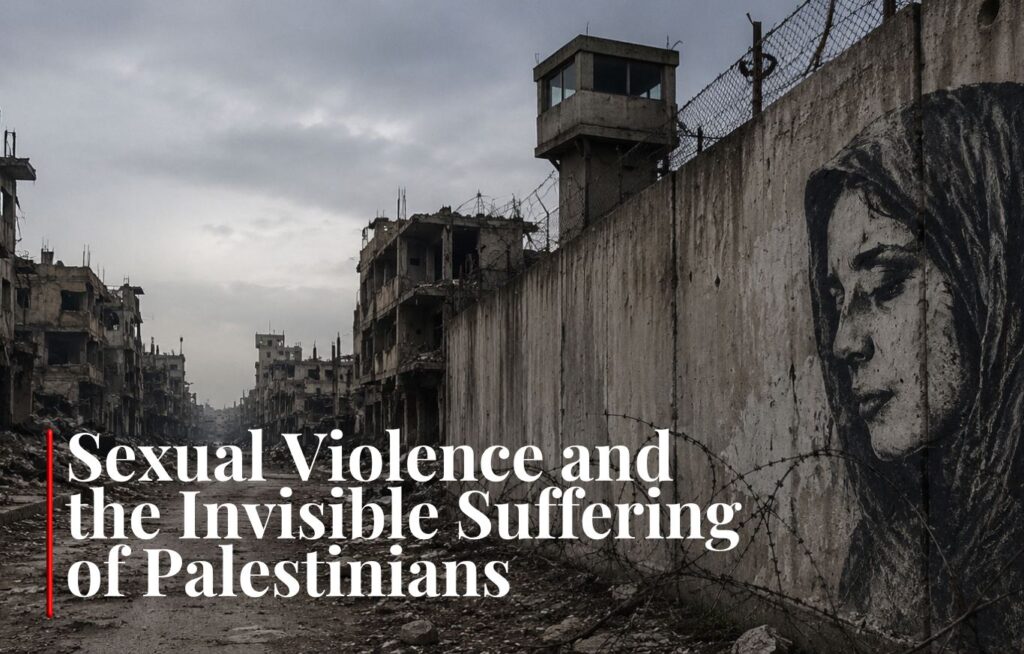
Amidst the destruction and rising tallies of casualties and displacement, a disturbing dimension of the Palestinian crisis is coming to light. Documented accounts detail severe instances of sexual abuse, personal humiliation, and organized degradation targeting Palestinians held in detention centers and under military occupation. Men recount rape with batons and objects. Women suffering of molestation, forced stripping and threats of sexual assault. Children describe humiliation so acute that language itself seems inadequate to reveal it. They are stories of human beings stripped of dignity before a world that appears too politically compromised to care.
The world, for years, has watched Gaza through the lens of military operations, security strategy and geopolitical expedience. However, beneath those debates exists the reality, one in which Palestinian bodies themselves have become sites of punishment, intimidation and domination.
The current international order presented itself as the guardian of a universal moral framework, one in which international law applied equally to all lives, all bodies and all suffering. But Palestine has exposed that hollow promise. Global divisions no longer seem to fall between protectors and violators of human rights, but rather between populations whose trauma is publicly grieved and those left to suffer in silence. This stratification of human empathy introduces a profoundly dangerous double standard.
Accounts from Palestinian detainees expose systemic violations rather than isolated misconduct, highlighting a breakdown of basic human rights protected by institutional immunity. A reality emerges where Palestinian dignity is treated as expendable when investigations are denied, recorded abuses go unpunished, and political figures ignore victim trauma.
These traumatizing experiences, for Palestinians, do not disappear once headlines move on. The consequences travel into homes, schools and entire communities. Women become fearful of movement through checkpoints. Families silence daughters out of fear and social stigma. Young men leave detention carrying trauma they cannot openly discuss.
These violations turn into sterile, administrative routines. Incidents like the humiliation of children at checkpoints, sexual assaults against detainees, and the terror of women navigating military barriers lose their status as human tragedies. Instead, they are reduced to background noise swallowed by strategic geopolitical calculations.
Occupation does not survive merely through tanks, walls or surveillance systems. It survives by breaking the spirit of the occupied, by teaching a people that their suffering will not move the world.
Acknowledging Palestinian suffering has, therefore, become politically uncomfortable in most of the Western capitals, where criticism of Israel’s conduct is often approached with caution, or sometimes, outright hostility. Consequently, allegations that should have triggered urgent independent investigations, instead risk becoming absorbed into the endless noise of war.
History does not forgive societies that normalize cruelty while preaching the language of humanity and civilization. Years from now, people may ask how the world reacted on painful testimonies of rape, torture and humiliation emerged from Palestine. They will search through speeches, resolutions and headlines looking for evidence that humanity possessed the courage to defend human dignity consistently. What they may find instead is hesitation, Evasion, Silence.
And silence, in moments of injustice, is never neutral.