
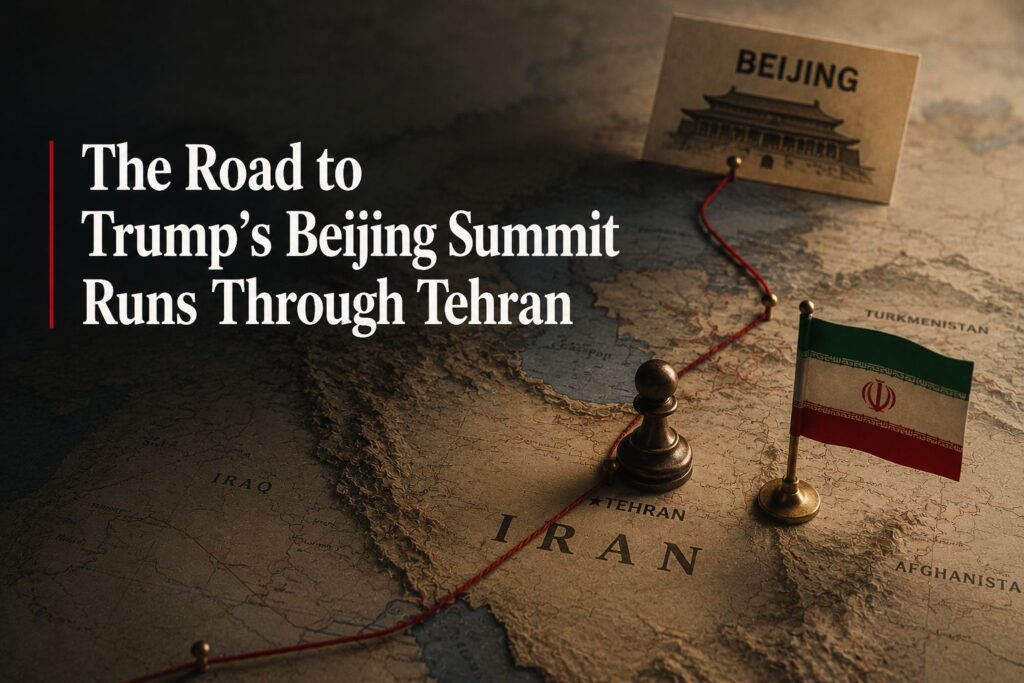
The unspoken reality hanging over this week’s summit between Donald Trump and Xi Jinping in Beijing is that the road to Beijing now runs through Tehran. Although, the agenda includes trade, Taiwan, rare earth minerals and military tensions in the Pacific, the summit has become an emergency geopolitical intervention centered on one issue alone, preventing the Iran war from collapsing into a wider international crisis.
The timing of recent diplomatic movements reveals just how serious the situation has become. Iranian Foreign Minister Abbas Araghchi visit to China, days before the summit, was an effort to ensure Beijing’s willingness to act as Tehran’s principal diplomatic shield. On the other hand, reports of expected visits by Pakistan’s PM shahbaz Sharif and Russian President Vladimir Putin to Beijing in the coming weeks are interesting developments. These are not routine diplomatic visits. Collectively, they project a larger picture: China is rapidly becoming the central convening power of the Eurasian response to the Iran conflict.
Unlike the US, China has maintained cordial relations simultaneously with Iran, Saudi Arabia, Pakistan and Russia. It imports Iranian oil despite Western sanctions, retains profound economic leverage over Tehran and presents itself as a power which strives for stability rather than ideological confrontation. The Araghchi visit was therefore not symbolic diplomacy, it was manifestation that any sustainable ceasefire now requires Chinese involvement.
However, China’s growing role extends beyond mediation. The Iran war has accelerated the pace of a loose geopolitical alignment. From Moscow to Islamabad, united less by ideology than by resistance to the US strategic objectives. Moscow views this dispute as a chance to weaken the US global leverage. Meanwhile, Islamabad worries about impending financial disruptions and border insecurity, while seeking to preserve its ties with both the United States and China. Concurrently, Beijing regards the situation as a critical trial to determine if its financial dominance can successfully convert into international political influence.
In this context, this visit is crucial for Trump. Oil prices are dangerously high, global shipping routes are disrupted and domestic criticism of the war is growing. Even America’s close partners fear that Washington entered the conflict with military objectives but without a coherent political endgame. Trump therefore desperately looking for desired results from this visit, not because China controls Iran, but because Beijing remains one of the few capitals Tehran still trusts. China understands this leverage perfectly.
China will not “deliver” Iran unconditionally. Instead, it will probably position itself as the indispensable stabilizer while carefully extracting concessions elsewhere. Those concessions may not involve dramatic changes over Taiwan. China might seek soft and strategically valuable gains, like easing technology restrictions, reducing tariff pressures, and relaxing sanctions on Chinese firms linked to Iranian oil trade. The most probable outcome of the summit, therefore, is not a grand peace agreement. It is a managed de-escalation framework.
Three possible developments are expected. First, a provisional agreement on maritime security in the Strait of Hormuz, likely facilitated by Chinese channels. Second, renewed backchannel negotiations offering release of frozen Iranian assets and targeted sanctions relief in exchange for restraints on uranium enrichment rather than total dismantlement. Third, a diplomatic mechanism involving regional actors, potentially Russia and Pakistan to prevent accidental escalation.
What should not be expected is total reconciliation. The core gap remains enormous. The US is not backing off from its stance on Iran’s nuclear capabilities, while Tehran wants sanctions relief and security guarantees without surrendering deterrence. The contradiction cannot be solved in a single summit without establishing a common ground.
However, the significance of this summit lies elsewhere. We may possibly be witnessing the moment of global diplomacy visibly shifting from a US-led order toward a more transactional multipolar system in which China is not just an economic player, but also the essential broker of international crises.
How ironic it is that a war intended to reassert American power may instead accelerate the arrival of a world where Washington can no longer dictate outcomes alone.