
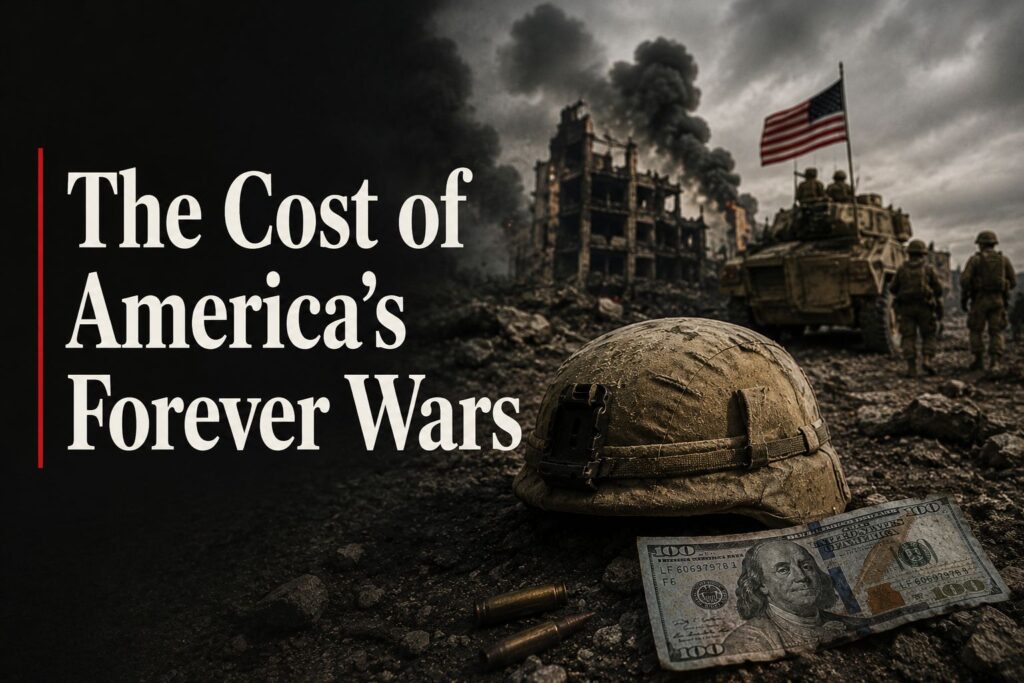
For more than two decades, the US has been engaged in various conflicts. From the deserts of Iraq to the mountains of Afghanistan, from drone campaigns in Africa to military stations in the Gulf, the US has spent an enormous amount of blood, money and political capital, trying to maintain a global order resistant to military solutions. However, the real tragedy is not the scale of these wars, but gap between their objectives and their outcomes. Interventions initiated in the name of security often produced instability. Campaigns to eliminate extremism usually deepened chaos. And wars meant to preserve American supremacy have, paradoxically, accelerated the erosion of its global dominance.
According to the Brown University Costs of War Project, the United States has spent more than $8 trillion on post-9/11 wars and military operations. These include the wars in Afghanistan and Iraq, operations in Syria, drone campaigns in Yemen and counterterror operations across Africa.
But the financial cost is not confined to battlefields. Most of these wars were funded through borrowing, leaving consequences for the future generations. Brown University researchers estimate some startling figures. The interest payments on war-related debt alone could exceed another $8 trillion by the 2050s. People may forget headlines of wars, but their economic aftershocks continue to drive American life.
The Iraq war is one of the prime examples of needless military campaigns. Launched over false claims of weapons of mass destruction, it drifted the Middle East into a chaos and sparked sectarian violence. Followed a similar pattern in Libya in 2011. NATO intervention removed Muammar Gaddafi, leaving behind a divided state dominated by militias and political chaos. Syria became another stage for the US prolonged intervention, proxy warfare and humanitarian catastrophe. Meanwhile, in Afghanistan, a twenty-year war ended with the Taliban returning to power almost exactly as they had ruled before the US arrival.
Now, the latest war with Iran threatens to deepen both America’s economic and strategic exhaustion. Pentagon estimates suggest the conflict has already cost nearly $29 billion within weeks, with operational expenses, missile deployments and military infrastructure costs continuing to rise. Even by Pentagon standards, the pace of expenditure has been extraordinary. The war demonstrates how rapidly modern military escalation can consume national resources in an era of already mounting debt and economic uncertainty.
The human cost has been staggering. Brown University estimates that at least 801,000 people died directly from violence in post-9/11 war zones, while indirect deaths caused by hunger, disease and destroyed infrastructure may reach into the millions. More than 38 million people have been displaced by these wars, one of the largest displacement crises of the modern era.
The US military entanglements have coincided with rising living costs, mounting debt and renewed inflationary pressures that continue to haunt ordinary Americans. Today, inflation rate has risen to 3.8%, the highest in nearly three years. Energy prices increased by 17.9% over the past year, while gasoline prices jumped 28.4%, mainly driven by instability in the Gulf and Iran war. Cost of living continue to rise, eroding real wages and causing economic anxiety across the country. Economists warn against the burden of prolonged geopolitical conflict.
These wars, at the geopolitical level, have also debilitated the very global position they were meant to maintain. While the US spent decades trapped in costly military campaigns, China remained focused on economic and technological expansion. Russia reasserted itself strategically. Consequently, the era of uncontested American primacy gradually gave way to a fragmented multipolar order.
Perhaps the greatest lesson of America’s endless wars is that military supremacy alone cannot guarantee political success. Weapons can destroy regimes, but they cannot build stable societies or strong institutions. In most cases, intervention created the very instability it sought to eliminate.
History suggests a pattern about how great powers collapse. They weaken gradually through economic exhaustion, strategic overextension and wars without clear endings. The US post-9/11 wars resemble that pattern. The costs are no longer measured only in distant battlefields, but in rising debt, inflation, political fatigue. The US endless wars have revealed precisely those dangers, and the costs are still unfolding.