
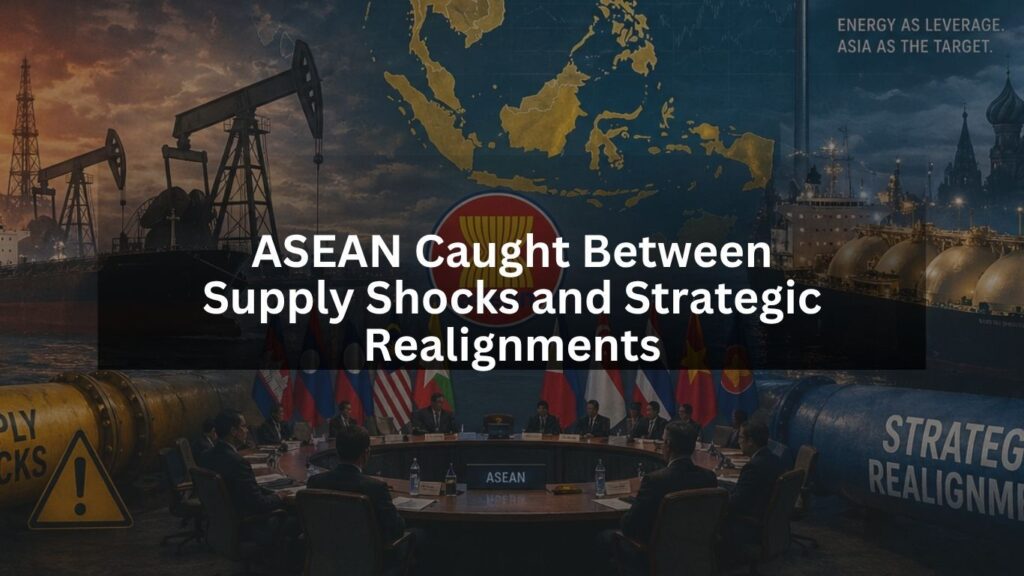
Southeast Asia is realizing that energy security is not just technocratic exercise reserved for planners and utilities, but also a fast-moving question of geopolitics, resilience, and strategic blocs. The special ASEAN Energy Ministers meeting convened on April 27 to deliberate on the growing anxiety about the fragility of global oil supply chains amid sprawling instability in the Middle East. ASEAN, Comprising Indonesia, Malaysia, Thailand, the Philippines, Singapore, Vietnam, Brunei, Cambodia, Laos, and Myanmar, is a bloc that has long maintained the principles of consensus-building and quiet diplomacy. It was not structured as a hard-security or deeply integrated economic union. Its strength has been its non-interference, gradualism, and flexibility. This model remained successful in an era of stable globalization and smooth energy flow. But now, it is forced into louder conversations about crisis preparedness
The region is a net importer of oil and gas, making it structurally vulnerable to global price volatility and disruption in maritime chokepoints. As the energy landscape is rapidly becoming volatile, the ASEAN statement on the situation emphasizes the significance of secure sea lanes and smooth transit under international law.
The gap between intent and execution
ASEAN has long discussed mechanisms for Stockpiling, petroleum cooperation, and ASEAN power Grid. But these designs to allow mutual assistance, and gradual integration of regional energy systems, largely remained theoretical. In practice, most of these mechanisms remained underutilized. It depicts a familiar ASEAN pattern, sophisticated planning structure, but weak enforcement capacity and absence of operational synchronization.
Russia’s calculated entry
Amid ASEAN debate on internal coordination, Russia is ready to fish in troubled waters. Russia, largely constrained in Western markets, is actively engaging to reposition itself as an alternative energy partner for Asia. Russia’s invitation to ASEAN leaders in Kazan in June manifests a strategic intent to strengthen economic ties with Asia while Western sanctions and geopolitical isolation persists. The “Pivot Diplomacy” is Russia’s global strategy of drifting trade flows eastward. With energy exports as its strongest leverage tool, Southeast Asia is a logical target market.
For ASEAN, importing Russian energy can be both an opportunity and a dilemma. Discounted energy sources versus the geopolitical risks of overdependence on another global power under sanctions pressure.
ASEAN at a strategic crossroads
These developments suggest that ASEAN is being forced to enter a more complex geopolitical stage. Energy security is not about finding new sources and securing supply contracts, it is about which bloc the region is gradually integrating into. The bloc’s internal challenge is turning concerns into coordination and coordination into speed. But the external challenge is equally important. As Russia strengthen its energy diplomacy and repositions itself as an alternative energy source, ASEAN’s future will be driven by choices it does not fully control.