
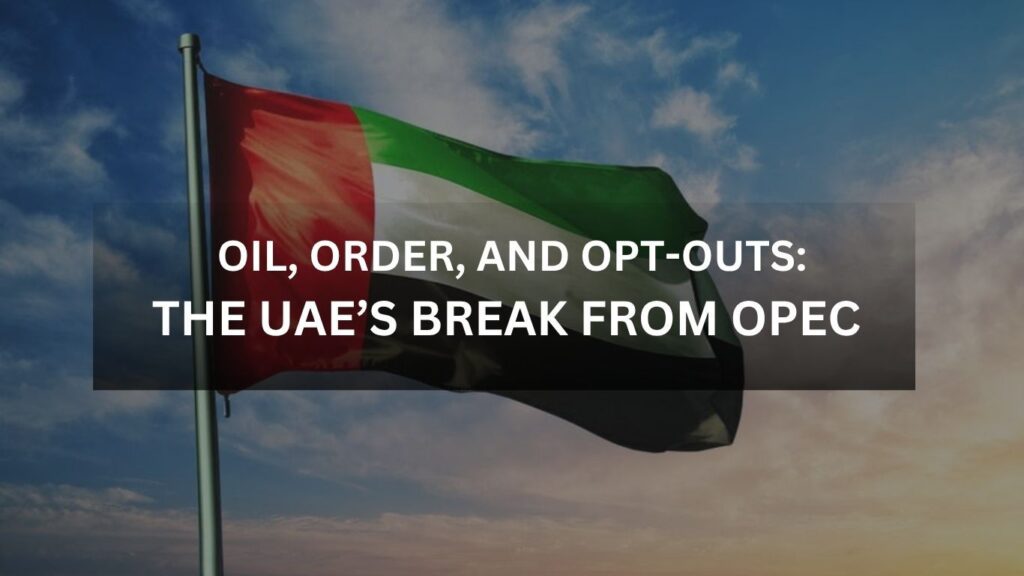
The Success of the Organization of the Petroleum Exporting Countries has long depended upon a tightrope between national ambitions and collective discipline. The UAE’s withdrawal from OPEC is being presented as a sovereign act aimed at securing these national ambitions. However, it is a high-stakes geopolitical gamble the UAE has chosen to play at a critical juncture, when the Gulf is already hanging in the balance.
The UAE’s simple argument is, why remain bound by quotas when production capacity can meet rising global demand. Freed from quota limits, Abu Dhabi can capture market share and intensify its oil diversification. On paper, this appears to be an agile energy policy. But agility alone cannot govern the oil markets. It is governed by discipline, historically enforced by Saudi Arabia. Opting out of that framework, the UAE will lose the shield against market volatility.
Restraint, not the unity, has been OPEC’s strength. The moment one major partner steps outside, it triggers the domino effect. Analysts already warn that the UAE’s exit will disrupt price stability. Consequently, the burden of stabilization will again reinforce Riyadh’s centrality. The UAE’s frustration is also tempted by an inadequate collective response from the Gulf partners against Iran’s fury. Yet rather than working for regional cohesion against shared security threats, the UAE has chosen divergence.
This is where the UAE’s calculation begins to look less like strategy and more like overreach. This manifests the strategic contradiction. On the one hand, the UAE is seeking economic independence, on the other hand, it is surrounded by a security environment where independence is inherently limited. By distancing itself from regional partners, both economic and political, the UAE may find itself in a situation where it may have to rely on external security guarantees, particularly from the US and Israel.
Such reassurance comes with a long-term cost. External security partnerships are transactional while regional alignments are structural. The UAE is weakening the durable, if imperfect, security architecture for an uncertain and conditional one. The assumption that flexibility can outweigh vulnerability may be true for stable times. But in a conflicted region surrounded by fears of chokepoints and external interventions, stability, not flexibility, has historically been the more valuable currency.
Not denying the fact that the UAE’s move is practical. But practicality and prudence are not always aligned. The real test of the Emirate starts now, and it is not how much additional oil it can pump, but how it navigates the geopolitical aftershocks of opting out of a framework that, for all its imperfections, provided strategic cover.