
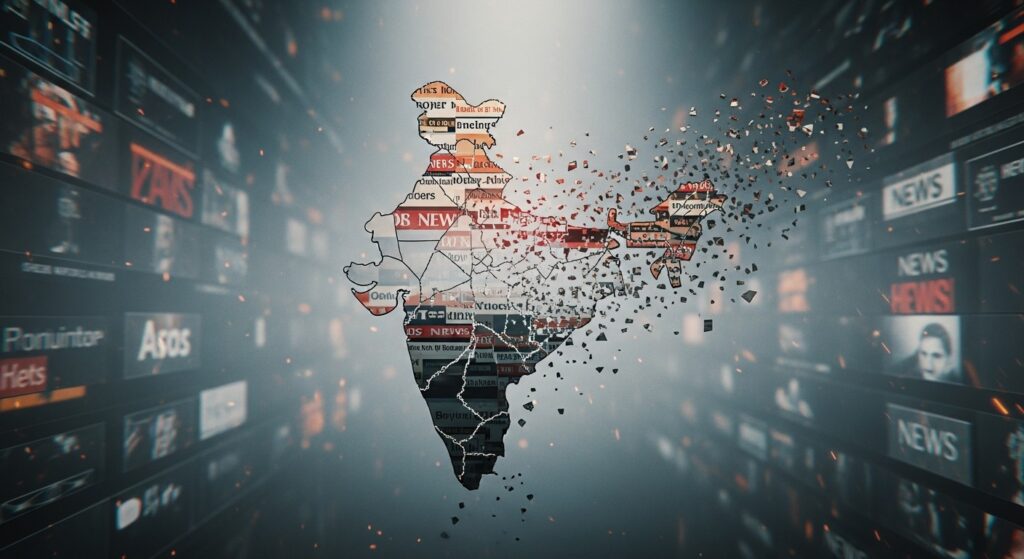
Operation Sindoor revealed not just India’s narrative ambitions, but its willingness to weaponize disinformation, and how badly that strategy backfired.
When India launched Operation Sindoor in May 2025, the missiles were real. The targets were real. The casualties were real. But much of what Indian media told its citizens, and attempted to tell the world, was not. During the confused moments of a war that lasted under four days, Indian fake news-weaving official television channels and digital outlets produced a lot of very loud lies, in fact, so extremely foolish and lying to the whole world at once in a way that even a child could see and understand, that these lies didn’t simply result in propaganda failure but the first failure, in a way, of these lies as propaganda. It became the story. And that is the crisis India’s strategic class refuses to honestly confront.
Documented Disinformation from Indian Media
The following instances are the kinds of false claims that were the most rampant on Indian television and other digital platforms that are aligned with the government during the war:
False claim of shooting down Pakistani jet: Several Indian news anchors, including those from Republic TV and Zee News, announced on their live telecast that the Indian Army had downed a Pakistani F-16.
Karachi port “on fire”: Indian channels’ viral graphics and chyrons claimed that Karachi port had been hit and was on fire. Satellite images, which were verified by international analysts within a few hours, revealed the absence of any such damage. The images used were actually of an old industrial fire and were a re-run.
Fabricated military casualties: Several channels broadcast specific, and entirely invented, death toll figures for Pakistani military personnel, citing unnamed “intelligence sources.” The numbers changed from bulletin to bulletin, with no accountability.
Video game footage aired as real strikes: At least two Indian channels broadcast clips from a military simulation video game as purported live footage of Indian airstrikes, a deception exposed within minutes by open-source investigators on social media, to global embarrassment.
False claims on Lahore strikes: Prominent anchors claimed Indian forces had struck military installations near Lahore. Ground reporting, corroborated by international journalists on location, found no evidence of any such strike in the area claimed.
This was not the heat-of-battle confusion that every military conflict produces. This was a coordinated, studio-driven disinformation operation, anchors screaming victory graphics over unverified claims, with production teams cutting in archival or fabricated footage to fill the spectacle. It was nationalism as entertainment, and truth as a casualty not of war, but of prime-time ratings.
The consequences were severe and self-inflicted. International fact-checkers, from Reuters to Bellingcat to independent OSINT communities, were publishing debunks faster than Indian channels could recycle new claims. The global audience, far from being persuaded of India’s narrative, began treating Indian media coverage as a source of comic unreliability. Diplomatic circles quietly noted the credibility gap. India’s stated case, that Operation Sindoor was a precise, lawful, targeted counter-terror action, was drowned out by the circus its own media had created around it.
The structural problem runs deep. Indian television news, controlled and largely influenced by a few hyper-nationalist channels that are closely ideologically aligned with the ruling establishment, have for years been conditioning their viewers to see conflict as a sort of entertainment. Nuance has no ratings. Verification has no urgency. The louder the anchor, the higher the viewership. In peacetime, this produces bad journalism. In a live military conflict, it produces active disinformation, with real geopolitical costs.
There is also the question of state complicity. A number of the most outrageous inaccuracies were first made public through official government social media accounts and only after several hours these posts were quietly removed. It looks like not just a failure of editorial standards but a conscious, though badly done attempt to manipulate the information environment through lies. Governments, by channeling disinformation through what are supposed to be independent media, end up undermining the very trust they would require when their side of the story is actually the truth.
Modern conflicts are not won by the side with the most missiles. They are increasingly judged, by global institutions, by potential mediators, by future historians, on the quality and honesty of their public record. A nation that fabricates jet shoot-downs and ports on fire does not appear strong. It appears desperate. And desperation, in the court of international opinion, is never a good look.
India had a legitimate story to tell after Operation Sindoor. It chose instead to bury that story under fabrication. The tragedy is not just that the disinformation failed, it is that it made the truth harder to believe.