
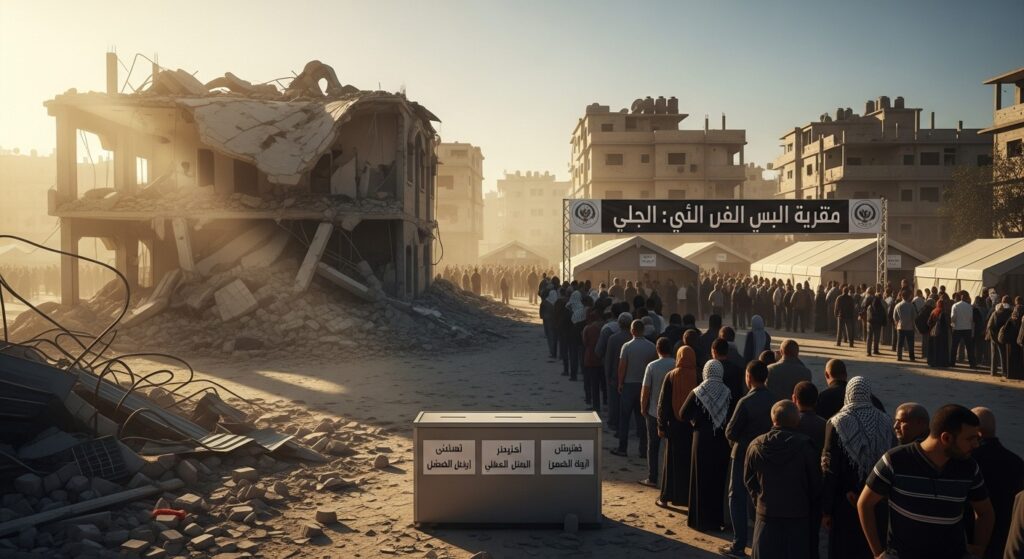
After a 20-year hiatus from voting, the people of Deir el-Balah are about to finalize their municipal council election this weekend – an event that Palestinians see as both overdue and highly symbolic. On Saturday, 25 April 2026, the people of Deir el-Balah in central Gaza will engage in an act that no other Palestinian from the enclave has done for two whole decades: voting. This weekend’s municipal election – which comes after 20 years of hiatus in Gaza since Hamas victory in the Palestinian Authority’s legislative elections in 2006 – is a small but major civic step amidst a territory that faces war, displacement, and institutional collapse.
Approximately 70,000 Palestinians are registered voters in Deir el-Balah, according to Fareed Taamallah, official spokesperson for the PA Central Elections Commission. This number is quite low when viewed from the historical perspective: in Gaza’s last full voter registration carried out in 2021, the territory had approximately 930,000 eligible voters. The difference, i.e. a decrease of about 92% in the voter calendar, is indicative of the widespread displacement, loss of registry records and the total destruction that make it impossible to organize elections in most parts of the territory. Israel still holds control of more than 53% of Gaza area as per an October 2025 ceasefire agreement, which excludes most of the Strip from any PA – administered processes.
Why Deir el-Balah?
The main reason the city was chosen is that it geographically experienced the least amount of destruction in terms of infrastructure among the whole Gaza strip when the military operations of the IDF lasted for almost two years after the terrorist attacks launched by Hamas on October 7, 2023. In fact, compared to the pre-war normal population of around 75 000 the number of inhabitants has been increased to more than double as a result of several waves of internally displaced families arriving from the north and south of Gaza, which have drastically changed the social fabric of the city. Voting will take place across 12 polling centres, including open fields and tents, in a logistical operation the elections commission describes as operating under “exceptional measures,” relying on civil registry data rather than conventional voter lists because so many records have been lost.
Each competing list must field a minimum of 15 candidates and include at least four women. Voters cast a ballot for a list and then choose five individual candidates from within it. The four lists in contention, “Peace and Construction,” “Deir al-Balah Unites Us,” “Future of Deir al-Balah,” and “Renaissance of Deir al-Balah”, are largely locally based and publicly framed as service-oriented rather than ideological.
A barometer for Hamas?
The vote is being observed primarily on the basis of Palestinian political mood through a rare moment. Officially, Hamas has boycotted the vote as their main loophole is that the PA has set a decree whereby every candidate must accept a set of conditions including recognizing Israel, which has led to them refusing to participate. However, analysts point out that some of the candidates on the ballot are believed to be pro-Hamas, and a West Bank political analyst Hani Al-Masri has pointed out that, without declaring their support of anyone, Hamas might be thinking of Kabooming their supporters through pro-Hamas candidates’ results.” The Palestinian Center for Policy and Survey Research conducted a survey in October 2025 that revealed 41% of Palestinians living in Gaza supported Hamas as opposed to 29% for Fatah, which are figures that have remained stable despite the extensive devastation caused by almost two years of war. Notably, Saturday’s election represents only the fifth municipal cycle in the West Bank since 2005; Gaza has participated in none of them until now.
More than garbage and water pipes
For many locals, the election is not focused on geopolitical symbolism but on the fact that local government in Gaza has been at a standstill for three years. The situation in local administration in Gaza is such that garbage that is not collected continues to pile up in the streets, water facilities have been greatly damaged, and basic urban services have almost completely collapsed as a result of the conflict and the blockade. Reham Owda, a Palestinian political analyst, has said that the elections are “a symbolic move to signal to the world that the Gaza Strip remains an integral part of the Palestinian political system.” Yet for the 70,000 voters queuing on Saturday, the most immediate stakes may be far more tangible, who repairs the pipes, who manages the waste, and who ensures that whatever civic normalcy exists does not slip further away.
Everyone wants to improve the country, especially after two years of war, what they witnessed, war and the destruction only.” Whether Saturday’s vote delivers on that desire, or merely records it, will depend on factors far beyond any ballot box.