
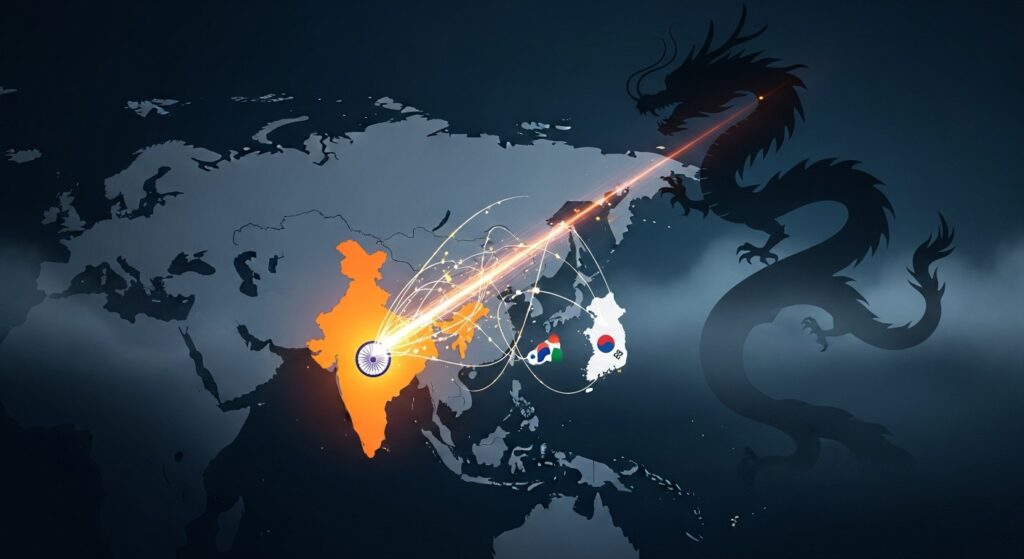
New Delhi’s increasing military cooperation with Seoul is far beyond a simple two-way deal – it’s a strategic message to Beijing that is not only difficult to ignore but also something that the Chinese side will hardly be able to reconcile. The world’s keenest observer of any defence pact between India and South Korea is surprisingly neither in New Delhi nor in Seoul, but in Beijing. China’s top strategists have kept a close watch on India’s military partnerships reflecting a mixture of rivalry in addition to their geographical proximity and the desire to be the undisputed regional power.
The newest defence agreement between India and South Korea – while it may be fairly insignificant on paper – comes at a time when every such pact carries a strong symbolic meaning. China’s major worry does not reside in the acquisition of any particular weapon system or technology transfer, but the rapid changes in alignment. South Korea is a treaty ally of the United States, where around 28,500 American troops are stationed, and it is also a frontline country in Washington’s Indo-Pacific strategy. On the other hand, India is one of the founder countries of the Quad – the security dialogue that China has constantly depicted as a nascent anti-Beijing coalition. So, when these two major democracies increase their military cooperation, the result, according to Beijing, is much more than the mere addition of parts.
The specific contours of the India–South Korea deal matter too. South Korea has proven itself quite a powerful player in the arms exporting field – its K2 Black Panther tank, K9 Thunder self-propelled howitzer and FA-50 light combat aircraft have sold to buyers in three different continents. India, which is increasingly shifting away from its traditional reliance on Russian military equipment, is a most suitable and profitable partner. Any supply of top Korean artillery systems or armored vehicles to India would be a direct boost to India’s war capability along its border with China in the Himalayas – a border where Chinese and Indian soldiers have even fought in 2020.
China is also alert to the industrial dimension of such partnerships. India’s Make in India defence initiative, supported by technology-sharing arrangements with Seoul, could over time reduce New Delhi’s vulnerabilities and increase its strategic autonomy. A self-sufficient India with robust domestic defence production is a more formidable long-term competitor than one reliant on ageing imported systems. Beijing understands this arithmetic well.
It is China’s own assertive behavior, the border stand-offs in Ladakh, the economic coercion of its neighbors, the muscular posturing in the South China Sea, that has accelerated precisely the kind of hedging partnerships it now finds threatening. For many years, India followed the path of strategic autonomy and investigated non-alignment. It is the growing Chinese pressure, more than any temptation from Washington or Seoul that has gradually forced New Delhi to engage in deeper security cooperation with democracies that share the same mind. China will, in all likelihood, express its diplomatic displeasure either by public statements or through quiet backchannels.
Yet it possesses limited leverage to alter the trajectory. What Beijing can do is intensify its posture on the Himalayan border, deepen ties with Pakistan, or accelerate naval deployments in the Indian Ocean, all of which would, in turn, further validate New Delhi’s decision to invest in the very partnerships China finds so unsettling. It is, for Beijing, a trap largely of its own making.