
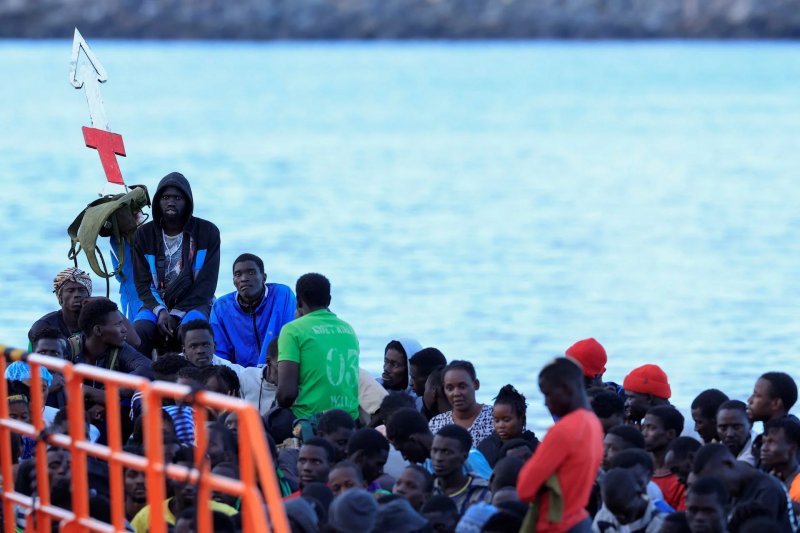
The regularization will leave a precedent, one in which migration has been looked at from the standpoint of rights.
500K+ Expected beneficiaries
840K Estimated undocumented in Spain (Funcas)
5 mo. Minimum stay to qualify
700K Petition signatures driving the campaign
Spain is considering a major change in its migration policy that would make the country stand out in Europe. On January 27 2026, PM Pedro Snchez’s administration endorsed a Royal Decree to allow an accelerated procedure for hundreds of thousands of illegal migrants who are already in Spain to get a residency permit. According to the press, the measure is probably the largest regularization scheme on the continent for over 20 years and it is reshaping the perception of the world about a humane migration policy. The figures are staggering.
Spain’s think tank Funcas estimates that there were around 840,000 illegal migrants in Spain at the start of 2025, with the largest groups being from Colombia (~290,000), Peru (~110,000), and Honduras (~90,000). The authorities are making a cautious assumption that as many as 500,000 people will be eligible for the program however, a leaked document from Spain’s National Center for Immigration and Borders suggests that the number could be as high as 1.1 million applications.
“Today is a historic day for our country. We are strengthening a migration model based on human rights, integration, coexistence, and compatibility with economic growth.”
— Elma Saiz, Spain’s Minister of Migration, January 27, 2026
The eligibility criteria is set to be broad. Any non-Spanish person who can prove that they have physically been in Spain for five consecutive months before December 31, 2025, and have a clean criminal record, can apply. The period to apply is set from April till June 30, 2026. Those who get the permit will be given a one-year residence-and-work permit valid anywhere in the country and in all sectors, and they will have a way of getting longer-term residence under Spain’s current immigration law. Children of qualifying migrants are covered simultaneously, receiving permits valid for five years, eliminating the cost and delay of separate family-reunification procedures.
The economic rationale is compelling. According to Spain’s central bank and the United Nations, the country needs about 300,000 new immigrant workers every year, just to keep its welfare system running. Workers who were born in other countries are already the main source of labor in the agriculture hospitality logistics, and elder-care sectors. In recent years, Spain’s GDP has expanded at a faster pace than any other big European economy, and the unemployment rate dropped to less than 10% at the end of 2025 the lowest point since 2008. Through the legalization of undocumented workers, the government expects to bring hundreds of thousands of people out of the informal or shadow economy and as a result, social security contributions and tax revenues will be significantly increased.
Academic studies indicate the 2005 action under Prime Minister Zapatero wherein Spain legalized more than 570,000 migrants raised tax revenues and led to better labor market outcomes without causing the “welfare magnet” effect that critics often warn about. Besides economics, the human implications are very significant. Undocumented migrants in Spain who lack legal status cannot seek medical care, register their kids in school, open a bank account, or sign a formal work contract the environment is such that they become entirely dependent on informal and often exploitative employment. The decree halts immediately any ongoing administrative expulsion procedures for eligible applicants and allows them unrestricted access to the public health system as well as the right to register for social security from the very first day.
“We are talking about people who are working without rights. This is one of the biggest labor rights advances in years.”
— Ione Belarra, Podemos leader, January 2026
The policy did not just suddenly appear. The local campaign Regularizacin Ya (“Regularize Now”) was actively working towards this for years, and finally in 2024 they managed to get over 700,000 signatures – enough to eliminate the need for a parliamentary vote.
Parliamentarians overwhelmingly supported taking the matter to debate regarding Spain’s legislative agenda nevertheless the minority coalition’s lack of majority in Congress caused a standstill. In January 2026, Snchez decided to disregard Parliament altogether by using his executive decree powers and had a last-minute arrangement with the left-wing Podemos party in order to have the Cabinet approve the measure. Spain’s decision is a complete turnaround from the rest of Europe’s.
Although the EU has expedited the signing of agreements whereby rejected asylum seekers can be taken to offshore processing centers, and several member states have increased border controls under the influence of far-right parties, Madrid has opted for a rights-based, integration-first approach. “Five months of mandatory stay is a lot shorter than what other countries require, ” said Laetitia Van der Vennet from the Platform for International Cooperation on Undocumented Migrants in Brussels, which goes on to show how widely Spain has extended its provisions.
For the hundreds of thousands of people who have lived in legal limbo for years, working in Spain’s fields, kitchens, and care homes, paying into communities without protection, this decree is more than a policy shift. It is, as Spain’s Migration Minister put it, a precedent: proof that a wealthy democracy can look at migration not through the lens of fear, but through the lens of rights.