
Two democracies, one occupying Palestinian land, one bulldozing Muslim neighborhoods, have quietly built a $20-billion weapons alliance. The world called it strategy. It is high time someone simply named the thing.
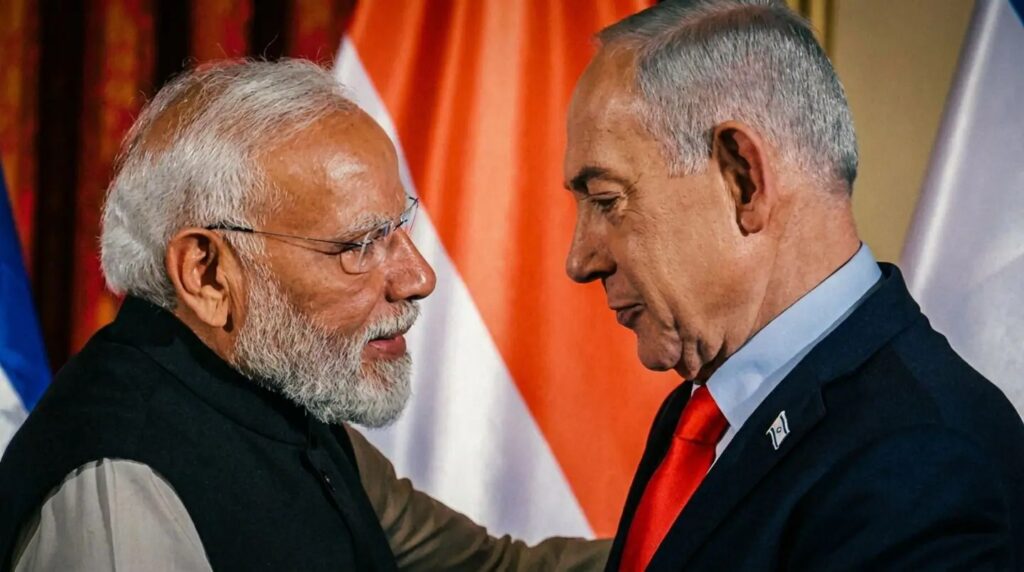
The arrival of Indian Prime Minister Narendra Modi in Tel Aviv in February 2026 was just one in the series of occasions which brought to the fore the gradual strengthening of the “Special Strategic Partnership” between the two nations that their respective governments have now officially nicknamed. The two democratic countries, the two leaders with firm handshakes and even more substantial mandates, and the two countries that loudly, continuously, and insistently assert that they are the ones combating terrorism; these were the perfect diplomatic optics.
However, the joint statement did not refer to the $20. 5 billion worth of weapons that have been exchanged between these two countries since 2020, nor the 1,000-plus Indian phone numbers targeted by Pegasus spyware of Israeli origin, nor the Palestinian civilians who were killed by the drones of the same technology that India is now using in Kashmir.
$20.5B Israeli arms to India, 2020–24
34% India’s share of all Israeli exports
1,000+ Indian numbers reportedly hit by Pegasus
42.1% Israel’s arms exports received by India (2022)
The arms pipeline nobody audits
Let us begin with the numbers, because they are extraordinary. According to SIPRI and Israel’s own Defence Ministry export directorate SIBAT, India absorbed 34 percent of all Israeli arms exports between 2020 and 2024. In 2022, that figure briefly touched 42.1 percent. Israel has sold India the Heron and Searcher surveillance drones, the Harop “suicide drone”, a loitering munition that autonomously hunts radar systems, the Barak-8 surface-to-air missile co-developed with India’s DRDO, Phalcon airborne radar systems, Rampage precision missiles, and SkyStriker strike drones. These are not defensive tools. They are offensive platforms. India deployed these weapons during Operation Sindoor in May 2025 a 23-minute attack on India-Pakistan border through air strikes that cause elimination of the targeted groups, principally 100 people, according to Indian figures. By calling the operation “measured and decisive,” Benjamin Netanyahu was, in fact, giving an implicit nod, to the weaponry of his own export list that performed at such a level of effectiveness.
“When Netanyahu praised Operation Sindoor, he was endorsing the combat performance of his own export catalogue.”
Spying on your own citizens, with Israeli tools
Then there is Pegasus. The NSO Group’s military-grade spyware, sold exclusively to governments, regulated as a weapons export under Israeli law, was reportedly deployed against over 1,000 Indian phone numbers. The targets were not foreign agents. The main victims were journalists, opposition politicians, lawyers, and civil rights activists of the country. The Supreme Court of India identified malware on five of the twenty-nine examined phones, yet the government in question not only refused to cooperate with its own court-appointed technical team but also continued with the phone tapping. India, which often describes itself as the world’s largest democracy, ended up using the Israeli surveillance technology to spy on its own democratic actors. On the other hand Israel which sold the tool, did not raise a single question in public about the manner in which it was being used. That silence is not neutrality. It is complicity.
The Gaza contradiction India cannot explain
India’s foreign policy establishment has always flaunted “strategic autonomy” as a commendable achievement. However, when Israel annihilated over 45,000 Palestinians in Gaza from October 2023 to early 2025 – a massacre that the International Court of Justice has considered as genocide – India kept quiet and also abstained from voting on the major United Nations resolutions that demanded ceasefires. India is also continuing to purchase weapons.
It has not frozen the MOU negotiations. It has not even taken a moment to rethink. Rather, New Delhi has surreptitiously intensified the relationship. As a matter of fact, there are reports that India supplied Israel with Hermes 900 drones during the Gaza conflict. A country which at one time led the call for Palestinian self-determination at the United Nations, which in 1947 voted against the original partition plan as a show of solidarity with the colonized peoples, is now providing arms to the very state that the UN Special Rapporteur has described as a “textbook case of genocide.” This is not strategic autonomy. This is strategic amnesia.
“India voted against partition in 1947 out of solidarity with colonized peoples. It now arms the state the UN examined for genocide.”
What the “Special Strategic Partnership” actually means
The November 2025 MOU and the February 2026 “Special Strategic Partnership” declaration are being sold to domestic audiences in both countries as technological progress, co-production, Make in India, self-reliance. What they actually represent is the industrialization of mutual impunity. Israel gets a massive, growing market that asks no moral questions. India gets battle-tested weapons from a country that tests them on civilians in Gaza and the West Bank. The deal works precisely because neither government faces meaningful domestic accountability for the other’s conduct. Rafael, Elbit, and IAI now have Indian subsidiaries. Their production lines are taking root in Indian soil. The weapons that razed Rafah will be manufactured in the same country that preaches ahimsa, non-violence, as a civilizational value.
A partnership built on shared impunity
The India–Israel security axis is not simply a bilateral arms deal. It is a model, of how two powerful states can deepen a relationship built on the shared logic of permanent counterterrorism, perpetual conflict, and the systematic dehumanization of Muslim populations, whether Palestinian or Kashmiri. Both governments use the language of security to pre-empt accountability. Both invoke terrorism to silence dissent. And both have found, in each other, the perfect partner: one that will never ask the question that matters most, at what human cost?