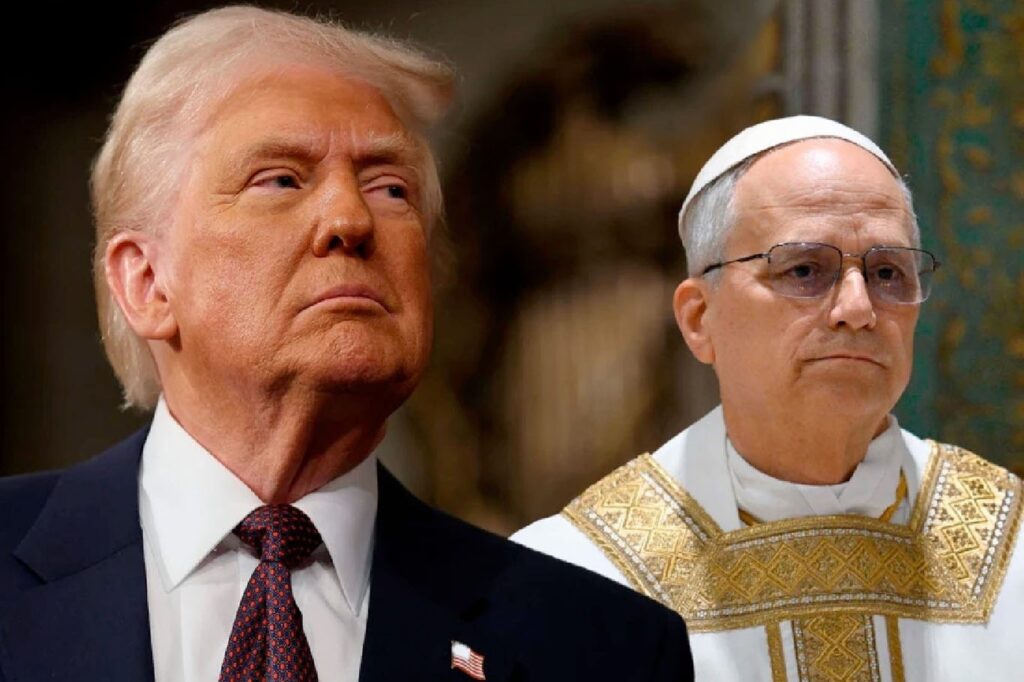
Jerusalem and Tehran are currently the focal points of global military strategy, but a new, arguably more symbolic front has opened between Washington and Vatican City. President Donald Trump, over a series of slowly intensifying verbal attacks, has now aimed his criticism at Pope Leo XIV, this being a record low in the US-Holy See relations.
This disagreement that started with the Pope refusing to support the joint US-Israeli military operation against Iran has unraveled into an uncivil and personal fight, quite atypical between political and religious leaders. President Trump using his Truth Social on April 13 2026 to express his displeasure as he called the Pope “the worst for the foreign policy” and “weak on crime” was actually a reaction to the Pope’s denial of the US President’s fiery language.
Trump, who in a discussion about Iranian civilian infrastructures said that “an entire civilization will die tonight, ” was met with a very uncommon, direct and firm rebuke from the Pope. The latter described such a threat as “unacceptable” and “unjust. For Trump, any deviation from his administration’s military doctrine is viewed as a betrayal. In his posts, he accused the Pope of “catering to the Radical Left” and claimed that Leo is an “Obama sympathizer” for meeting with figures like David Axelrod. In perhaps the most surreal turn of the tirade, Trump compared the Pope unfavorably to his own brother, Louis Prevost, a Florida resident whom Trump praised for being “all MAGA.” The implication was clear: in the President’s worldview, political loyalty to his movement is a higher virtue than the moral mandates of the Papacy.
This is not merely a clash of personalities; it is a clash of worldviews regarding the use of force. The Trump administration has adopted a “no limits” approach to the conflict with Iran, a stance that the Vatican views as a departure from the “Just War” tradition. Reports have surfaced of a “bitter lecture” delivered by U.S. Under Secretary of Defense Elbridge Colby to Cardinal Christophe Pierre. During this meeting, the Pentagon reportedly warned the Vatican that Washington possesses the military might to act without international consensus and suggested that the Pope “better take its side.” Most chillingly, U.S. officials allegedly referenced the “Avignon Papacy”—a historical era where the Church was effectively a puppet of the French crown—hinting that the U.S. expects similar subservience today.
Trump’s rhetoric has also taken a messianic turn. Shortly after attacking the Pope’s legitimacy—claiming, without evidence, that Leo only holds the position because the Church wanted to appease the Trump administration—the President shared an AI-generated image of himself as a Christ-like figure. This follows a previous incident where the White House posted images of Trump in papal regalia. By positioning himself as a rival spiritual authority, Trump is attempting to bypass the traditional moral influence of the Vatican, appealing instead to a base that views his political “strength” as a divine mandate.
The Pope, however, is not backing down. ” In his “State of the World” address, Leo XIV spoke about how major powers are moving toward “force-based diplomacy” which is in fact the Trump doctrine. Things got so tense that the Pope like a symbol refused an invitation from the White House on the 4th of July. Instead of accompanying the President on the South Lawn, Leo said he would be on the island of Lampedusa with the African refugees therein.
By choosing the periphery of the migrant crisis over the center of American power, Pope Leo XIV has sent a definitive message. While the Trump administration asserts that it can do “whatever it wants” through military power, the Vatican is reminding the world that moral authority cannot be coerced by jet planes or eagles. As the assault on Iran continues, this battle between the Oval Office and the Altar remains a high-stakes struggle for the conscience of the West.