
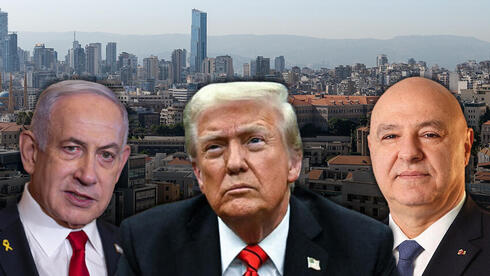
In a place where the scars of the past continue to bleed and the absence of voice acts as the strongest support for crimes of history, the news from the White House this week sounded not like a usual diplomatic news but like a great shock in the world. The President Donald Trump, another time just playing the part of a self-styled greatest deal-maker, has announced that the heads of states of Israel and Lebanon are getting ready to interact with each other hand to hand for the very first time after more than 30 years.
It is hardly a moment for a clear path. As of mid-April 2026, the borderlands between the two nations are not defined by diplomatic protocols, but by the acrid smoke of a six-week-old war that has threatened to pull the entire Middle East into a terminal tailspin.
The Weight of Three Decades
To understand the magnitude of Trump’s announcement, one must look back to the early 1990s, the last time the executive leadership of these two neighbors shared a meaningful dialogue. Since then, the relationship has been defined by “red lines,” proxy battles, and a total absence of official recognition.
By inserting himself into this calcified animosity, Trump is attempting to bypass the traditional, sluggish channels of State Department bureaucracy in favor of high-level, “leader-to-leader” theater. However, the ground reality in the Levant remains far more complicated than a handshake in the Rose Garden. The conflict, which started in early March when Hezbollah dramatically intervened on the side of Tehran, has changed southern Lebanon into a scene of devastation and strategic games.
The Shadow of Bint Jbeil
While Washington talks about “historic negotiations, ” the real scenario is Bint Jbeil. This town, which is very important for southern Lebanon, has again been the focus of the Israeli Defense Forces (IDF) ground operations. From Israel’s point of view, Bint Jbeil is not only a geographic location; it is a symbol of Hezbollah’s resistance and a military target that the administration of Prime Minister Benjamin Netanyahu needs to deal with.
Some experts in military affairs argue that Netanyahu does not want to sign the agreement hastily until his troops have created a “security zone” which will make Hezbollah’s short-range missiles practically ineffective. The reasoning of the Israeli Security Cabinet internally seems to be: “Committing to war now to secure the condition of peace later by ensuring the other side’s muteness.” This sharpens the challenge for Trump’s diplomacy. Can there really be a peace deal if the two sides are still fighting each other at the same time?
A Divided Lebanon
Lebanon Split Apart Across the “Blue Line,” Lebanese leaders face a major crisis through their very survival, This means a few names which come up in conversations at the diplomatic level General Joseph Aoun and Nawaf Salam are representing a Lebanese state which is deeply troubled and to some extent lost in the struggle for its sovereignty because of the paramilitary power of Hezbollah.
For the Lebanese government, having talks with Israel would be like a double-edged sword. It presents vehemently a way to stop the horrendous bombardments that have brought the country’s entire infrastructure to a standstill but on the other hand, it also has its perils. On the other, any direct engagement with the “Zionist entity” risks a domestic backlash from Hezbollah and its Iranian backers, who view such talks as an act of treason.
Trump’s gamble relies on the hope that Lebanon’s civilian and military leadership are desperate enough for an exit ramp that they will risk the wrath of the militants within their own borders.
The Washington Pressure Cooker
In fact, the White House is not just “hinting” peace, it is mobilizing all the measures at its disposal. According to some dispatches from the West Wing, the government is applying “maximum pressure” to the Israeli cabinet to gain their consent for a ceasefire agreement. The sweetener being offered is a larger, multi-lateral deal that would deal with the.
Iranian nuclear threat – which is a major worry of Netanyahu. Nevertheless, the “Trump Doctrine” has always been a strategy of upheaval. By announcing these talks before they have been officially confirmed by Jerusalem or Beirut, the President is essentially forcing the hands of the players involved. It is a “public-first” diplomacy that leaves little room for the quiet, face-saving concessions usually required in Middle Eastern negotiations.
Strategic Pause or Genuine Peace?
The skepticism of regional experts is very obvious. Most think that what is being labeled as a “historic opening” might simply be a “strategic pause.” Throughout the history of Israel-Lebanon conflict, ceasefires have quite often allowed the both sides to re-arm, dig deeper tunnels, and finalize their lists of targets.
Lebanese officials have privately expressed concerns that Israel is simply looking for a diplomatic window to consolidate its gains in the south before the next phase of the conflict begins. Conversely, the Israeli public, still reeling from rocket fire in the north, is wary of any deal that leaves Hezbollah’s infrastructure intact.
The Verdict
By any objective standard, a possible phone conversation or meeting between the leaders of Israel and Lebanon would be a major event. Doing so will be ending a 34-year-old taboo and recognizing that the “no-talk” policy which was imposed for the last three decades cannot stop occasional eruptions of violence at least one time.
However, diplomacy does not operate in a vacuum. So long as Hezbollah is an independent military organization within Lebanon, and Israel considers its northern security largely through the lens of military superiority, even a “historic talk” is likely to be very careful and limited.
Donald Trump has promoted himself as a master deal-maker, the “Art of the Deal” being the cornerstone of his political image. But in the streets of Bint Jbeil where everything is in ruins as well as in the power centers of Beirut, he is dealing with a fracture that has resisted every deal-maker for fifty years. Is this the start of a new era or only a pause in a never-ending war? The world is now waiting to witness if the silence is going to be broken after all.