
By Adam Reed
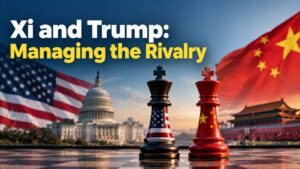
The upcoming summit between Chinese President Xi Jinping and US President Donald Trump in Washington feels like a turning point, a moment where both sides have to show whether two global heavyweights can actually build something stable in the face of mounting rivalry. This isn’t about papering over deep divides with sweeping agreements. Instead, it’s about both leaders admitting that if things spiral out of control, the fallout won’t just hit their own countries, it’ll shake the world. After their first meeting in Beijing, coming face to face again makes it clear: unchecked conflict isn’t an option. What they’re really hoping to get out of this meeting isn’t a magic solution, but something practical. They want firm guardrails in place, buffer zones, really, to stop every bump in the road from triggering a crisis.
That’s not just talk, either. US Treasury Secretary Scott Bessent and Chinese Vice Premier He Lifeng have been hammering out the details, showing they’re both determined to shield the most critical trade channels from getting dragged under by politics. At the core, this is driven by raw economic need. Even with recent slowdowns, trade between the two countries is still huge, somewhere around $500 billion a year. And with the clock ticking down on their current trade truce, set to expire November 10, both Xi and Trump are feeling pressure at home to keep things stable. One of the most realistic plans on the table right now is for both sides to roll back tariffs on $30 billion worth of imports. It’s incremental, but it’s something. Henry Huiyao Wang, who heads the Center for China and Globalization, sees this idea, a basic tariff free arrangement, as the foundation that could support a broader relationship over time.
China still controls about 70% of mining and more than 90% of refining globally for rare earths and critical minerals.
But tariffs are just the start. They’re also looking at a formal investment framework that would allow select Chinese capital into targeted American industries. If they pull that off, it could take the edge off supply chain disputes and keep the flow of crucial materials, like rare earths and minerals, steady. China still dominates this sector, with control over about 70% of mining and more than 90% of refining globally. That puts Beijing in a powerful position when it comes to what the rest of the world needs to build everything from electronics to cars.
The tech race between the US and China, especially in artificial intelligence, adds another layer of tension but also shows where cooperation has to happen. The fight to lead in semiconductors, top tier computing, and advanced AI is intense. The risk of mistakes goes way up as both rush to innovate, and they both know unchecked AI could cause problems way beyond their own borders. James Borton at Johns Hopkins SAIS calls it a balancing act: fierce technological rivalry, but with just enough cooperation to keep the most dangerous risks at bay. Creating a formal mechanism for AI safety could give both governments a neutral ground to talk about things like risk at the frontier, algorithmic stability, and global norms, without asking either side to back down from the competition.
At the same time, outside flashpoints threaten to upset whatever balance gets struck. The rollout of new US sanctions against Russia on September 18 is a big one. The law lets the US slap tariffs of up to 100 percent on anyone buying major energy imports from Russia, and since China buys a lot, that could wreck the current trade deal in one blow. If those tariffs go into play, Beijing could hit back hard, maybe by cutting vital minerals exports to the US. Sourabh Gupta at the Institute for China America Studies points out that hitting China with these maximum penalties would completely undermine efforts to stabilize US China relations. That’s why using the president’s authority to grant waivers and keep Russia tensions separate from the main China negotiations might be the only way forward.
By building reliable crisis management routines deep into their policies on trade, technology, energy, and diplomacy, both superpowers can prove that intense rivalry doesn’t have to end in disaster.
Meanwhile, the Middle East has forced Beijing and Washington into reluctant parallel action. As violence creeps up near the Strait of Hormuz and the Bab al Mandeb, and Houthi strikes hit regional shipping, the risk to vital sea lanes grows. China, heavily dependent on energy passing through these waterways, has a direct interest in keeping them open. Following subtle requests from regional partners, Beijing has quietly leaned on Tehran to dial back maritime disruptions. It’s hardly about playing mediator for the US, but China’s influence in the region at least offers Washington a back channel to help calm things down where it counts most.
And then there’s Taiwan, the ultimate test of limits in US China ties. Wang Hanyi, a research fellow, says bluntly that Taiwan sits at the very heart of China’s core interests. There’s no room for compromise on Beijing’s side, and Washington won’t budge on its long standing support for Taipei either. There’s a real risk here. With no clear solution in sight, both sides are left relying on carefully crafted executive messages and a strong chain of communication between their militaries, hoping to stop any close call from erupting into a full blown crisis across the Strait.
Zhiqun Zhu at Bucknell University sums it up: don’t expect game changing breakthroughs out of Washington. The real test will be whether the US and China can keep their relationship working, even when things get tough and surprises pop up. By building reliable crisis management routines deep into their policies on trade, technology, energy, and diplomacy, they can prove that even intense rivalry doesn’t have to end in disaster. Ultimately, this summit in Washington is about something much bigger than a headline deal. It’s the chance to show the world whether the two largest economies can turn brief pauses into a lasting structure, one that manages competition and avoids catastrophe.
About the Author
Adam Reed is an International affairs analyst focusing on geopolitics, defense strategy, and global security trends.