
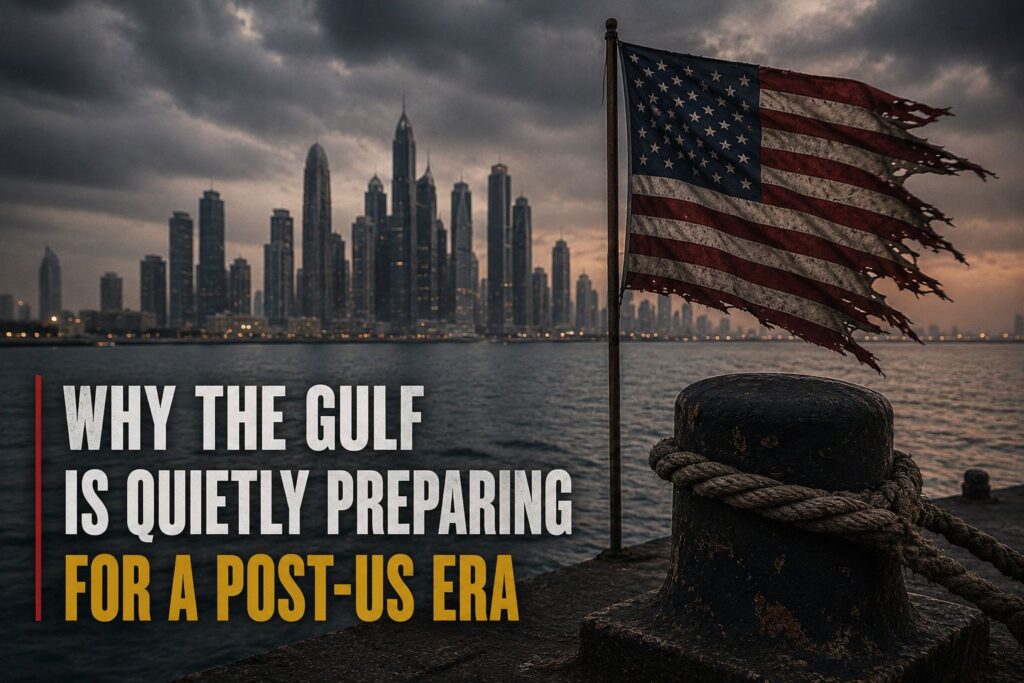
While the initial strikes hit Iran, the real damage is being felt in the very foundation of Middle Eastern politics. Beyond the explosions and tough talk, we are possibly witnessing something much bigger: the death of the US-led security era in the Gulf. For years, the deal was simple, the US promised stability for loyalty. This conflict has shaken the security mechanisms. Now, Gulf leaders are not wondering if the US can still guarantee their security; they are realizing that the US presence is actually making the region so volatile in the first place.
This realization has essentially split the Gulf Cooperation Council into rival strategic factions. On one side, the UAE is leaning into its role as Israel’s top Arab partner. For Abu Dhabi, this war is a chance to double down on intelligence and military ties with Tel Aviv, while pitching itself to Washington as the most dependable anti-Iran force in the region. This is not just a quick move, it is part of ambitions to become the economic and political heavyweight of the Middle East once the fighting stops.
But this “UAE-first” strategy is creating some serious friction with its neighbors. Across the Arab world, the mood is still incredibly hostile toward Israel, especially with the ongoing nightmare in Gaza and Israeli strikes hitting harder across the region. By intensifying efforts to normalize relations right now, Abu Dhabi is miscalculating the situation. It is starting to appear isolated, fueling the narrative that it is willing to sell out collective Arab interests just to secure its own seat at the head of the table.
Saudi Arabia, on the other hand, seems to be shifting toward a much more careful and realistic approach. Unlike the UAE, Riyadh is starting to see that a never-ending feud with Iran does not just hurt regional peace, it puts its “Vision 2030” economic goals at risk.
Rather than jumping headfirst into a conflict, the Saudi Arabia is playing a smarter game by diversifying its alliances. It is deepening its strategic convergence with Pakistan, pursuing rapprochement with Turkey and Egypt, and building a stronger bridge to China. At the same time, it is not shutting the door on Tehran. This whole balancing act shows a new mindset in the Gulf: relying solely on the US is not the safe bet it used to be.
This divergence points to a deeper reality in today’s Middle East. The days of a single, pro-American Gulf bloc are pretty much over. These monarchies do not see the US as a reliable partner anymore. There is a growing fear that Washington is willing to spark a massive regional war, even if it wrecks local economies. More and more, leaders in the Gulf feel that stability is not the US policy, it is being driven by political agendas that put Israeli interests ahead of everything else.
The Iran war has essentially forced a “wake-up call” for the Gulf, pushing them to build their own safety nets without waiting for Washington. Moving toward their own air defenses, shared energy grids, and even building their own weapons and rail lines just to stay afloat during a crisis. It all comes down to a harsh lesson they just learned: when things go south, the US looks out for its own interests first, leaving the Gulf states to deal with the fallout and pick up the pieces.
Ironically, the very war meant to cement US and Israeli power might actually be what tears it down. Instead of bringing everyone together against Iran, Israel’s bigger footprint in the region is just making the cracks in the Arab world deeper. Meanwhile, the US is losing its “steady hand” reputation. It is not a stabilizing force anymore, it looks like a loose cannon, willing to roll the dice on everyone else’s safety just to live up to Israel’s objectives.
Consequently, a new Middle East is crawling out of the wreckage of this war, it is complicated but definitely not taking orders from Washington anymore. The old days, where the US called all the shots, are fading fast. Gulf states are now playing both sides to stay safe, China is moving in to fill the gaps, and alliances are not about shared values anymore, they are strictly about survival.