
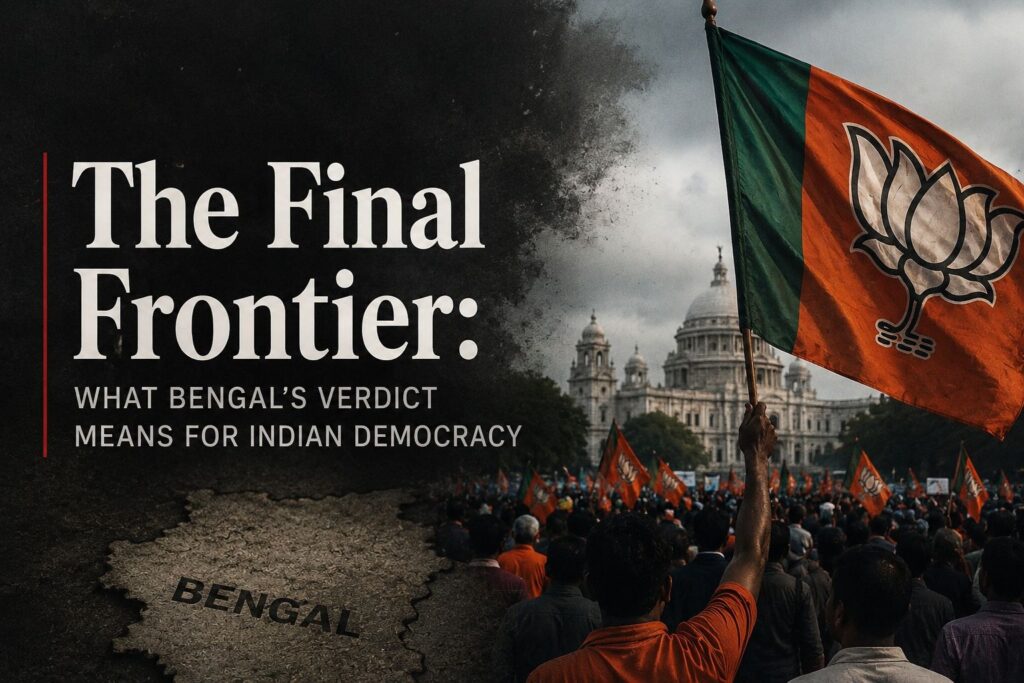
For years, West Bengal was the big “what if” in Indian politics. While the BJP was sweeping across the country, Bengal felt like a different world, a place where linguistic pride and a stubborn history of secularism acted as a natural shield against the saffron wave. For years, it was the one map the BJP just couldn’t color in. But that wall just crumbled.
This is not just another electoral success or a simple change in leadership. It marks a major shift in the country’s political trajectory. By finally winning Bengal, the BJP has done more than just secure an electoral victory, they have certainly cleared the last major hurdle toward BJP’s brand of nationalism. The implications of the electoral results, therefore, go way beyond the streets of Kolkata, suggesting that the very idea of the Indian republic is being rewritten.
Bengal mattered precisely because it was one of the last large states where the BJP faced a strong, organized alternative. Mamata Banerjee’s Trinamool Congress, despite serious criticism over populist excess, represented a distinct political culture. One rooted in regional identity, linguistic pride, and more inclusive interpretation of Indian secularism. That space has now narrowed.
The immediate aftermath of the results was tense. It exposes growing culture of hatred in India’s contemporary politics. Violence broke out in several areas. Party offices were attacked, workers clashed, and the streets in some places turned chaotic. Realistically, this is no longer surprising in Indian elections. The line between democratic competition and political confrontation has become increasingly thin.
The BJP’s campaign in Bengal also made its approach clear. Religion was not a side theme, it was central. Talk of “Hindu consolidation” and repeated references to religious identity framed the election in sharper terms. Opponents were not just political rivals; they were presented as part of a competing social bloc.
That shift has consequences, especially for minorities.
For Muslims in India, the Bengal result deepens the already festering communal wound. the last decade has already been unsettling, from mob violence and aggressive political rhetoric to discriminatory legislation and bulldozer demolitions. The message is clear, minorities may remain citizens legally, but they are excluded from the emotional core of India’s political narrative. Bengal had still offered a slightly different picture, a state where Muslims retained real electoral significance within a competitive system. However, that balance now looks more fragile.
At the same time, concerns are growing around institutional independence. Allegations about bias or interference, whether proven or not, matter less than the growing sense among different political groups that the referee is no longer fully trusted. And once that perception takes hold, democracy begins to feel less stable, even if elections continue as usual.
This is the paradox of today’s India. The country remains loudly democratic, elections, campaigns, turnout, all of it continues at scale. But the political atmosphere around it has become sharper, more centralized, and far less forgiving of dissenting space.
Bengal’s result fits into that larger shift. It is not just about one government falling and another taking its place. It is about the gradual shrinking of political diversity within a system that still formally celebrates it.
And that leaves behind a question hanging over the country’s democratic future, not about elections, but about direction. If India’s politics continues to move toward a single dominant narrative and BJP’s definition of nationalism, what happens to the idea of plurality that once defined it?