
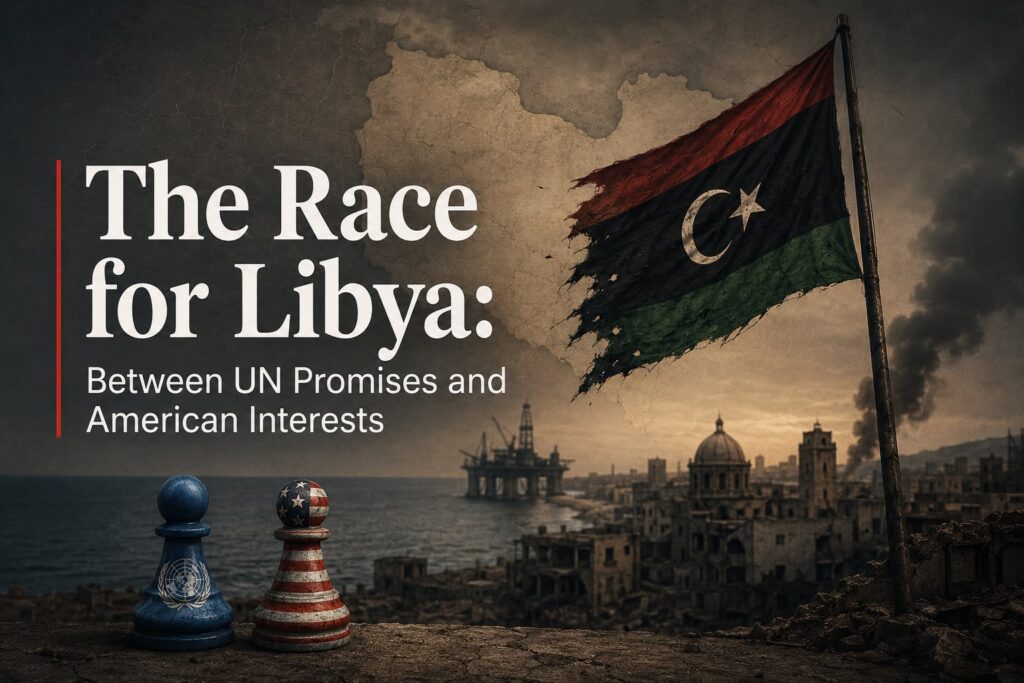
 The Race for Libya: Between UN Promises and American Interests
Fifteen years after the fall of Muammar Gaddafi, Libya remains trapped in a cycle of competing governments, foreign interventions, and failed political roadmaps. The latest debate surrounding the United Nations’ political process and an emerging American-backed alternative is not simply about elections or institutional reform. It is about who gets to shape Libya’s future: the Libyan people themselves or external powers pursuing their own strategic interests.
The debate arose after the briefing made by UN envoy Hanna Tetteh to the Security Council regarding the stalling of the transition in Libya. There was a UN-sponsored “Structured Dialogue” where about 120 Libyans were engaged in making recommendations for about 6 months, and nearly 600 recommendations have been made in order to foster political reconciliation and create grounds for elections in the country. While this shows a will to reach a consensus, critics argue that the sheer volume of recommendations illustrates the deeper problem facing Libya: endless consultation without decisive implementation.
The numbers tell a troubling story. Libya has not held nationally accepted presidential elections since the collapse of the Gaddafi regime in 2011. Parliamentary elections in 2014 helped trigger the institutional split between eastern and western Libya. Since then, multiple internationally backed initiatives, including the Libyan Political Agreement, the Geneva Political Dialogue Forum, and numerous ceasefire arrangements, have promised a pathway to stability. Yet the country remains divided between rival political centers, competing security structures, and powerful armed groups.
According to international estimates, Libya is endowed with the largest proven oil reserves in Africa, estimated at 48 billion barrels. The country’s oil production contributes to 90 percent of its state income and about 95 percent of its export income. This is the main reason why Libya continues to attract foreign presence. Discussions on democracy, constitutional arrangements, and transition are based on a simple geopolitical fact: whoever shapes Libya’s political future will have access to one of the key energy producers in the Mediterranean region.
It is within this context that reports of a parallel American initiative have generated significant attention. The plan reportedly associated with US envoy Massad Boulos seeks a direct power-sharing arrangement between Libya’s dominant political factions. Rather than focusing on lengthy national dialogues and hundreds of recommendations, the proposal reportedly aims to create a political settlement among existing power centers and accelerate stability. Washington’s interest is hardly surprising. Libya’s oil production currently fluctuates around 1.2 to 1.4 million barrels per day, but international energy companies believe production could potentially exceed 3 million barrels daily under stable conditions.
Advocates for such an approach state that Libya can no longer afford a decade of political gridlock. They claim that, despite its abundant reserves of oil and gas, Libyans continue to suffer. The infrastructure is underdeveloped, electricity is scarce, and the uncertain political climate deters investments. In other words, a compromise by existing forces would seem more sensible than yet another transition.
Yet this argument raises a serious concern. Stability imposed from above is not necessarily the same as legitimacy. Libya’s recent history offers numerous examples of internationally sponsored arrangements that temporarily reduced tensions without resolving underlying disputes. Agreements that distribute positions among elites often fail because they do not address the fundamental question of political authority. Who governs Libya? Under what constitutional framework? And with what democratic mandate?
This is the central weakness identified by many observers. The reported American initiative appears focused on power-sharing, while the UN process emphasizes consensus-building and eventual elections. Neither approach fully resolves Libya’s constitutional dilemma. The country still lacks a universally accepted framework defining presidential powers, parliamentary authority, and the relationship between national and regional institutions.
Geopolitics further exacerbates the situation. Libya has traditionally been one of the battlefields for global politics and competing interests. There are countries like Turkey, Egypt, Russia, Italy, France, and the United States that have strong interests in Libya. While some care about securing energy supply, others concentrate on the migratory routes across the Mediterranean, and some look at Libya from the perspective of geopolitical ambitions. As a result, nearly every political initiative is evaluated not only by Libyans but also by foreign capitals calculating their strategic gains.
The tragedy is that ordinary Libyans often become secondary considerations in discussions supposedly designed to secure their future. After years of war, Libyans care more about the facts of life, such as working public infrastructure, economic prospects, security, and accountable government, than about which diplomatic system is used. Numerous polls by various international agencies have indicated a great deal of public support for holding national elections, reflecting widespread frustration with transitional arrangements that seem permanent rather than temporary.
The current debate also exposes a larger challenge facing international diplomacy. The UN approach embodies the belief that inclusive political processes create durable legitimacy. The American approach reflects a belief that effective power-sharing can create stability first, with political reforms following later. Both models have strengths and weaknesses. Consensus-building without implementation can become endless bureaucracy. Elite bargains without public legitimacy can collapse the moment political interests diverge.
The danger now is not merely another failed roadmap. It is the gradual normalization of permanent transition. Every new initiative is presented as a temporary solution, yet temporary arrangements have defined Libya’s political landscape for years. Each delay pushes elections further into the future and deepens public skepticism toward political institutions.
Ultimately, the Libyan problem will not be solved simply through discussions in the UN or any power-sharing agreement brokered by foreign forces. While oil revenues, diplomacy, and elite discussions may create a temporary atmosphere for peace, the hard part lies in developing a constitutional framework accepted by the Libyans themselves. The absence of such a basis would mean that all road maps will just become another episode in a long saga of incomplete transitions. Libya’s greatest challenge is no longer ending conflict, it is ending the endless cycle of temporary solutions that have prevented the country from fully reclaiming its sovereignty and political future.