
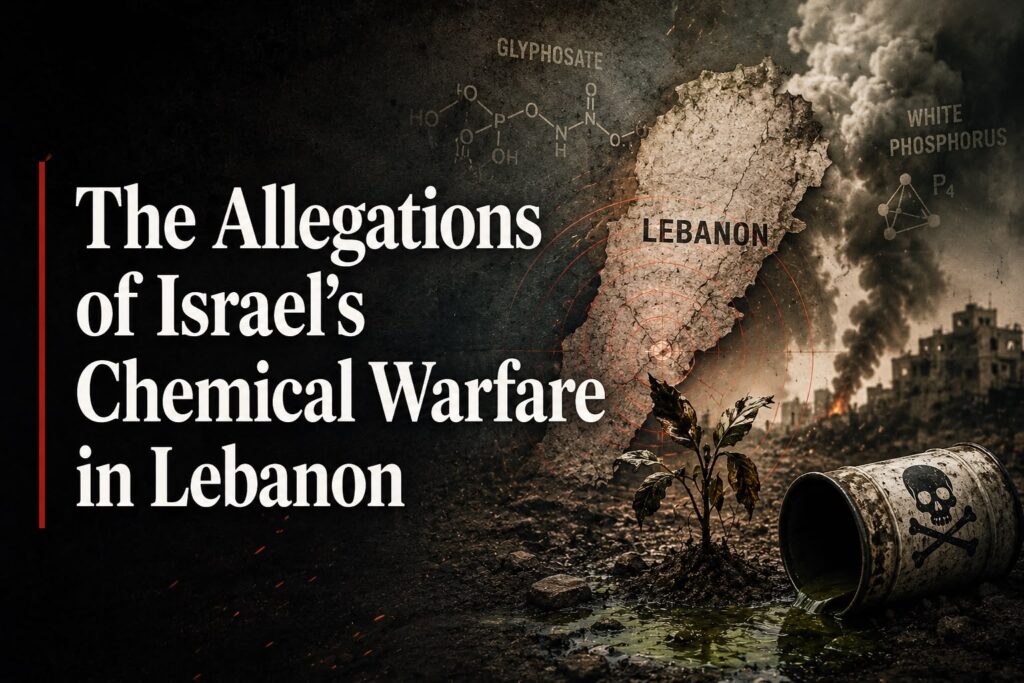
“War is cruelty, and you cannot refine it,” said General William Tecumseh Sherman. However, even in war, international law attempts to draw red lines. The growing allegations surrounding Israel’s reported use of white phosphorus and glyphosate in Lebanon suggest a conflict where those red lines are being tested with alarming frequency. If verified, these accusations are not merely about military tactics; they raise profound questions about the weaponization of environmental destruction, civilian suffering, and the erosion of humanitarian norms in modern warfare.
The latest controversy emerged because of revelations by the Lebanese government as well as international organizations regarding the presence of glyphosate at uncharacteristically high concentrations in southern Lebanon and areas under Syria’s occupation. The high concentration is said to be up to 20-30 times more than what would be expected in normal environment. Lebanese officials described the findings as potential environmental crimes, warning of long-term consequences for agriculture, biodiversity, water resources, and public health.
The most common herbicide in use throughout the world is Glyphosate. Although it is mostly used in agriculture, it has always been controversial when talking about its implications for the environment. The International Agency for Research on Cancer has labeled Glyphosate as “probably carcinogenic to humans.” While regulatory bodies in several countries dispute that assessment, the dangers posed by these chemicals are real. If such chemicals were deliberately used as part of military operations, the implications would extend far beyond conventional warfare.
Even more alarming are the new allegations of the repeated use of white phosphorus by the Israeli army. Human rights groups such as Human Rights Watch and Amnesty International have, in the past, reported cases in which there were reports of the use of white phosphorus ammunition on civilian areas in Gaza and Southern Lebanon. White phosphorus burns when it comes into contact with oxygen, burning at a temperature of above 800 degrees Centigrade. Contact with human skin can cause catastrophic injuries, severe burns, organ damage, and lifelong disabilities. Beyond immediate casualties, its use can contaminate farmland and render entire areas hazardous long after military operations end.
The humanitarian consequences of white phosphorus are particularly severe, since this kind of weapon does not make distinctions between combatants and civilians. Those who return to their farms, children who play nearby the affected area, and people who try to restore their community become highly vulnerable. White phosphorus is not prohibited by international humanitarian law, but its use against civilian populations or in densely populated areas is heavily restricted under various international legal frameworks.
What makes the current allegations especially significant is the suggestion that the chemicals involved may have originated from industrial supply chains linked to major Western corporations. Reports by Medico International and the German advocacy group Coordination gegen Bayer-Gefahren point toward possible connections between Bayer-owned production facilities and materials allegedly used in military operations. Bayer has denied directly supplying glyphosate to either Israeli or American military forces. Nevertheless, the controversy highlights a broader question that extends beyond any single company: where does corporate responsibility end when products designed for civilian use allegedly become associated with military activities?
History has repeatedly seen instances of environmental degradation resulting from wars. When the US invaded Vietnam, one of the tactics was to spray with Agent Orange across vast territories, leaving ecological and health consequences that persist decades later. It was only later that the world realized that environmental devastation can be used as a weapon in the conflict. This historical experience is why allegations involving glyphosate and white phosphorus provoke such intense concern. They evoke memories of conflicts where the damage outlived the battles.
The greater question is not just whether specific chemicals were employed, but what such use tells us about the changing nature of warfare today. More and more, wars are being waged not just against other armies but against the very infrastructure that provides sustenance and support. Damaging crops, poisoning the earth, and ensuring the economic ruin of a community can be weapons every bit as powerful as bombs and bullets. The victims are often civilians who have little connection to the battlefield.
Critics argue that Israel’s military strategy has increasingly blurred the distinction between military objectives and the civilian environments surrounding them. From Gaza’s devastated urban landscape to southern Lebanon’s damaged agricultural zones, allegations of disproportionate force have become a recurring feature of international debate. Supporters of Israel maintain that military necessity and security concerns drive such operations. However, the growing volume of documentation from rights groups, journalists, medical personnel, and environmental experts continues to raise difficult questions that cannot be dismissed simply as wartime propaganda.
As the philosopher Hannah Arendt warned, “The most radical revolutionary becomes a conservative the day after the revolution.” In warfare, a similar truth applies: states that repeatedly justify extraordinary measures eventually risk normalizing them. What begins as an exception can gradually become doctrine.
In the end, the allegations surrounding Israel’s reported use of white phosphorus and glyphosate go far beyond weapons or battlefield tactics. They point to a wider pattern of conduct in which the line between military necessity and civilian suffering appears repeatedly blurred, from Gaza to Lebanon. When entire neighborhoods are reduced to rubble, when farmland is scorched or contaminated, and when civilians are left to live with injuries and environmental scars long after the fighting stops, the language of “defense” begins to ring increasingly hollow. No security rationale can convincingly justify turning civilian life and the natural environment into collateral instruments of war. If these allegations are substantiated, they will not just add to a list of disputed incidents, they will deepen an already growing global reckoning over the cost of Israeli military conduct, where the destruction endured by civilians becomes not an exception, but a recurring outcome of the conflict itself.