
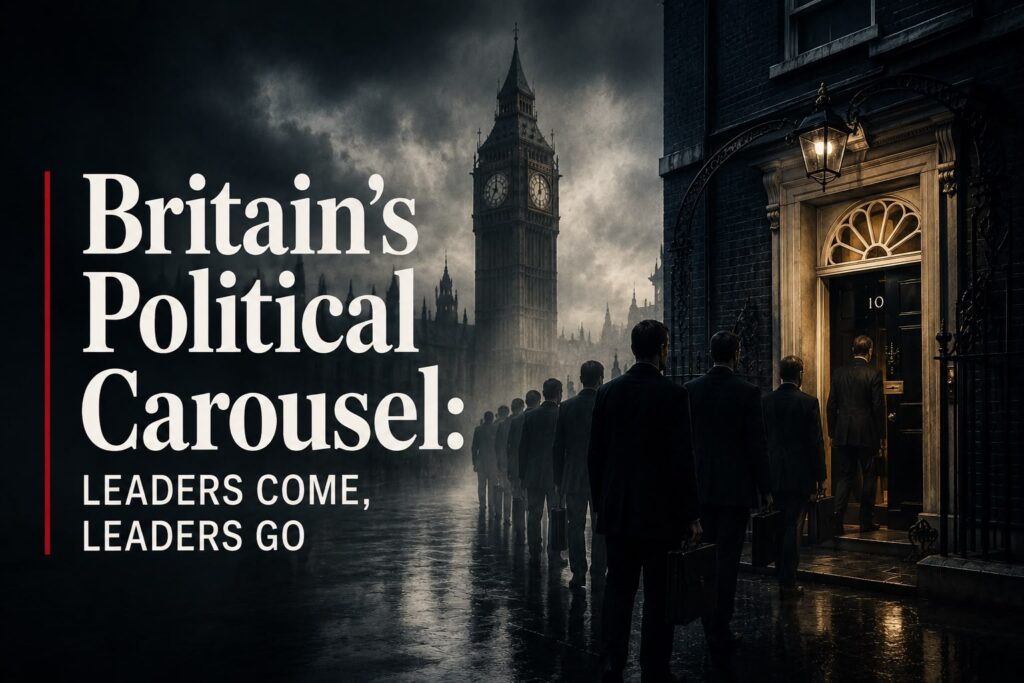
There was a time when British politics was synonymous with stability. The United Kingdom, often celebrated as the cradle of parliamentary democracy, exported political institutions across the world and presented itself as the model of constitutional continuity. Yet the resignation of Keir Starmer after less than two years in office means Britain is now preparing to say hello to its seventh prime minister in just ten years. For a country that once prided itself on political steadiness, the rapid turnover has become a symbol of a deeper crisis. The question is no longer why one prime minister has fallen. The question is why Britain’s political system is producing leaders faster than it can sustain them.
This instability was not introduced by Starmer but dates back to the political earthquake caused by the Brexit referendum of 2016. Brexit not only polarized the British population on its relation with Europe, but it also divided political parties, broke trust and made demands which cannot be fulfilled by any government. Since then, every prime minister has inherited a political landscape defined by polarization, economic uncertainty, and competing visions of Britain’s future.
The downfall of David Cameron following the referendum on Brexit was just the start. For years, Theresa May worked to garner parliamentary approval for a deal, yet fell short. Boris Johnson got Brexit done but ended up being ensnared by scandal, rendering him untrustworthy. Liz Truss managed to remain in office for 49 days before falling due to an economic policy experiment gone wrong and causing a financial crisis. Rishi Sunak oversaw an electoral disaster, and now Starmer leaves because of his own party’s pressure. The pattern is too consistent to be explained by individual mistakes alone. Something more structural is at work.
One major factor is the growing gap between public expectations and governmental capacity. Voters in the UK have been continually told that things will be transformed, but successive administrations have failed to bring about any noticeable improvement in people’s living standards. Growth has been disappointingly low over most of the last ten years. The strain on public services grows greater. The National Health Service is still fighting its battle against lengthy waiting lists, and local councils find themselves under budgetary pressure. As expectations rise and delivery falls short, public frustration quickly turns into political punishment.
As the old saying goes, “The fruits of the tree should speak for itself.”
As the old proverb warns, “A tree is judged by its fruit.” Modern British governments are judged not by promises but by immediate results. In the age of social media, twenty-four-hour news cycle, and intense scrutiny of the citizenry, political leaders have limited room to redeem themselves after setbacks. Political patience has become one of the scarcest commodities in democratic politics.
The crisis is also rooted in the transformation of Britain’s political parties. Both Labour and the Conservatives have become fragmented coalitions rather than unified political movements. Internal rebellions now pose almost as much danger to prime ministers as opposition parties. Starmer’s resignation reportedly followed mounting dissatisfaction within Labour ranks after disappointing local election performances. The same dynamic brought down May and Johnson. The greatest threat to modern British leaders often comes not from across the parliamentary aisle but from their own benches.
The consequences extend beyond domestic politics. Britain’s frequent leadership changes inevitably affect its international standing. Allies and rivals alike value predictability. When governments change repeatedly, long-term strategy becomes difficult to maintain. Foreign partners often find themselves negotiating with one British leader only to encounter another months later. Stability is a form of power in international affairs, and Britain’s recent political volatility has weakened that asset.
Britain’s chaos is not taking place in a vacuum; it is part of a larger problem being experienced by many Western democracies. In both Europe and North America, existing political systems are finding it difficult to respond to a time characterized by economic uncertainty, culture wars, and technological revolution. Citizens are demanding quick fixes for difficult situations, while governments face structural constraints that make quick fixes impossible. The result is a cycle of disappointment, leadership turnover, and growing public cynicism.
Political philosopher Alexis de Tocqueville once observed that democratic societies can become unstable when expectations rise faster than institutions can satisfy them. Few observations better describe contemporary Britain. The electorate demands transformative change; political leaders promise it; reality intervenes; and another prime minister falls.
Starmer’s resignation is not only the resignation of yet another premiership;
The resignation of Starmer therefore represents more than the end of another premiership. It shows how difficult it can be for a system to reconcile democratic responsiveness with political stability. Britain is one of the oldest democracies in the world, but even mature democratic institutions are not immune to prolonged periods of turbulence.
George Santayana, the famous philosopher, was right when he said, “Those who cannot remember the past are condemned to repeat it.” It is high time for the British politicians to learn from it. The frequent turnover in the political leadership is more likely to satisfy short-term political pressures than solve long-term structural problems.
Seven prime ministers in ten years is not the mark of a healthy political system; it is the sound of a democracy grinding against its own contradictions. The nation that taught generations about stable government now appears trapped in an endless cycle of leadership crises, party rebellions and public disillusionment. The revolving door of Downing Street is spinning faster than ever. It resembles a waiting room rather than a seat of enduring leadership. Unless Britain confronts the forces driving this turmoil, the mother of parliaments may find itself remembered less for its democratic legacy and more for its political dysfunction.