
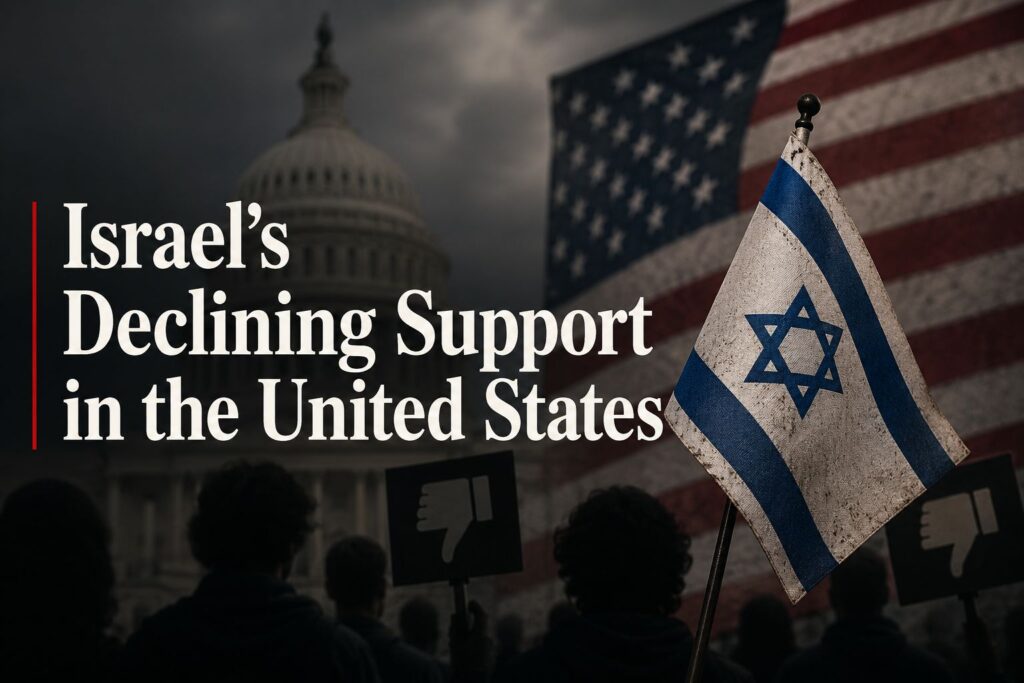
For decades, American support for Israel was treated as one of the most stable constants in global politics. That assumption is now under visible strain. A new Pew Research Center survey showing that roughly 60% of Americans view Israel unfavorably marks more than a statistical shift, it reflects a deeper moral and generational reorientation in how Israel’s policies are being perceived inside its most important ally.
The change is especially pronounced among younger Americans, where unfavorable views rise sharply, while confidence in Prime Minister Benjamin Netanyahu has fallen to near-minority levels. In a political system, where public opinion influences foreign policy debate, these trends signal a slow but significant erosion of Israel’s traditional bipartisan shield in the United States.
At the heart of this transformation is the war in Gaza, which has caused an unparalleled level of humanitarian suffering. According to figures provided by the Ministry of Health in Gaza City, which are widely quoted by UN bodies and generally seen as being reliable on the whole according to various humanitarian analysts, the number of Palestinians who died following the start of the conflict in October 2023 exceeds 70,000. Later independent analysis and academic studies have indicated that the true death toll, once other deaths from malnutrition, illness, and the collapse of healthcare infrastructures have been included, may be even higher.
The scope of destruction has also been very apparent. According to reports from UN organizations like OCHA and UNRWA, much of the infrastructure in Gaza has been heavily damaged and destroyed, as displacement orders have been issued, displacing most of the 2.2 million inhabitants of Gaza. The lack of aid is becoming more apparent, with food, clean water, and medical supplies being extremely limited, which has led to a spread of diseases in the overcrowded displacement camps.
It is this constant visibility of human suffering that has transformed American opinion in a way that nothing before could have done. While past wars were covered in media landscapes shaped by traditional journalism, this war has been witnessed in the age of social media where graphic footage of ruined communities, traumatized kids, and displacement is distributed instantaneously. For the average American under the age of 35, there are no geopolitics to this war, only humanitarianism.
This has resulted in an ever-expanding rift between institutional US foreign policy and its public opinion. Whereas the US Congress and consecutive administrations maintain their focus on strategic ties with Israel, the general attitude towards the conduct, scope, and duration of military engagements is more and more negative in public discourse. According to recent Pew polls, Americans have the highest levels of ideological polarization compared to any other country covered by the survey, with left-leaning individuals expressing largely negative attitudes towards Israel, whereas the latter enjoy greater support among the politically right.
Significantly, this development is no longer restricted to the language of elites. It has become firmly entrenched in the context of generational shifts. Americans who are 18-34 years old express the highest unfavorable attitudes towards Israel. This is important, since the opinion held by any particular generation in the US is usually persistent and eventually shapes politics and policymaking.
Moreover, the more extensive international polls further underscore the shift. In Europe, parts of Asia, and the developing world, negative attitudes toward Israel now prevail in the popular perception in many nations, indicative of the overall deterioration of the image of Israel in the international arena. Although this attitude varies to some extent, the key point is the rising role of humanitarian considerations in public attitudes.
For Israel, the considerations involved are more strategic than reputational. America is its most significant ally both diplomatically and militarily, but in the end, that relationship is dependent upon legitimacy within the domestic politics of the United States. With the Gaza war increasingly shaping the world conversation, Israel is finally being evaluated less for issues of security and more for issues of proportionality and harm.
While the US government could still provide some kind of formal support network, a consistent disparity between public perception and policy decisions will constrict political space. In democratic politics, there always comes a time when moral perception translates into political reality.
American public opinion thus represents more than mere frustration with any particular war. Rather, it represents a wider evaluation of the balance between military might, protection of civilians, and responsibility in foreign policy decision-making. The Gaza’s destruction in the consciousness of the American public has pushed this evaluation to its peak.
In essence, what Pew found is not just a matter of decreasing favorability, there is a structural change in the way that Israel is perceived within American society. The new generation that is growing up, one that is inundated with information and humanitarian values, cannot disassociate strategic alliance from its human impact.
Whether this leads to a recalibration of US foreign policy remains uncertain. But the direction of public sentiment is clear: Israel’s standing in the United States is no longer anchored in automatic sympathy. It is now subject to scrutiny, debate, and growing conditionality driven by the realities of the Gaza war and its aftermath.