
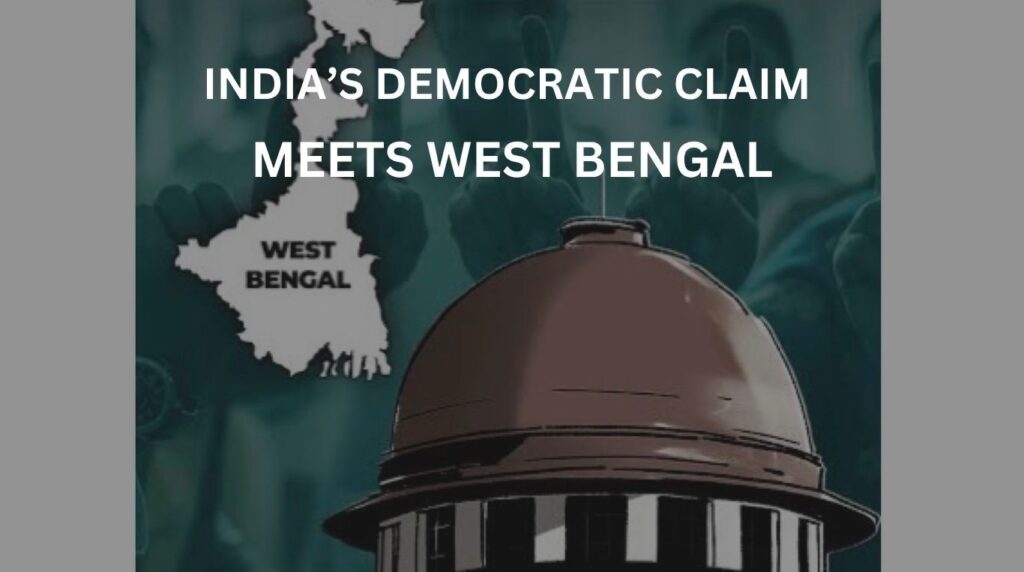
Elections in India are seen as the world’s largest democratic exercise. But scale alone cannot guarantee fair play. Recent reports of large-scale exclusion of Muslims from electoral rolls ahead of Provincial elections in West Bengal raise serious questions about the fairness of electoral framework in India. West Bengal, which was once known for its pluralistic ethos, a state where minorities found relative political voice and social space, is now losing that image as a minority-friendly state. Since Muslims constitute roughly 27 percent of West Bengal’s demography, their electoral participation is central to the state’s political balance. Although electoral roll revisions are a necessary procedural component of a democracy, the pattern of such exercises should not taint the legitimacy of electoral process.
Reports of violence and voter intimidation are equally contributing to the allegations of uneven playing field. Clashes between rival political workers not only undermine the legitimacy of elections but also create an atmosphere of fear, particularly among marginalized communities. In such an environment, the combination of political exclusion and physical intimidation can have a chilling effect on India’s tall claims of being the largest democracy in the world.
It would be naïve to ignore the broader political environment of India while studying the growing systematic anti-Muslim Socio-political sentiments. The BJP’s rise nationally has been accompanied by its quest for majoritarian politics in India. The timing of these developments substantiates these accusations. Narendra Modi and his party, the BJP have accelerated efforts to expand their footprint in West Bengal, a state they have long dreamt of ruling. The BJP looks desperate to unseat Mamata Banerjee whose Trinamool Congress has ruled since 2011.
While healthy political competition is the beauty of democracy, the methods employed diagnose the health of democracy. Ground reports are manifestations of concerning consequences of these methods. Families finding their names missing despite possessing valid ID. Some face bureaucratic barriers related to name changes, minor spelling inconsistencies, and migration histories. These are not isolated deviations, they reflect structural flaws that affect marginalized segments of society, in which the Muslim minority almost always becomes the first casualty.
For a state that once prided itself on its inclusive ethos, this moment reflects more than just an electoral controversy. West Bengal can either reaffirm its legacy as a bastion of inclusivity or drift into a political model where electoral arithmetic overrides democratic principles.
It is not about one party or one election. It is about the resilience of democratic norms, that too, when you claim to be the largest democracy in the world. One of the core pillars of democratic principles is equal participation, which, when compromised, even subtly, can have far-reaching consequences. The question ultimately is, can institutions rise above political pressures? Can political actors resist the temptation to exploit identity divisions for short-term gains? The answers will drive not only the state’s future but also present a reflection on the ongoing direction of Indian democracy itself.