
By Ahan S. Prakash
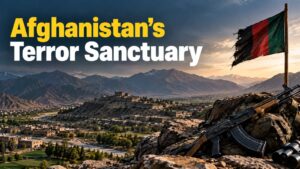
Right now, Afghanistan sits at the heart of one of the most dangerous chapters in global security since 9/11. Detailed reports from the Atlantic Council and the United Nations Security Council paint a stark picture: Afghanistan, under the Tehreek e Taliban Afghanistan’s rule, isn’t just struggling to control its borders or manage rogue actors. The reality is much worse. What’s happening today is a deliberate policy, a state backed system that gives extremist groups the freedom to regroup, train, and plan attacks with frightening efficiency. They don’t just get a place to hide; they enjoy wide operational freedom, logistics, and, crucially, time to rebuild and expand across the region and beyond.
You see this most clearly in the actions of the Tehreek e Taliban Pakistan (TTP). The group now operates almost openly from Afghanistan, launching wave after wave of cross border attacks into Pakistan. The numbers show the drastic spike in violence: last year, the Center for Research and Security Studies recorded over 3,400 deaths linked to militant attacks in Pakistan, marking a sharp rise since the Taliban took Kabul in 2021. The Global Terrorism Index, released in March 2026, put it bluntly: Pakistan now ranks as the country most impacted by terrorism worldwide. The TTP is one of the deadliest terrorist groups operating today, and their power has only grown.
The Global Terrorism Index, released in March 2026, put it bluntly: Pakistan now ranks as the country most impacted by terrorism worldwide.
But the relationship between the Taliban in Kabul and these militants is not just a marriage of convenience. It’s a deep, strategic partnership, cemented by decades of shared battles and a common worldview. Officially, the Taliban shrugs off these claims, repeating the line that they’re not harboring terrorists or exporting violence. Yet, intelligence reports, including a recent United Nations Security Council report from August 2026, tell a very different story. The Afghan Taliban not only tolerates but actively arms militants, providing them with advanced weapons like night vision goggles, modern assault rifles, and thermal imaging gear. This state sponsored support has given groups like the TTP new abilities to carry out attacks with precision and deadly force.
Meanwhile, Al Qaeda’s quiet resurgence under Taliban protection exposes the emptiness of Afghan promises. After the U.S. withdrawal, the Taliban pledged that Afghanistan would never again serve as a base for terrorist groups targeting other nations. But on the ground, monitors have confirmed that Al Qaeda runs safe houses, training facilities, even media centers, across several Afghan provinces. That same 2026 U.N. report underlined the point: Al Qaeda remains firmly rooted, with newly established training camps in places like Nuristan province. Worse, Al Qaeda in the Indian Subcontinent now anchors a fresh coalition, the Ittihad ul Mujahideen Pakistan, which just claimed responsibility for a deadly suicide bombing in Bannu, killing 21 people.
Their operations aren’t in the shadows. They’re protected by regime insiders, with some fighters holding positions right inside Taliban administrative and security structures. This level of shelter allows Al Qaeda to train, recruit, move money, and plan with little interference. The conditions that allowed Al Qaeda to become a global menace two decades ago are now back in play, almost unchanged.
And it doesn’t end there. The array of extremist groups using Afghanistan as their home base is broad and growing. The East Turkestan Islamic Movement, for example, has active ties to jihadist factions in northern Afghanistan, threatening Chinese border security and stirring instability throughout Central Asia. U.N. monitors have confirmed their militants are training in these new Al Qaeda camps. Meanwhile, despite the Taliban’s publicized offensives against the Islamic State Khorasan Province (ISKP), the group is still thriving in Afghanistan’s difficult terrain. ISKP carries out well planned attacks inside Afghanistan and keeps expanding outward. Alarming reports from intelligence agencies show that ISKP has recently begun distributing guides on developing biological weapons, hinting at a persistent interest in chemical and biological terrorism.
The conditions that allowed Al Qaeda to become a global menace two decades ago are now back in play, almost unchanged.
ISKP’s recruiting push now reaches deep into Central Asia, targeting isolated young people in Tajikistan and surrounding countries. The fallout from this terror network is already showing up in the form of prevented attacks and active investigations across Europe, Eurasia, and even North America. This proves what many feared: Afghanistan’s permissive environment for extremists is a global problem, not just a regional headache. Terrorist infrastructure built there easily leaks across borders, threatening security from South Asia to the west.
For countries near Afghanistan, the cost is unbearably high. Neighbors like Pakistan, Tajikistan, and others have to funnel huge amounts of money and people into securing their borders. Every border clash or bombing wipes out years of economic progress, shutters businesses, and scares away desperately needed foreign investors. Ordinary families, stuck in the crossfire, lose more than peace of mind: they lose livelihoods, homes, even lives. The hope among some international policymakers was that economic engagement, trade, or aid would convince the Taliban to clamp down on militants. The idea was that the need for recognition and funding would tame their ideology. Yet reality has shown just the opposite. The Taliban’s core alliances and jihadist agenda consistently trump any economic or international incentive.
So, what’s next? Waiting and hoping that this situation will fix itself is wishful thinking. Piecemeal border policing and disconnected diplomatic gestures won’t budge Kabul’s leaders from their current path. Regional powers, global institutions, the whole international community, needs to come together and set clear, enforceable rules. Any move toward recognizing Afghanistan’s government or easing sanctions must be tied directly to independent, verifiable proof that the Taliban is genuinely uprooting these terror groups. Humanitarian aid and economic sticks and carrots have to carry real consequences.
Until the leadership in Kabul acts to break up extremist networks and end its policy of selective sanctuary, Afghanistan will hold onto its status as a springboard for terrorism.
Until the leadership in Kabul acts to break up extremist networks and end its policy of selective sanctuary, Afghanistan will hold onto its status as a springboard for terrorism. The ripple effects, including more attacks, more instability, and growing threats to peace, will keep spreading, far beyond the country’s borders, for years to come. This isn’t just Afghanistan’s problem; it’s the world’s. The time for clear, coordinated action is now.
About the Author
Ahan S. Prakash is a Geopolitical analyst and columnist covering South Asian affairs, strategic security, and international relations.