
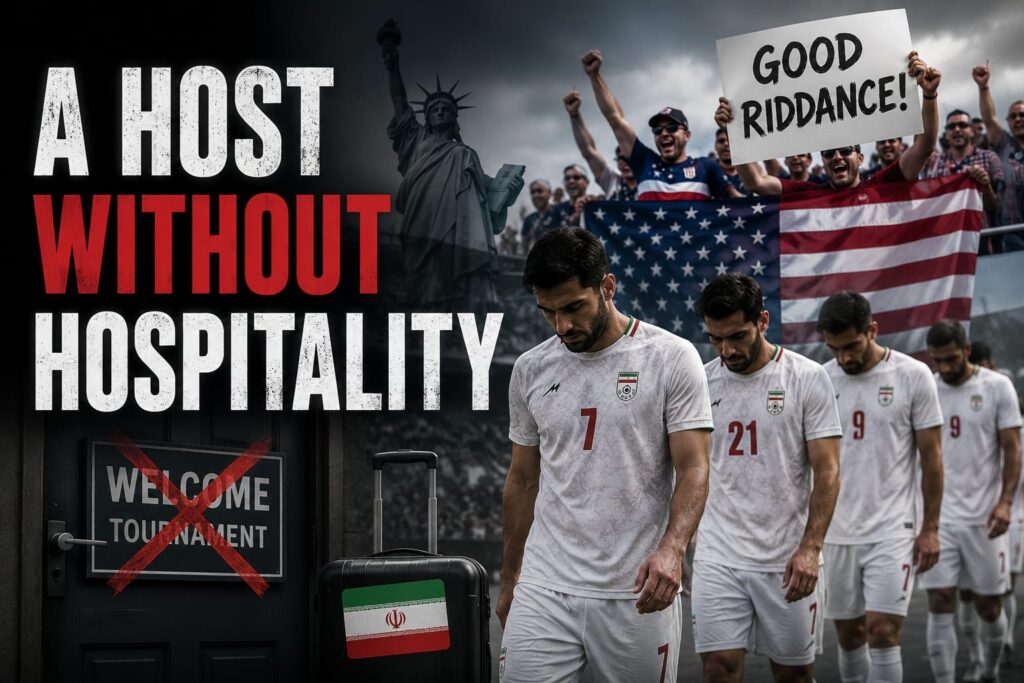
The global arena of international sport has long been anchored by a foundational myth: that for ninety minutes on a pitch, the blood feuds, ideological rifts, and structural inequities of the real-world fade into a vacuum of pure, meritocratic competition. It is a beautiful sentiment, one that FIFA and host nations aggressively market to a global audience to sanitize the massive commercial machinery of the World Cup. Yet, at the 2026 tournament, this carefully cultivated illusion did not merely fracture; it was deliberately shattered by the host nation itself. The treatment of the Iranian national football team by the United States state apparatus, contrasted sharply with the genuine hospitality they received just across the border in Mexico, revealed a deeply pathetic undercurrent of political petulance. The low point of this logistical and diplomatic farce arrived when U.S. Homeland Security Secretary Markwayne Mullin publicly boasted that he “danced a happy dance” upon Team Melli’s elimination. In a single, undignified admission, a senior official of a superpower host country pulled back the curtain on a tournament that will be remembered less for its athletic achievements and more for the weaponization of state bureaucracy against twenty-six young athletes.
To understand the sheer scale of the institutional hostility directed at the Iranian squad, one must look at the structural straightjacket manufactured by Washington long before the opening match. The World Cup is an international privilege granted under the explicit condition that host nations guarantee equitable access, professional standards, and basic human dignity to all qualifying participants. The United States completely abandoned this contract, opting instead to view a group of footballers through the paranoid lens of security theater. Originally intending to base their pre-tournament training camp in the climate of Arizona, the Iranian squad was subjected to a calculated, agonizing series of visa delays that effectively barred them from setting up their facilities on American soil. Crucially, fifteen vital members of the delegation, including indispensable technical staff, tactical analysts, medical trainers, and the media director, were denied entry entirely under sweeping, opaque national security pretexts. Stripped of their core support network, the players were forced to navigate the world’s premier sporting event with a severely compromised managerial infrastructure.
When the tournament began, the logistical restrictions escalated from bureaucratic obstruction to physical attrition. Under the draconian terms of their specialized visas, the Iranian players were subjected to an unprecedented fly-in, fly-out mandate that read more like a deportation order than an athletic itinerary. They were permitted to enter U.S. territory only twenty-four hours prior to their first two group-stage matches and were legally required to vacate the country on the exact same night the final whistle blew. While their opponents returned to state-of-the-art recovery centers, luxury hotels, and high-tech sports science regimens to prepare for the grueling demands of a World Cup schedule, the Iranian athletes were bundled onto immediate post-match flights. They endured midnight border crossings, rushed airport screenings, and completely disrupted sleep cycles, returning to Mexico just hours after running miles on the pitch. Even when these rules were marginally relaxed for their final match in Seattle, allowing them to arrive two days early, the cumulative physical toll and mental exhaustion had already been systematically weaponized against them.
The profound failure of American hospitality stood in stark, humiliating contrast to the refuge provided by Mexico. Faced with structural rejection across the northern border, Iran found a genuine sanctuary in Tijuana. The local community and Mexican authorities stepped into the breach with an unconditional display of traditional sporting warmth, providing the team with the facilities, security, and peace of mind denied to them by the United States. In Tijuana, sports were successfully separated from the toxic theater of global geopolitics. The profound impact of this kindness was laid bare when the team finally departed, leaving behind a handwritten note that thanked the people of Mexico for showing them “true hosting” rooted in “respect, humanity, and dignity.” The note carried a devastating implicit rebuke of Washington, asking a fundamental question that will permanently taint the legacy of the 2026 games: “Did every team truly compete under equal conditions and equal professional standards?”
The tragic irony is that despite being treated as a criminal enterprise by the American state apparatus, Team Melli fought with immense resilience on the pitch. Competing in Group G, they managed three gritty, hard-fought draws under conditions that would have broken lesser squads. Their final, fateful encounter against Egypt in Seattle became a heartbreaking microcosm of their entire tournament. After battling back from an early deficit, with Ramin Rezaeian delivering a crucial equalizer, the team poured everything into the final minutes to keep their knockout-stage dreams alive. In the deep, agonizing moments of stoppage time, Iran appeared to score a dramatic, miraculous match-winner, sending their traveling supporters into a frenzy. Yet, the euphoria was instantly extinguished by a highly controversial VAR review that nullified the goal for a razor-thin, marginal offside. Denied the victory, their subsequent elimination was coldly sealed the following day when Algeria and Austria played out a dramatic 3-3 draw, leaving Iran out of the running on goal difference.
Had the story ended on the pitch, it would have been a standard tale of sporting heartbreak. Instead, Secretary Mullin ensured it became an international scandal of diplomatic misconduct. Rather than maintaining the quiet, dignified decorum expected of a Cabinet-level official representing a global superpower, Mullin chose to gloat like a petulant bully. He openly bragged to the press about his joy at revoking the team’s visas the moment their elimination was confirmed, declaring that he was so happy to see them leave U.S. soil that he “might’ve sung a song or two or maybe even danced a happy dance.” He went on to complain about the administrative burden the team presented, entirely blind to the fact that the logistical nightmare was completely manufactured by his own department’s vindictive policies.
There is something profoundly hollow and insecure about a nation that uses its vast geopolitical muscle to torment an athletic delegation, only for its top officials to celebrate their exit like a playground triumph. Mullin’s public chest-thumping did not make the United States look powerful, resolute, or tough on foreign adversaries; it made the country look incredibly small, brittle, and deeply unfit to act as a custodian of the global game. It revealed a political mindset so warped by chauvinism that it could not tolerate the mere presence of twenty-six young men playing football. As the Iranian football federation rightly noted in a scathing response, such behavior speaks volumes about the character of the host rather than the hosted, projecting a level of institutional pettiness that tarnishes the international image of the United States far more than any geopolitical dispute ever could. When a superpower transforms the world’s greatest celebration of human athletic achievement into a crude outlet for state-sanctioned harassment, it abdicates its claim to global leadership. Long after the scores are forgotten, history will judge who genuinely welcomed the world with the dignity of a true host, and who resorted to a pathetic, vindictive dance in the shadows of an unequal playing field.