
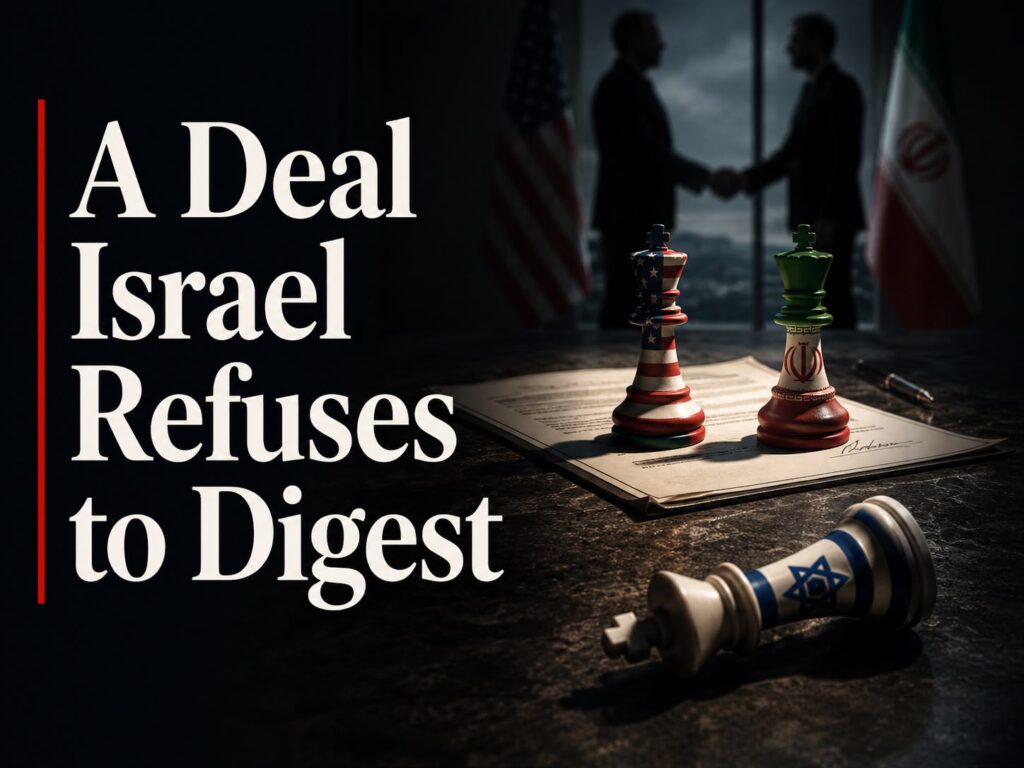
 A Deal Israel Refuses to Digest
For Israel’s political and security establishment, the emerging U.S-Iran understanding is not being read as diplomacy in motion but as a strategic alarm bell. A framework that Tehran can survive, Washington can justify, and Europe can tolerate is being received in Jerusalem as something far more unsettling: a negotiated settlement that does not begin with Israel’s core demands, and does not end with its preferred outcome. That gap between expectation and reality is now driving a rare moment of visible tension between Israel and its principal ally, exposing how far U.S. regional policy is willing to move without Israeli consent.
Not only has the newfound U.S.-Iran agreement highlighted the gap in diplomatic approaches between Washington and Jerusalem, but it has pointed out the limitations imposed on Israel’s ability to veto American foreign policy initiatives in light of shifting strategic priorities in the United States. Despite its cooperation with America in terms of military matters during the initial phase of the Iranian crisis, it now finds itself in a position where it must respond to an initiative that it was not part of, that it has not endorsed, and that it refuses to embrace.
The essence of Israeli opposition is rooted in one basic demand that can’t be compromised: the deal does not ensure full strategic disarming of Iran. Israeli representatives have highlighted three issues in particular. Firstly, this is the issue of diluting and not destroying the approximately 400 kilograms of near-weapons grade uranium held by Iran. Secondly, this concerns the absence of the Iranian missile program among the topics for discussion at the first stage. And thirdly, it involves the phased unfreezing of funds, which are assessed in the billions, at a time when the regional structure of Iran remains fully operational.
These are not minor technical disagreements. They reflect a fundamental divergence in how both sides define “containment.” For Washington, containment appears to mean verified limits, inspection regimes, and phased de-escalation. For Israel’s current security establishment, containment means structural degradation of Iran’s long-term capabilities, even at the cost of diplomatic escalation.
Israeli leaders across the spectrum,coalition hardliners like Itamar Ben Gvir, defense officials like Israel Katz, and opposition figures such as Yair Golan, are converging on a single argument: that the agreement leaves Israel exposed while granting Iran breathing space. Yet beneath this consensus lies a more revealing assumption, that Israel retains the right to determine the acceptable parameters of U.S. diplomacy with a third country. The present crisis suggests that assumption is no longer guaranteed.
Timing is crucial here. The deal comes after an era where Israel was heavily involved in military action against Iran, actions that changed the face of the region. However, during negotiations, Israeli leaders were not included among the important negotiating parties. That exclusion has triggered a political reaction in Israel that is as much about status as it is about security.
Prime Minister Netanyahu’s position illustrates this tension. Publicly, his government insists that Israel will continue to act independently to prevent Iranian nuclear capability. Privately, however, the framework of U.S. diplomacy limits the space for unilateral escalation without risking friction with Washington. This contradiction is now openly visible, especially after U.S. President Donald Trump publicly rebuked Israeli strikes in Lebanon for jeopardising negotiations and described Netanyahu as “difficult” to manage.
Such language is not incidental. It signals an American leadership increasingly unwilling to absorb unlimited regional volatility on behalf of an ally, even a close one.
The problem with structure is clear in that Israel desires an outcome that calls for a permanent paralysis of Iran’s nuclear and missile capability prior to economic sanctions being lifted and normalizing relations. The American process takes a different approach in that both incentives, limits, and negotiations take place at the same time.
However, the political reality is that Israel’s objections are colliding with broader international fatigue over perpetual escalation. The estimated 400 kg uranium stockpile, while alarming from a non-proliferation standpoint, is already under international monitoring frameworks. Ballistic missile capabilities, while strategically significant, are not unique to Iran in the regional context. And the release of frozen assets, controversial as it may be, is being justified in Washington as a tool to stabilise economic collapse scenarios that could otherwise trigger uncontrolled escalation.
The deeper contradiction here is the Israeli demand for operational independence while at the same time refusing to accept limitations on its escalation. The point of view put forward by Defense Minister Katz regarding maintaining operational independence is reflective of this policy. The reality, however, is that operational independence increasingly runs into dependency upon American political protection. Washington can tolerate divergence, but not indefinite destabilization of its negotiation architecture.
If Israel continues to treat the agreement as fundamentally illegitimate rather than incomplete, it risks isolating itself from the very diplomatic process that will determine Iran’s long-term constraints. Conversely, if Washington proceeds regardless of Israeli objections, it signals a shift in which Israeli influence is no longer decisive in shaping U.S. regional diplomacy.
It is noteworthy that the objections from Israel go beyond merely security-related considerations and touch upon the question of the legitimacy of the entire negotiating process. By repeatedly labeling the agreement as one that “leaves Iran intact” or “ignores Israeli security reality,” Israel rejects the viability of incrementalism as a negotiating tool. However, incrementalism has been the hallmark of most negotiations aimed at nuclear non-proliferation throughout the world, including North Korea and previous rounds with Iran.
In case the deal goes ahead despite opposition from Israel, it will not resolve the fundamental nuclear problem but will certainly set a new precedent, one which shows the willingness of the United States to stabilize the region despite the lack of conviction among its closest ally.
Ultimately, Israel’s issue is not the clauses of the deal but the loss of its unilateral veto over how the region is managed. By answering diplomacy with escalation and treating every U.S-Iran opening as something to be disrupted rather than tested, it risks turning strategic isolation into a self-fulfilling outcome. The uncomfortable reality is that a regional reset may be underway with or without its consent, and the harder Israel pushes against it, the more it exposes that its real objection is not to Iran at all, but to any peace architecture it cannot dominate.