
If foreign influence in Washington is measured by proximity to power, then perhaps the most revealing place to look is not Congress, the Pentagon, or even the Oval Office. It is the newsroom. More specifically, it is a newsroom that has become one of the principal translators of White House thinking to the world and one of the principal translators of Israeli thinking back to Washington. This is the context in which Axios has come to occupy a highly significant position within the American political ecosystem.
Axios was launched in 2016 when three former executives at Politico, Jim VandeHei, Mike Allen, and Roy Schwartz, created it after analyzing the problems that had arisen within journalism. Essentially, traditional journalism was not fast enough, detailed enough, or close enough to the demands of the people making decisions. In response, they created “smart brevity,” an approach to journalism that aimed to provide readers with key facts without any unnecessary detail. The approach worked brilliantly because of the environment in Washington; instead of trying to reach everyone, Axios was aimed at the elite who were making decisions in politics, business, and other fields.
Axios’ significance comes neither from its scale nor its influence over the general population but rather from its audience. Axios does not have to take center stage and control the conversation. It simply has to get heard by those who are nearest to the decision-makers. Under such conditions, even short articles tend to have an outsized impact, as they may precede any official statements and often serve to frame the narrative of the event in question for the rest of the media. This helped to establish Axios as an important part of the Washington information circuit.
The rapid growth of influence bells alarms when we look at the people involved in the development of this institution. Among these is Roy Schwartz, one of Axios’ founders and presidents, who is from Israel and has kept close connections to his birthplace throughout his career. Although personal background does not define media policy, the involvement of people with significant national and cultural connections in institutions that occupy such an important place in political narrative construction certainly deserves closer scrutiny. This is because media establishments are not neutral entities; rather, they are constructed realities shaped by their designers.
The situation gets even more delicate when referring to Barak Ravid, one of the most renowned foreign affairs correspondents at Axios. Ravid turned out to be the key reporter when it comes to covering the foreign policy of the United States concerning the issues connected to Israel, Iran, and diplomatic relations in the Middle East. Ravid’s reports appear to mirror the first signals that indicate the change in policy decisions, negotiations, or internal discussions within the American government. Before entering journalism, Ravid served in Israeli military intelligence and continues to maintain a prominent role within Israeli media as well, creating a rare dual positioning within both American and Israeli information environments.
This combination of roles is unusual in any geopolitical context involving major powers. In most other cases, journalists with prior service in intelligence institutions of a foreign state would face sustained scrutiny regarding access, neutrality, and influence. The sensitivity of such relationships becomes even more pronounced when the journalist in question reports on the foreign policy of a country that is itself deeply involved in strategic coordination with that state. The issue here is not personal conduct but structural transparency: how such positions intersect with the production of political information in environments where access itself is a form of power.
Axios’s importance in Washington foreign policy journalism cannot be detached from the organization’s approach that emphasizes access. The organization regularly produces exclusives that rely on briefings from high-ranking sources, anonymous sources from government circles, and discussions inside the government. During major developments involving Iran, Israel, and the Trump administration, Axios repeatedly emerged as one of the first platforms to report on diplomatic contacts, negotiation channels, military considerations, and strategic shifts. These reports often became the foundation upon which other media outlets constructed their own coverage, amplifying Axios’s role as an agenda-setting institution rather than merely a reporting one.
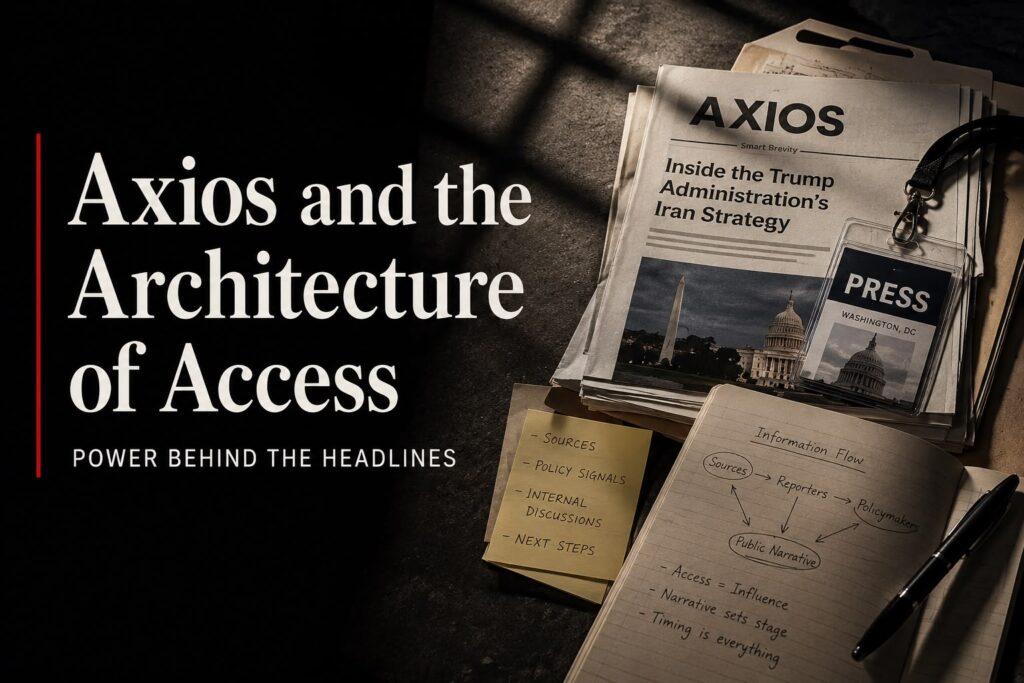
This highlights one of the key characteristics of contemporary political discourse in Washington. Information does not flow in a direct chain from the government through the media to citizens. Instead, it is a process of circulation within a closed circle among policymakers, journalists, and government officials who constantly decode each other’s messages. Governments strategically leak information for the purpose of shaping perceptions. Journalists release this information for the sake of staying relevant and accessible. And policymakers react to the information released, thus creating new cycles of briefings and disclosures. Over time, this cycle creates an environment where perception and policy evolve together in real time.
The Trump administration’s foreign policy alignment with Israel, particularly on issues involving Iran and regional security, further intensified the relevance of these information networks. It was at this time that the convergence of U.S. and Israeli interests was at its most apparent, with both administrations constantly echoing each other in their rhetoric regarding containment, deterrence, and regional realignment. In such an atmosphere, the exchange of information among trusted sources assumed greater importance, given the parallel creation of narratives concerning diplomacy and warfare.
What this means for today’s political environment in Washington is that there is no way of understanding the current political dynamics without taking into account the information systems that exist around it. Influence now exists beyond the lobbying groups and official foreign policy negotiations. It is distributed across a network of journalists, officials, and intermediaries who collectively shape how events are perceived long before they are formally decided. In this sense, media institutions become part of the infrastructure of power rather than external commentators on it.
The story of Axios is not just about one media organization or a few individuals within it. It reflects a structure where access itself becomes influence. When reporting on Iran and regional crises consistently flows through channels deeply embedded in both Washington and Israeli strategic networks, the line between journalism and participation narrows. The concern is not abstract; it is that Israeli perspectives are not merely influencing Washington from outside, but are present within the very information channels through which the White House interprets global events.