
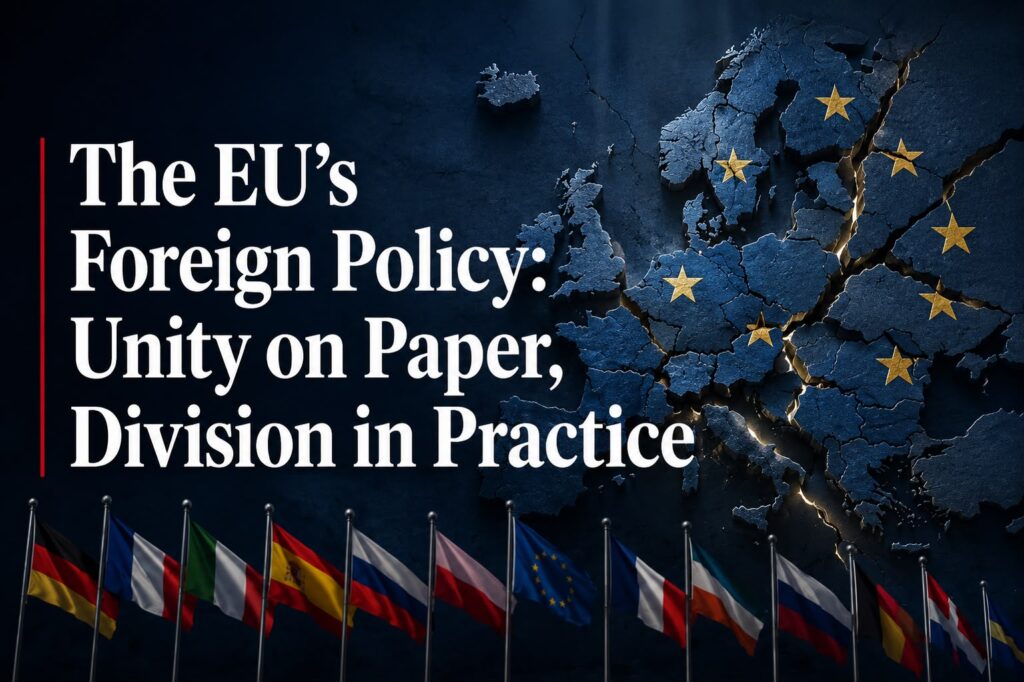
For decades, the European Union sold itself as the world’s most ambitious diplomatic experiment: a bloc capable of turning economic integration into geopolitical coherence. That promise now looks increasingly strained. The debate triggered by France and Germany over reshaping the EU’s foreign policy machinery is an admission that Europe’s diplomatic model is struggling to survive the very world it sought to shape. Beneath the language of “efficiency” and “reform” lies a more uncomfortable truth: the EU is drifting from a unified global actor into a collection of competing foreign policies loosely stitched together by shared institutions.
The central issue of the contemporary controversy lies in the mandate of the High Representative for Foreign Affairs and Security Policy within the EU, as well as the external action service, which has more than 140 delegations in different parts of the world. These bodies should serve as guarantors of speaking with one voice. In reality, however, their role is quite opposite: these entities are merely coordinating the process of divergence, not convergence. This is why France and Germany are trying to change the status quo.
This contradiction is by no means new either. In fact, the EU always harbored an intrinsic paradox, it aims to coordinate its foreign policy at the center while retaining national sovereignty within the sphere of activities that are most important for maintaining such sovereignty, namely security and diplomacy. Major countries like France and Germany have never renounced their ability to conduct independent geopolitical policies. France, for example, retains the global strategic identity that depends on its military might and colonial legacy, whereas Germany, despite its traditionally prudent approach, has gradually gained significant diplomatic and economic influence. The result is not a common foreign policy but a layered hierarchy of influence where Brussels often follows rather than leads.
Nowhere is this fragmentation more visible than in Europe’s response to major international crises. The war in Ukraine initially produced an unusual degree of unity, particularly around sanctions and military assistance. Yet even here, divergences quickly emerged over escalation thresholds, energy dependence, and long-term engagement with Russia. Some states pushed for maximal pressure, others quietly favored keeping diplomatic channels open. In the end, many of the decisive moves were not EU decisions in the strict sense but outcomes of NATO alignment and coordination among key capitals under US strategic leadership. The EU, despite its formal structures, struggled to act as an autonomous center of power.
A similar scenario plays out in the Middle East, where the lack of unity in the EU position vis-à-vis Gaza demonstrates the weakness of consensus-based foreign policy. Member states are polarized into factions of those calling for tougher humanitarian and legal measures and those who prioritize strategic coordination with historic allies. This leads to institutional immobility and internal divisions. Official pronouncements from Brussels are indicative of the ambiguity that is the hallmark of diplomatic negotiation, rather than of coherent strategy formulation.
The current reform discussion is thus part of this larger paradigm shift. France and Germany are not only seeking to cut bureaucratic red tape but also tacitly recognizing that the existing approach will not allow them to take any meaningful political action in a world characterized by fast-moving crises, big power competition, and power politics. The real challenge, nevertheless, is to decide whether their proposals contribute to greater European cohesion or to Europe’s further disintegration. By increasing the weight of national capitals within EU foreign policy, reforms risk entrenching the very fragmentation they aim to solve.
This presents a paradox of structure. A more pronounced role for the member states would enhance reactivity in the short term, enabling quicker coordination between the involved European states in a bilateral or minilateral fashion. However, it would also weaken the collective power of the EU structures, transforming Brussels from a center of strategy into a center of administration.
The implications extend beyond Europe’s internal balance. Global actors increasingly calibrate their strategies based on whether the EU acts as a single entity or a patchwork of states. A unified EU can function as a regulatory superpower, shaping trade norms, sanctions regimes, and diplomatic standards. A fragmented EU, by contrast, becomes easier to navigate, and easier to divide. For external powers, bilateral engagement with individual European capitals may become more effective than negotiating with Brussels, further eroding the authority of EU institutions.
The problem of credibility becomes evident even in the way that the EU is perceived in the Global South today. The EU is rarely regarded as a distinct geopolitical actor; instead, it is viewed as an entity that is simply part of the greater process of harmonizing Western policies. The illusion of the EU’s independence is shattered when member states openly express their disagreements on crucial issues and when the stance of the EU seems like a reflection of transatlantic policies than independently formulated strategies.
The greater problem, however, is that the foreign policy crisis of Europe is not only a matter of process but is fundamentally philosophical. For decades, the EU has rested on the premise that economic interdependence will ultimately lead to political alignment. This idea has now come under pressure in an age in which the interconnectedness of economics exists alongside strategic competition and in which velocity, adaptability, and force dominate international affairs.
However, there are dangers involved in forsaking centralization. The complete decentralization of the EU’s foreign policy could lead to increased competition among member states, reduced coherence during crises, and diminished influence when negotiating with other world powers such as America, China, and Russia. The problem is thus not deciding between unity and disunity, but achieving the balance between the two, which has remained unattainable.
In essence, the discussion about Kaja Kallas’s place and the structure of EU foreign policy is symptomatic of a deeper shift; Europe is not living in a world defined by its presuppositions anymore. It needs to adjust to a geopolitical reality where power is distributed, allegiances are flexible, and coherence is continuously challenged. Whether Europe rises to the challenge of finding common ground and speaking as a unit, or succumbs to a reality of strategic fragmentation, will define not just Brussels’ future, but that of Europe as well.