
By Adam Reed
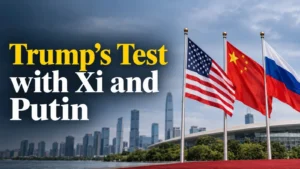
When Donald Trump sets foot in Kylin Villa in Shenzhen this Thursday, he won’t just be sitting down with two seasoned autocrats. He’ll be walking straight into a setup meant to expose his vulnerability and see if a president bruised by losses at home still has the backbone to enforce America’s red lines abroad. This trilateral meeting, Trump, Xi Jinping, and Vladimir Putin, all together on the sidelines of the Asia Pacific Economic Cooperation summit, lands at a moment when everything feels up in the air. After Democrats swept the midterms in November, Beijing and Moscow can’t wait to find out whether Trump’s now a lame duck, or if he’s going to be even more unpredictable after getting humbled at home.
Totalitarian leaders like Xi and Putin don’t spend their nights worrying about approval ratings or Congressional gridlock. That gives them an edge in Shenzhen, at least when it comes to psychological warfare. To both men, the chaos and turnover built into America’s system is a weakness. So in their eyes, Trump is coming to southern China already wounded, knowing he’ll face a hostile Congress in January that will fight him every step of the way, make every move harder, and threaten to shred any major deals before the ink even dries. But mistaking a battered president for a feeble one would be a serious misread. Trump may not be able to offer sweeping sanctions relief or big, bulletproof deals, Congress can kneecap those any time. But his commander in chief powers? Those are untouched. Losing the ability to make promises doesn’t mean he’s lost the power to act, especially when military threats are on the table.
That line is sharpest when you look at Iran. The White House has been at war with itself over how to handle the long running conflict with Tehran. By sidelining Vice President JD Vance’s efforts to quietly negotiate and publicly insisting America doesn’t need a deal, Trump has thrown his lot in with the hawks, Secretary of State Marco Rubio and Treasury Secretary Scott Bessent are calling the tune. The playbook: squeeze Iran until it buckles, using naval blockades and economic pressure, but stop short of deploying ground troops. There’s a limit, though. The sanctions and pressure only work if Beijing and Moscow stop propping up Tehran.
Totalitarian leaders view domestic political chaos as weakness, but losing the ability to make promises does not mean a president has lost the power to act.
The numbers lay it all bare. China bought around 1.4 million barrels of Iranian crude a day throughout 2025, tossing Tehran a lifeline in both cash and goods, even as Western sanctions put a chokehold on Iran’s official banking. At the same time, Russian ships haul military gear across the Caspian under a special partnership, while banks like VTB keep Iranian trade alive by bypassing the dollar entirely. Trump is heading to Shenzhen to press Xi and Putin to pull the plug. But let’s be honest, neither has a reason to throw Iran under the bus just to help an American president out of a foreign policy mess, unless the US is ready to make not just demands, but threats that bite back.
So now Trump’s leverage is running thin. When he sits down with Putin, this will be their first face to face since the fruitless Alaska meeting in August, Russia’s president will press for big American oil companies like ExxonMobil to get back into projects like Sakhalin 1, and he’ll push for new tech transfers for Russia’s Arctic LNG ventures. Putin’s in a corner. Europe is set to ban Russian LNG under long term contracts starting January 2027, meaning Moscow will lean harder on China, which isn’t making any pricing commitments on new gas pipelines until it squeezes out a bigger discount. Normally Trump could use promises of energy cooperation to coax concessions from Russia on Ukraine or Iran. Post midterms, that carrot looks kind of rotten, everyone in the corporate world knows Congress can overturn any relief the White House negotiates.
Xi, meanwhile, is playing from an even stronger position, having home court advantage in Shenzhen. China already made it clear: they want this meeting to be about trade barriers, artificial intelligence, and energy, not a stage for American complaints about Iran, Ukraine, or nukes. By dodging a joint statement and scripting every detail, China gets to control the optics, painting Xi as a responsible world leader. He can toss out small favors, maybe relaxing or reimposing rare earth export restrictions, while pushing Trump for giant, lasting moves on Taiwan. What Beijing wants isn’t vague; they want Washington to go beyond its usual not supporting Taiwanese independence and come out flatly opposing it.
If Trump leaves empty handed without real changes from Beijing or Moscow, the strategy of squeezing Iran economically falls apart entirely.
For Trump, making any trade that swaps US strategic commitments for empty promises on Iran would be a disaster. Xi and Putin are pros at this, they’ll say all the right things in public, but behind the scenes, the money, the weapons, the support for Tehran will keep flowing. If Trump leaves empty handed, with no real changes from Beijing or Moscow, the strategy of squeezing Iran economically falls apart.
When that happens, everything changes. If Iran senses it has cover from Russia and China, and Trump is under fire at home, blamed for high prices and an endless conflict, he might decide that diplomacy and sanctions have gone as far as they possibly can. The buzz in Washington about regime change in Tehran only gets louder. If Shenzhen ends up as nothing but a photo opp, the odds of real military action, whether from the US or green lighted for Israel, jump overnight.
In the end, this summit isn’t about hammering out some grand new peace plan. It’s a test, who holds real power, who backs down. Xi and Putin figure Trump’s domestic defeat has taken the fight out of him. To prove them wrong, he doesn’t have to start a new Cold War, and he definitely can’t keep wobbling between threats and cozy deals. He has to make it clear that helping Tehran comes with a direct, painful cost for Chinese banks and Russian energy. If he hesitates, his opponents will take him for all he’s worth, and he’ll end up with no options but the military escalation he’s been desperate to avoid.
About the Author
Adam Reed is an International affairs analyst focusing on geopolitics, defense strategy, and global security trends.