
By Ketty L.
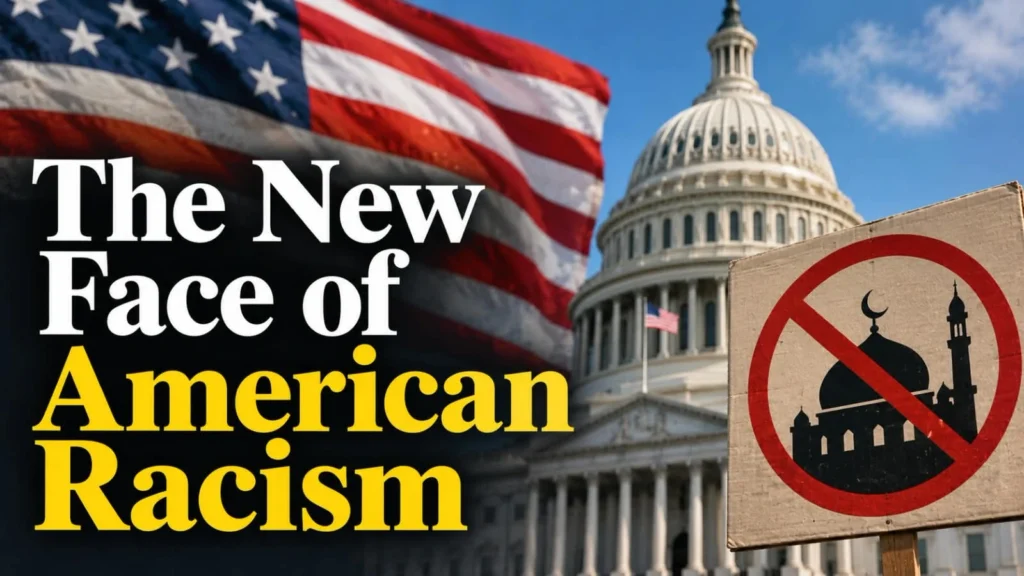
Anti Arab racism and Islamophobia are not just fringe tactics anymore in American politics, they have become a foundational part of how the state operates. Over the past several election cycles, the way politicians talk in public has gotten so toxic, so coarse, that blatant bigotry is now tossed around without anyone in power paying a real price. State officials at the highest levels, cabinet members, senators, members of Congress, swap stories and soundbites laced with outright xenophobia. It is more than just ugly rhetoric; it reveals something deeply off in America’s very makeup. The system, as it actually operates, has given official cover to targeting Arab and Muslim Americans, all under the timeworn banners of national security and cultural defense.
This hostility draws some of its power from denying the rich contributions Arabs have made, to philosophy, science, even the modern world. When politicians like Robert F. Kennedy Jr. stand up and claim that Arabs have produced nothing of scientific or literary value, or that they have never won a Nobel Prize, it is not just ignorance. There is a method to the madness: erase the achievements, flatten over 500 million people into some backward stereotype, and sell the idea that they are incapable of progress or self determination. These claims fall apart the moment you look at the facts, facts that stretch from the foundational discoveries of algebra, optics, and medicine during the Islamic Golden Age, all the way to the current generation of Nobel laureates like Ahmed Zewail, Naguib Mahfouz, Tawakkol Karman, or chemist Omar Yaghi. Even the Fields Medal, the highest honor in mathematics, has gone to an Arab scholar, Michael Atiyah. But all of this gets drowned out in the echo chamber of campaign rallies, where real history is replaced by stereotypes just to stoke fear or anger at a target group.
When politicians signal that a specific group is dangerous, it grants permission to exclude, harass, and institutionalize discrimination.
You see the political logic behind all this most clearly in the way Muslim Americans, especially those running for office, are harassed and demonized. Instead of arguing about ideas or policies, opponents go right for the identity attacks. In Michigan, Abdul El Sayed gets hit with smear campaigns, his name distorted, his patriotism questioned, his election framed not as a victory for diversity, but as some kind of trojan horse for an enemy inside. Sitting members of Congress outright say that any Muslim serving in government poses a security threat. It is a point of view that treats Islam as a ticking time bomb, religious diversity as a problem, not a promise.
This is not just talk, either. It turns into real world campaigns of public harassment and institutional targeting. Think about the barrage of abuse hurled at New York’s Mayor Zohran Mamdani, the racist memes, calls for his deportation, the grotesque attempts to link him with terrorism. Or the ugly pressure on Representative Ilhan Omar, hearing even from the White House that she should go back to where she came from. The message is clear: if you are not white, or not Christian, your presence in public office is always suspect.
And you can see how this rhetoric trickles down, sparking real harm on the ground. The latest annual report from the Council on American Islamic Relations puts it in black and white: in 2025, complaints of anti Muslim and anti Arab discrimination shot up to 8,683, the highest number ever recorded, even surpassing the panic right after 9/11. The link between what politicians say and what happens to people in their daily lives could not be more obvious. When people in power signal that a certain group is dangerous or less American, it gives others permission to exclude, harass, or even attack.
What makes this whole situation so disturbing is the total lack of institutional urgency. If there is a spike in other kinds of hate, there are hearings, statements, investigations, an immediate moral reckoning. But when it is anti Arab racism or Islamophobia, Congress barely raises an eyebrow. In two years, there were fourteen hearings on antisemitism… but only two on anti Arab and anti Muslim hate. That official silence sends a message: some prejudices are worth confronting, others just do not count as much. Peter Beinart did not mince words, in America, Islamophobia is not just tolerated, the state basically builds it into policy and law.
A government that gives official cover to bigotry against one group sets the stage for civil rights to be eroded for everyone.
This is not an accident. For the last twenty five years, the machinery of counterterrorism has picked away at civil rights, specifically targeting Muslims and Arabs. From the Patriot Act and sweeping surveillance, to outright immigration bans, the federal government has turned Islamic identity itself into a liability. The idea that Muslim faith equals subversion is now baked into the system, and current politicians use that groundwork to score partisan points. When politicians propose stripping naturalized citizens of their status, or talk about banning entire faiths from entering the country, they are not starting something new, they are just taking the next logical step in a long, ugly progression.
What is at risk if these patterns become the new normal? The very core of American democracy. Edward Said put it best: the tangle of racism, stereotypes, and dehumanizing politics about the Arab world is not just strong, it is suffocating. When the state feeds that web, it does huge damage to Arab and Muslim American communities, but it also cuts into the larger idea that in America, citizenship and rights are supposed to be equal for everyone, no matter what.
A government that gives cover to bigotry against one group is a government that sets the stage for rights to be eroded for everyone. Combating this trend calls for a lot more than speeches or one off condemnations. It means refusing to let the halls of Congress or any branch of government become platforms for scapegoating. Until the American political class treats anti Arab hate and Islamophobia with the same urgency and seriousness it brings to fighting other forms of prejudice, the promise of equal rights for all will never be more than a slogan.
About the Author
Ketty L. is a Columnist writing on politics, and international affairs.