
By Adam Reed
For years, Gulf security was built around a pretty simple deal: the United States took care of military protection over key shipping routes, while the Gulf states kept oil flowing smoothly to the rest of the world. It worked until it did not. Now, that old agreement is gone. The reality on the ground, especially in the Red Sea, makes this collapse impossible to ignore. Non state groups have dug in at key chokepoints along the Bab el Mandeb strait, places like Mocha, Dhubab, and Perim Island, making it crystal clear that counting on an outside superpower is risky. The priorities of Washington do not always match what the region needs. What once seemed like cracks in Middle East security are now open breaks.
Riyadh, Cairo, and their neighbors are starting to wake up to a tough truth. At the heart of their problem is a mismatch in how the U.S. sees the world versus what the region actually needs. When America looks at global shipping, it acts based on what matters most to its own voters and its own interests. If a crisis in the Red Sea or the Gulf threatens oil shipments to Asia or disrupts trade with Europe, it barely makes a dent in U.S. politics, especially during election season, when most Americans only care about domestic prices and how tired they are of foreign wars. When these shipping lanes mean more for foreign economies than for U.S. shelves, America’s guarantees show their real colors: support can be spotty, conditional, and change almost overnight.
Long term safety cannot be outsourced to distant countries with shifting priorities and unpredictable political commitments.
This shift is not just something you see in military reports, it is hitting wallets and bank accounts across the region. Look at Saudi Arabia. The whole point of building the Petroline from the Gulf to Yanbu was to get oil out without having to pass through the dangerous Strait of Hormuz. For years, that seemed like a solid backup plan. But all that logistics and infrastructure does not mean much if the Red Sea itself is not safe. When the southern Red Sea turned into a battleground, the very route designed for flexibility became a new headache. At one point, Saudi oil exports through Yanbu shot up to 4.3 million barrels a day. Once new blockades tightened, that number crashed, and global oil prices spiked past 107 dollars a barrel. Egypt feels the pain, too, Suez Canal tolls are a lifeline for their economy. Every time a cargo ship detours around Africa instead of cutting through the canal, Egypt’s financial situation goes from bad to worse.
These shocks laid bare the danger of relying on outside powers for security. Foreign troops and ships can simply be reassigned, stalled, or sent home whenever leaders in Washington, or any other capital, decide it makes sense politically. If your security counts on someone else’s election calendar, you are just one policy change away from being left exposed. More and more, leaders in the region are forced to accept a tough fact: long term safety cannot be outsourced to countries with shifting priorities and unpredictable commitments.
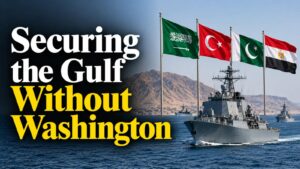
That is why we are seeing a major shift. Gulf countries are starting to take defense into their own hands, and not as some diplomatic experiment, it has become a matter of survival. They are building broad security networks with their own neighbors: Saudi Arabia, Egypt, Türkiye, Pakistan, and other coastal countries around the region. This is not about sending messages to the world; it is about creating real power on the ground and at sea.
True stability comes when Gulf states, along with regional partners, build, pay for, and manage their own defenses.
Türkiye and Pakistan play huge parts in making this work. Türkiye does not just bring a navy, it brings drone technology, layered air defense, and strong relationships that stretch from the Red Sea to the Horn of Africa. Turkish military support comes free from the political strings and sudden about faces that often come with Western military aid. Basically, Ankara offers muscle that the region can truly call its own.
Pakistan’s involvement is no less important. It has become the Gulf’s security anchor, tied tight to Riyadh through years of joint operations and formal agreements like the Mecca Accord. Pakistan supplies not just troops and ships, but also the kind of nuclear backed deterrence that outside powers are reluctant to provide. Their military is battle hardened, their navy knows these waters, and they are uniquely positioned to talk to both Tehran and the Gulf states. The recent joint mission to Tehran, which pulled in top commanders from Pakistan, intelligence from Türkiye, and defense officials from Saudi Arabia, shows just how central Islamabad is to any lasting regional peace, and this partnership is backed by real military strength, not just paperwork and promises.
The breakdown we are seeing in the Red Sea is not just a regional problem. It is a clear sign for the world that the old system, where distant powers handled security while local governments watched from the sidelines, does not work anymore. Hoping someone else will keep the oil flowing or protect shipping lanes is a recipe for disaster. True stability will not come from waiting for Washington or any other foreign capital to change its mind. It comes when Gulf states, along with partners like Türkiye and Pakistan, build, pay for, and manage their own defenses. Only then can they really protect their waters, economies, and future.
About the Author
Adam Reed is an International affairs analyst focusing on geopolitics, defense strategy, and global security trends.