
By Ketty L.
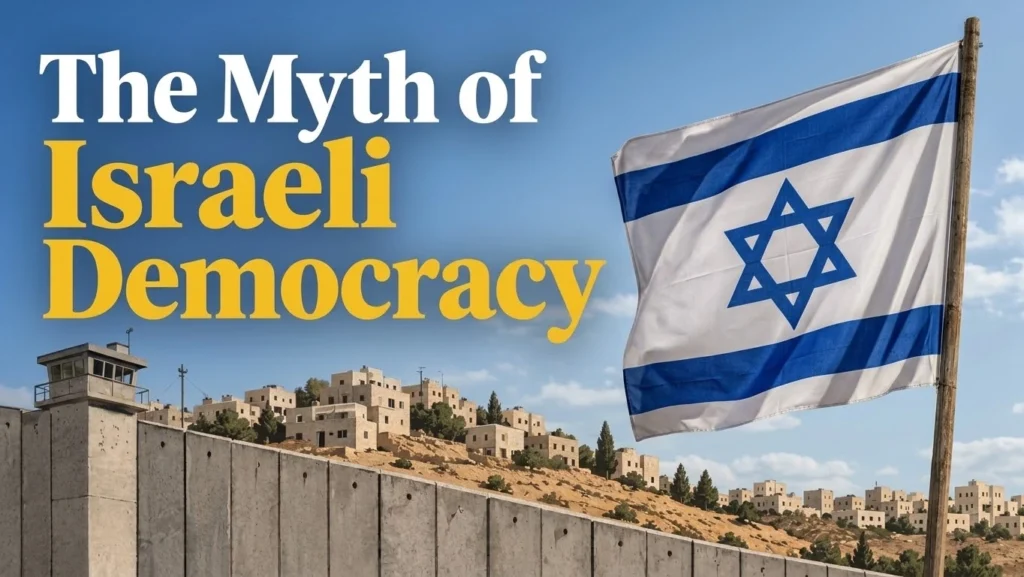
At the heart of Israel’s identity is a contradiction that is tough to ignore: On one hand, it insists it is the Middle East’s only real democracy. On the other, its political and legal machinery systematically blocks Palestinians from equal rights and tries to sideline Arab political voices. Whenever Palestinian citizens in Israel turn out in record numbers to vote, and it happens, the government does not cheer for democracy. Instead, top officials scramble to paint that participation as a threat to the state’s very survival. This is not just some new problem or a fluke tied to a specific leader or party. This is how an ethno nationalist system keeps its grip, always working to protect Jewish political dominance.
Look at what happens after national elections. When Arab parties rack up significant wins in the Knesset, like snagging 19 seats in a splintered parliament, the major Jewish factions do not welcome them. Instead, they openly accuse these groups of threatening the system, insisting their votes are illegitimate subversion. In the run up to voting, government bodies and right wing politicians keep trying to kick anti Zionist and Arab lists like the Joint List or Ra’am out of the running altogether. Sure, legal channels, like the Supreme Court, sometimes overturn these bans, but the larger political talk remains nasty and exclusionary. Palestinian citizens hear the message, loud and clear: Your participation is only fine as long as you do not actually try to change anything fundamental.
That domestic exclusion is not just a fluke inside the borders. It shapes, and is shaped by, the military doctrines Israel rolls out against Palestinians in the occupied territories. Even in Western commentary, so called moderates like Gadi Eisenkot are hailed as sensible alternatives, but there is not much daylight between opponents. Mainstream politicians quibble over leadership style, not direction. The security consensus, with all its destructive logic, stays locked in place.
This is not just some new problem or a fluke tied to a specific leader; this is how an ethno nationalist system keeps its grip, always working to protect Jewish political dominance.
It is not just talk, high ranking leaders have spent decades pushing strategies built on collective punishment. The Dahiyeh Doctrine is a prime example. Eisenkot, then the head of Israel’s Northern Command, spelled it out in 2008: The plan is to unleash disproportionate force, wreak havoc, and treat entire civilian areas as military targets. It is not just a hypothetical, it is policy. The idea is simple: Crush communities until the cost of resistance seems too high, and use destruction as deterrence.
The numbers tell the story, too. During the 2014 Gaza war, according to the UN’s humanitarian office, more than 2,200 Palestinians died, most of them civilians. Then came the 2018 protests at the Gaza fence. UN investigators found that Israeli troops killed 189 Palestinians, most shot with live rounds. Behind the statistics is a pattern: civilian casualties in the thousands, huge numbers forced from their homes, entire neighborhoods leveled. This is not just collateral damage. It is a deliberate strategy, embraced by the country’s defense leadership. When international observers call the architects of these campaigns pragmatic centrists, it sends a message that basic rights are optional, disposable, even.
The devastation in Gaza, the sheer wreckage and mass displacement, shows this doctrine in overdrive. Global rights groups, law experts, and international bodies have been gathering evidence for years, documenting the systematic nature of the violence. In September 2025, the UN’s Commission of Inquiry definitively said it: Israel committed genocide in Gaza. Their findings spelled out how targeting homes, hospitals, water systems, and farmland went well beyond the bounds of regular conflict. These were not just unfortunate side effects, they fit the definition of state engineered destruction. To brush all this aside as simple partisan politics is to ignore the deep, structural violence at play.
When civil rights depend on your background, when occupation is endless, and when military doctrines embrace collective punishment, calling that system a democracy is just window dressing.
On the world stage, Israel’s democratic claims are carefully maintained through decades of diplomatic strategy, mostly with unwavering Western backing. The language of counterterrorism works wonders here, it deflects outside criticism, delegitimizes Palestinian resistance, and pushes aside the basic demand for self determination. U.S. financial, military, and diplomatic help lets Israeli leadership sidestep accountability almost entirely. International orders and verdicts get tossed out without fear of any real consequence.
And it is not just military campaigns or elections. On the ground, the relentless building of illegal settlements, grabbing of land, and state backed settler violence carve up the West Bank permanently. United Nations data rings the alarm again and again: Israel’s policies are designed to break up Palestinian territory, making a viable, sovereign state impossible. By redrawing maps and keeping millions under military rule while denying them rights, Israel hardwires inequality into the landscape itself.
As Edward Said wrote, “You cannot continue to victimize someone who has already been victimized, and expect them not to resist.” Swapping out a prime minister or forming a new coalition does not change the country’s fundamentals. When civil rights depend on your background, when occupation is endless, and when military doctrines embrace collective punishment, calling that system a democracy is just window dressing. Leadership changes simply put a fresh face on an old machine. Unless the occupation’s foundations are dismantled and real equality is on the table for everyone between the river and the sea, Israel’s story will always be stuck between its democratic image and the hard reality of oppression and violence.
About the Author
Ketty L. is a Columnist writing on politics, and international affairs.