
By Daniel Frost
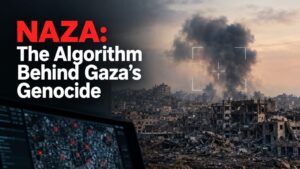
The standing ovation at the Venice International Film Festival lasted for twenty five minutes. People did not just clap, they wept. Packed theaters in New York and Paris saw audiences moved to tears, all because of NAZA, an eighty minute documentary by Yuval Abraham and Rachel Szor. The title comes from the Hebrew acronym nezek agavi, a bureaucratic term that translates to collateral damage. The film takes us to the shadows, literally. Through disguised voices and barely visible rooftop silhouettes shot in Tel Aviv, twenty four Israeli intelligence officers lay out something chilling: modern military targeting is no longer a human decision. It is become an automated, industrial process, as impersonal as a factory line, but the product is mass death.
NAZA tears away the myths that shield Western militaries from facing what their wars have really become. Inside, the filmmakers pull back the curtain on the new face of warfare, how advanced artificial intelligence systems, with names like Lavender and Gospel, changed the devastation of Gaza into a methodical, systematic operation. One intelligence officer puts it bluntly: the job was about quantity, not quality. Automated systems spit out tens of thousands of names and locations for killing, with almost no meaningful human supervision. Lower level suspects were not tracked in secret, they were targeted right at home, with the expectation that wives, children, and neighbors would be killed too. In one especially haunting case, officers hacked the phone of a twelve year old girl just to see when her father would show up. The moment he did, they launched a precision strike. Both of them died.
Militaries have always used polite, sterile language to cover up the violence they unleash. Murder turns into collateral damage, mass displacement gets called strategic relocation, and blowing apart a city becomes operational necessity. But AI does not just repeat this trick; it perfects it. An algorithm cannot feel guilty or hesitate, it just turns people into data points, handing over a facade of objectivity to military legal teams who want cover for their decisions. When an analyst approves a machine generated target in seconds, the data is not just an input; it becomes like a modern god, almost sacred, pulling the responsibility for death away from any single human being.
Modern military targeting is no longer a human decision, it has become an automated, industrial process where algorithms turn people into data points for mass death.
NAZA’s global success speaks volumes about how hungry people are for real stories, stripped of gloss or propaganda. Yet inside Israel, the government’s response has been furious. Far right ministers went straight for the filmmakers, calling them traitors. Prime Minister Benjamin Netanyahu tried to pass emergency laws to strip their citizenship. Crowds gathered outside director Rachel Szor’s family home, shouting threats and calling for executions, even home demolition. The Israeli military rushed out statements, insisting the documentary twisted the facts and saying tools like Lavender are just intelligence databases, not lists for assassination.
But these careful distinctions do not stand up to reality. Whether you call something an advisory database or a strike system, the outcome is the same. People under pressure often end up simply trusting what the machines tell them. When decisions about who lives and who dies run at the speed of algorithms, there is no time for proper checking. Things play out very differently than the military’s official statements about international law. With whole neighborhoods in Gaza flattened and tens of thousands of civilians dead, official claims about precision and civilian protection sound empty, almost mocking.
What is happening in Gaza is not just about this one war. It is a glimpse of the future of conflict everywhere. Once governments hand over the power of life and death to machine learning, the bar for violence drops. The horror in NAZA is not only that machines make killing easier, it is that they erase guilt, making mass murder feel routine, all wrapped in legal paperwork that makes it seem proper.
The real threat is not that machines suddenly start making decisions for themselves, it is that people willingly give up their own sense of right and wrong.
As historian Omer Bartov points out, NAZA forces audiences to face the truth, refusing to let authorities retreat behind polite denials. It pushes us to really hear the people behind algorithmic warfare, to see what the official language hides. Technology has not made war cleaner or more humane. Instead, it lets governments wage old kinds of destruction, now hidden behind walls of computer code.
The lesson from Gaza should not be overlooked or dismissed as an outlier. It is the blueprint for what is coming, wars where code, not conscience, picks the victims, and software calculates how many dead civilians are acceptable. When algorithms choose who gets killed in a city under siege, talk of international law and human rights loses all meaning. NAZA leaves us no escape from this fact: once the state uses AI to dodge the burden of human morality, industrial scale killing becomes a simple bureaucratic chore.
This warning runs far past the borders of the Middle East. High tech militaries worldwide are paying close attention, learning that civilian deaths can be recast as just another metric in operational planning when machine learning does the sorting. If international institutions fail to draw firm lines, this could become the basic playbook for every future war, a world where mass civilian deaths are baked into the system.
In the end, the voices in NAZA do not just warn us about AI running amok. The real threat is not that machines suddenly start making decisions for themselves; it is that people willingly give up their own sense of right and wrong. When killing anyone, anywhere, can be done from behind a desk, cloaked in technical jargon, the thin line between lawful democracy and brutal savagery just vanishes. What played out on those Tel Aviv rooftops is more than yesterday’s scandal. It is a message to the world: if we accept automated mass killing as ordinary state policy, then we have all become collateral damage.
About the Author
Daniel Frost is a Foreign affairs columnist specializing in global geopolitics, European security, and strategic policy.