
By Daniel Frost
The French Republic loves to see itself as the birthplace of liberty, equality, and fraternity. Those ideals are practically stitched into its national identity. But when you see teenagers blocking school entrances, putting up barricades, and staging protests, it’s hard not to feel that the country’s promise of equality is taking a tough hit. The massive wave of student protests that swept across France in September and really ramped up in October 2026 laid bare a crisis at the core of its institutions. Sending in police might clear out protestors for a bit, but that doesn’t tackle the deeper rot that’s pushing kids to rise up against their own schools.
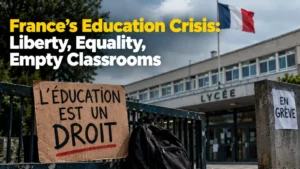
It didn’t start with a bang. It began quietly in Créteil, a suburb near Paris, kicked off by frustrations over constant staff shortages and exhausted teachers. But students didn’t stop there: they started to call out a much bigger issue, namely inequality baked into the system. They pointed out that if you are in a poor suburban neighborhood, you usually get worse instruction, buildings that are literally falling apart, and virtually no chance to move up in society. So when teenagers hoist signs that say education isn’t a privilege, it’s a right, they are challenging the very soul of France’s social contract. In a country that swears by egalitarianism, rundown schools and perpetually empty classrooms feel like a betrayal.
Walk into the schools these protestors come from, and you won’t find the shining halls featured in government brochures. You will probably find rooms that are ovens in the summer and ice boxes in winter. Kids complain constantly about leaks in the ceiling, walls collapsing, rats scuttling underfoot. It has all been documented, both by the media and the students themselves. On top of that, French high schoolers face some of the longest school days in Europe. They spend more time with their teachers and these crumbling walls than with their own families. When your school is uncomfortable, unsafe, and undignified, it’s no wonder anger boils over.
In a country that swears by egalitarianism, rundown schools and perpetually empty classrooms feel like a profound betrayal of the social contract.
But the crisis isn’t just about broken buildings; it runs even deeper. There’s a real failure in how education is delivered. For decades, policymakers have loved to show off France’s centralized school system as a great equalizer, promising to turn any kid, no matter where they started, into a responsible citizen. But after years of budget cuts, shifting government priorities, and lopsided funding, that promise feels pretty hollow. If you live in the banlieues, the poorest suburbs, you get schools where teachers leave constantly and help for struggling students barely exists. The state talks about equality, sure, but its actions create a split system with massive gaps between the privileged and the marginalized.
Officials point to big numbers, claiming they have allocated 65.5 billion euros for schools in 2027, which is a hair more than the 63.4 billion euros for national defense. But let’s be real: those numbers don’t fix a broken heater or find a substitute teacher. What matters to students is how their school feels and functions day to day. When the money never seems to trickle down to those who need it most, fancy budget figures lose all meaning.
This disconnect isn’t just about money, it’s about communication too. Paris bureaucrats talk budget constraints and national priorities in stuffy meeting rooms, but none of that means anything to students shivering in unheated classrooms or watching as teachers keep disappearing. That gulf breeds bitterness. Young people see leaders as totally out of touch with what’s happening in their schools.
Politically, the protests have torn the country apart. Left wing politicians like Jean Luc Mélenchon back the students, slamming police actions as over the top and violent. The government’s supporters accuse the far left of using vulnerable teenagers as tools for their own agenda. And, sure, politics is always lurking in the background. But if you reduce the protests to just another political game, you let the government off the hook for actually fixing schools.
If the state’s answer to young protest is force, it risks pushing an entire generation away from democratic values.
Of course, the debate spills into the wider culture. What starts as a legitimate protest about school conditions quickly becomes about law and order, vandalism, or rumors of radical activists infiltrating. Instead of talking about why schools are broken, everyone gets stuck on the chaos: property damage, fights with police. The risk is that authorities only deal with the noise, not the deeper problems.
Things got dangerous, too. By October, the Interior Ministry said thousands of minors had been arrested. Hundreds of students and police were hurt in clashes, and the closure of up to 500 high schools threw thousands off their normal routines. These disruptions threaten to overwhelm the original demands and turn campuses into battlegrounds.
The sight of riot police firing tear gas near schools feels like an absurd contradiction. On one hand, schools teach democracy; on the other, armored vehicles show up to silence dissent. If the state’s answer to young protest is force, it risks pushing an entire generation away from democratic values. Once trust breaks down, it’s incredibly hard to rebuild, and making police presence normal at schools sets a troubling precedent.
Things stepped up another notch when labor unions got involved. The CGT, one of France’s most powerful unions, jumped in to support students, pledging to join protests and shield high schoolers. Suddenly, this isn’t just about students, it’s about workers too. Bringing unions into the fight transforms a local school frustration into a much bigger social issue, putting more pressure on the government.
That kind of solidarity has echoes in French history. When students and workers team up, governments have had to listen. Teachers’ unions, already exhausted by low pay and burnout, naturally align themselves with students demanding better conditions. As unions mobilize, the protest’s scope expands from fixing schools to questions about public investment, labor rights, and the direction of welfare itself.
Now, the government faces a real crossroads. It can keep sending police to break up protests, or it can start making actual changes. Clearing blockades works for a day, but if Paris wants lasting peace, it needs to hire more teachers, fix buildings, and make sure resources go where they are most needed. Concrete, transparent plans, not vague numbers, are what will restore faith.
Ultimately, the 2026 student uprising is more than just a protest, it’s a wake up call for France. It forces everyone to confront the difference between the country’s proud ideals and the rough reality faced by its youth. Fixing it demands far more than political speeches or a few extra euros in the budget. It takes a renewed commitment: public education as the foundation of democracy, deserving respect and the resources to actually deliver on those principles.
About the Author
Daniel Frost is a Foreign affairs columnist specializing in global geopolitics, European security, and strategic policy.