
By Adam Reed
There’s a tendency, especially among policy circles, to measure military alliances strictly by counting soldiers, jets, ships, and hardware. But when Saudi Arabia, Türkiye, and Pakistan signed the Mecca Joint Defense Agreement, it set off ripples well beyond the usual calculus. This isn’t just about firepower or deterrence in the classic sense; it’s about changing the rules for everyone else, especially non state actors like the Houthis. The pact shifts regional dynamics, creating pressure points that aren’t about bombs or bullets, but about the stories people tell, the alliances they trust, and the legitimacy they claim.
For years, the Houthis have played a clever game with their narrative. They didn’t just fight their neighbors or attack ships in the Red Sea; they claimed these moves as bold acts against imperialism, as a frontline battle for Palestine. This was more than propaganda. It was a mask that let them gloss over governance failures and economic chaos at home and silence internal dissent. Their identity hinged on the idea that they weren’t just fighting Saudi Arabia; they were standing up against a supposedly pro Western axis. It helped them drum up support both inside Yemen and across the region, tapping into shared anger over Israel’s actions and deep seated suspicion of Washington.
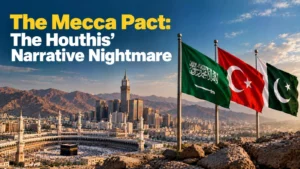
Now, with the Mecca pact, that story hits a wall. Naming the agreement after Islam’s holiest site isn’t subtle. It projects unity and religious legitimacy, especially when three heavyweight Islamic countries band together and claim collective security and solidarity. But it’s the specifics that matter most. Türkiye and Pakistan, for all Riyadh’s shifting alliances, have built reputations as advocates for Palestine. Turkish leaders loudly criticize Israeli policies, and Pakistan, for decades, has backed the Palestinian cause at the diplomatic level without hesitation. When Saudi Arabia teams up with Ankara and Islamabad, it’s pretty hard for the Houthis to argue that the kingdom is acting as an extension of the West, or as an enemy of Islam. Their propaganda, once a shield, becomes a liability. Suddenly, their attacks aren’t defending the Muslim world; they’re fighting against nations that actually champion the causes they claim to defend.
Naming the agreement after Islam’s holiest site projects unity and religious legitimacy, dismantling the Houthis’ self-appointed role as sole champions of the Muslim world.
That’s just one layer. Dig deeper, and you find the diplomatic machinery humming underneath, with Pakistan playing a pivotal role. Islamabad has ties, close ones, with Tehran, which provides the Houthis with vital support, weapons, and strategic depth. At the same time, Pakistan is a cornerstone of the new alliance. This dual position gives Pakistan leverage, allowing it to mediate, pressure, and defuse rather than simply escalate. While Riyadh and Ankara may focus on military deterrence, Islamabad’s quieter diplomatic channels offer an alternative. They encourage de escalation, help lower tensions, and gently nudge Iran to rethink its support for the Houthis. It’s more nuanced than gunboat diplomacy: less obvious, but often more effective.
To really grasp how significant this alliance is, though, you’ve got to look at the bigger picture. Over the last decade, traditional security guarantees from the West have lost credibility, and regional powers are tired of being pawns. The Mecca agreement, formalized in August 2026 and fleshed out with detailed protocols soon after, marks a shift. These three countries aren’t waiting around for foreign intervention. Saudi brings money and strategic real estate. Türkiye supplies defense manufacturing and advanced technology. Pakistan delivers military muscle and diplomatic reach, especially into non Arab capitals. This isn’t a collection of leftovers; it’s a deliberate pooling of strengths that challenges old assumptions about power in the Middle East.
By closing ranks, the alliance pulls the rug from under non state actors like the Houthis, who usually exploit diplomatic isolation and sectarian divides. Insurgents thrive when their opponents are squabbling or disconnected. Now, with Saudi Arabia, the guardian of Islam’s holiest sites, standing shoulder to shoulder with two populous, militarily capable Muslim nations, those fault lines aren’t so easy to exploit. The Houthis’ rhetoric, painting their violence as holy resistance, starts to look hollow when the coalition itself boasts undeniable credentials as defenders of Palestine.
Pakistan’s close ties with Tehran create new diplomatic avenues for de-escalation, offering Iran a face-saving exit to pull back support without brute military force.
Pakistan’s backchannel to Iran matters too. Iran’s support, without question, has fueled the Houthis with modern weaponry and the confidence to expand their campaigns well beyond Yemen’s borders. Previously, the Arab coalition tried to cut this lifeline with military strikes, but it rarely worked for long. Now, with Pakistan able to talk directly to Tehran, while staying loyal to the pact, it creates new avenues for negotiation and restraint. Tehran gets a diplomatic option, a face saving exit if it wants to pull back support without appearing weak. That’s not something brute military power can accomplish.
In the end, the Mecca pact isn’t just another mutual defense agreement. It’s multifaceted. It reframes the ideological battlefield, dismantling the Houthis’ self appointed role as sole champions of the Muslim world. It sets up diplomatic conduits, especially through Islamabad, that turn military alliances into political realities. It’s a security architecture built as much on perception, narrative, and shared legitimacy as on tangible hardware.
Importantly, as operational plans move from press releases to actual deployment, this kind of alliance doesn’t win its most important victories with missiles or armored brigades. It wins by chipping away at the Houthis’ legitimacy, by making their claim to moral authority unsustainable. For insurgent groups, narrative is everything. Once that starts to crack, the whole movement faces an existential challenge.
The Mecca Joint Defense Agreement might be new, but its implications run deep. It’s a reminder that alliances matter, not just for how many troops they can mobilize, but for the stories they can rewrite and the divides they can heal. As the Middle East adapts to a world where power is shared, not dictated, this pact gives Saudi Arabia, Türkiye, and Pakistan the edge, turning collective action into collective credibility, and redefining what it means to lead in a region once ruled by outsiders and fractured by differences. In the long run, the real contest won’t play out across Yemen’s deserts, but in the narratives that shape the next generation’s view of legitimacy, resistance, and the meaning of Islamic solidarity.
About the Author
Adam Reed is an International affairs analyst focusing on geopolitics, defense strategy, and global security trends.