
By Ketty L.
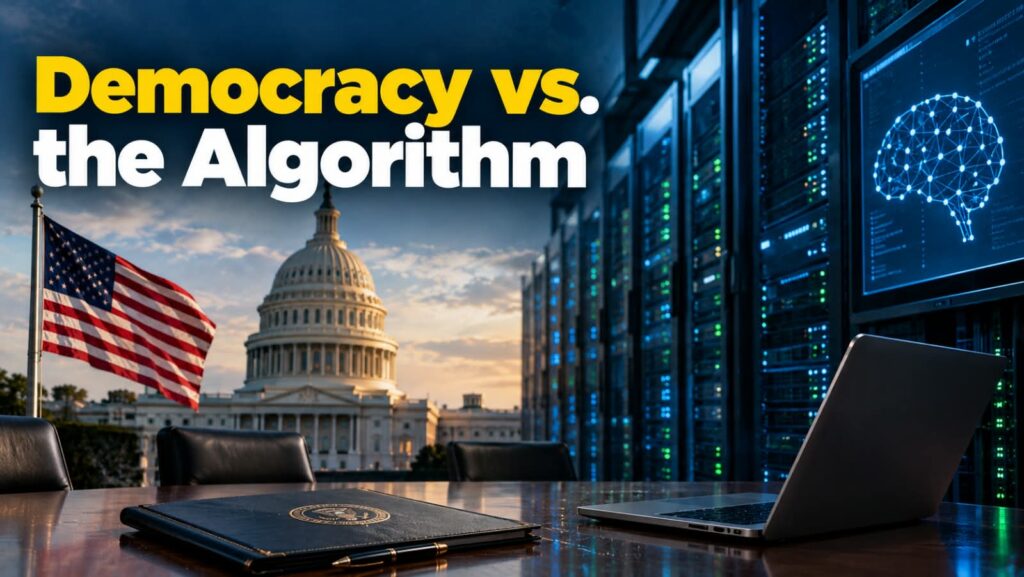
There’s something striking about watching the old guard of nation state power sit down across the table from the new architects of the digital world. When President Donald Trump hosted a heavy hitting crew, including Mark Zuckerberg from Meta, OpenAI’s Greg Brockman, Anthropic’s Dario Amodei, Nvidia’s Jensen Huang, and Sundar Pichai from Google, at a high wattage White House summit, the moment wasn’t just a routine briefing. It played out like a carefully staged theater; the elected leader of the United States facing off with the people who build, run, and shape the core infrastructure of human cognition. The symbolism was unmistakable.
They didn’t just talk. The meeting produced two headline actions. First, they rolled out the so called “Accord on Super Intelligence”, an agreement between the government and tech giants, but one dressed up as self regulation. Second, an executive order landed: 14434, mandating that every federal agency swap out the old “Artificial Intelligence” for the new “Super Intelligence” in all official documents and communications. These moves were clearly meant to look strong and proactive, but the real, uncomfortable question lingered in the background: Does traditional political power actually have any control left when the most critical tools for shaping our thoughts, our commerce, and our public life are locked away in the vaults of a handful of Silicon Valley companies?
If anything, that new self regulation accord exposes how state authority is beginning to run up against its own walls. Legal experts and activists didn’t waste time pointing out that the agreement wasn’t actually binding. No penalties if someone breaks the rules, no real requirement to share information with the public, no government watchdog keeping tech companies in line. The companies basically promise to babysit themselves: they define their standards, they pick their own review boards, they grade their own homework. As legal scholar Kimberlee Weatherall put it, when you let industry actors redraw the lines of compliance, government “oversight” turns into empty ceremony, functionally outsourced right back to the regulated. The foxes run the henhouse.
When you let industry actors redraw the lines of compliance, government oversight turns into empty ceremony, functionally outsourced right back to the regulated.
Meanwhile, the nuts and bolts fallout from the AI revolution is getting messier. Rural and suburban communities across America have started to push back, protesting the sudden arrival of gigantic, power hungry data centers in their backyards. Local folks are angry about spiking energy bills, drained water sources, and lost green space. The standard political reply? Don’t worry, this will boost our economy! Officials promise that these new facilities will bring jobs, tax revenue, and spending on local roads and utilities. But there’s a deeper problem here, one those reassurances skip over. Classic state authority just isn’t set up to manage the immediate, sprawling environmental impact created by technologies that scale at rates no town hall or city council can keep up with.
Pull the camera back, and you see the bigger dilemma that’s been brewing in modern political thought. Governments run on statutory procedures, lengthy debates, slow moving legislation, and the rhythms of election cycles. Writing laws, building enforcement agencies, those are projects measured in months and years. But on the tech side, algorithms and neural nets update and iterate in seconds, not seasons. So when a president signs an executive order to relabel AI as “Super Intelligence,” it isn’t about actually taking the wheel. It’s about trying to keep up with a world these private labs have already redesigned while no one was looking. The best the government can now hope for is to be a commentator on a runaway train, still able to address the crowd but with no way to slow down the machine.
This isn’t just political theater or jostling for headlines; it’s a real shift in how daily life gets shaped. Go back to Aristotle, who talked about leisure as the space where free people could do their real thinking, make choices, and define their own lives, separate from the grind of work. But today? Leisure itself has become a different beast. Scrolling through social feeds, interacting with AI chatbots, creating digital content, what most people now call “free time” is just another feedstock for corporate data machines. Every tap, pause, and swipe is raw material to fuel algorithmic models that endlessly refine their tricks for predicting and nudging our behavior. What used to be leisure is now unpaid labor feeding the commercial platforms all day, every day.
The best the government can now hope for is to be a commentator on a runaway train, still able to address the crowd but with no way to slow down the machine.
You’ll hear tech CEOs, people like Sam Altman, insist that automation and intelligence are here to free humanity from drudgery. In theory, these tools are supposed to unleash human creativity, let us make bigger choices, live with more meaning. But if you come down to earth, you see something else. Algorithms now shape which stories we see, what we buy, even how we think politically. Human attention has become the most valuable raw resource and it’s being strip mined by systems designed, above all, to maximize engagement.
There’s an even deeper split between how political and technological powers are set up. Democratically elected power is always on the clock. Presidents, prime ministers; they serve fixed terms, need to keep voters happy, work within the boundaries of laws and regions. They swap out after a few years, and can be upended by a restless electorate. But technology? Those data centers and proprietary codebases aren’t elected, they don’t answer to voters, and they don’t care about national borders. Politicians come and go, but the neural networks just keep growing, learning, and exerting their influence. Real power isn’t about who’s on TV talking about pledges; it’s about who controls the infrastructure everyone uses to think and make choices.
In the end, that big meeting in the White House wasn’t really a show of control. It was a signal, almost an admission, that traditional political power feels outpaced. Executive orders, sweeping statements, declarations of intent; they’re all starting to look like relics beside the world of self evolving digital architecture.
Governments still have muscle: mobilizing their populations, drafting policies, using state force if needed. But the engines that move human attention, drive economic power, and shape cognitive habits are now elsewhere, beyond easy reach. Unless democratic societies find some way to establish real, enforceable oversight for computational power, the familiar machinery of state risks turning into a hollow performance. The grand old chambers will keep hosting their pageants and summits, but real authority, the choices that shape society, will be made quietly, deep in server farms, far from public debate or democratic control.
About the Author
Ketty L. is a Columnist writing on politics, and international affairs.