
By Ahan S. Prakash
The demolition of the Babri Masjid in 1992, a mosque that had stood for centuries, marks the moment when the Bharatiya Janata Party really broke into the center of Indian politics. What kicked off as a campaign pushed by religious groups, mostly majoritarian, quickly found a permanent voice in Hindutva, making it more than just a passing outrage. At the time, the destruction was painted as some wild, uncontrollable surge by an emotional mob. But, let us be honest, everyone watching knew something else was going on. Official inquiries later confirmed it: the whole thing was planned. Years slipped by, people dodged responsibility, and by the time the government lined up behind majoritarian ideology, India’s highest court granted the disputed land for a massive temple complex. That moment is not just a footnote; it has become the playbook for a broader campaign to erase minority heritage across India.
What started as spectacle now feels routine. Targeting Islamic religious sites has become just a part of how some state administrations work. Investigative pieces, like those from Millat Times, a respected Indian Muslim news outlet, have tracked over 2,100 incidents since 2020: demolitions, evictions, forced removals hitting mosques, shrines, and Islamic educational centers. It is not angry mobs anymore. It is predawn operations with bulldozers and police, sanctioned and organized by civil authorities. Uttar Pradesh, a state with tens of millions of Muslims, is practically ground zero for this policy. Here, the government operates with near total impunity.
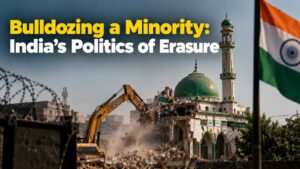
Take the collectorate mosque in Saharanpur. It stood for more than a hundred years right inside the district administration’s complex; then, almost overnight, officials labeled it an illegal encroachment. In early September 2026, earthmovers arrived before sunrise, flanked by hundreds of police and paramilitary guards. Local politicians like MP Iqra Hasan, who tried to challenge the demolition or even get to the mosque, were put under house arrest. The mosque was razed before any court could intervene or issue a stay.
Municipal machinery and predawn bulldozer operations have transformed targeted minority property demolitions into a routine administrative tool.
The bigger picture is pretty stark: constitutional protections meant to shield citizens from arbitrary state power are crumbling. Legal safeguards have been twisted, speeding up demolitions while bypassing due process. You see it everywhere: buildings that have stood for generations suddenly marked as illegal occupations. Bureaucrats issue snap notices, often skipping statutory waiting periods altogether. Appeals from affected mosque committees get delayed or dismissed. By the time higher courts take up writ petitions, the site has already been bulldozed, leaving families and communities with nothing to fight for.
International human rights organizations keep sounding the alarm. Amnesty International and others have put out detailed reports about how municipal machinery in India’s cities has been weaponized. They document punitive demolitions targeting minority properties, often skipping legal notice or fair hearings entirely. Out of dozens of verified cases, barely any had proper legal review. Global human rights protocols completely ban arbitrary or collective punishment, but government spokespeople routinely insist these demolitions are just routine cleanups, traffic management, or neutral anti encroachment drives.
You can see the impact in countless videos and eyewitness reports; the bulldozers have become a central tool of “justice,” woven into law enforcement and municipal policy. But it is not really about fixing a street or a neighborhood. The real aim stretches well beyond urban planning. By declaring old mosques, homes, and even voter lists as illegal, the ruling establishment crafts an environment where minority existence itself feels unwelcome. Laws about processions, old zoning rules, heritage protection, they all bend toward erasing Islamic history from public view. And local officials do not hesitate; they are confident that hardline anti minority actions bring political rewards and carry zero risk.
Protecting diverse heritage and drawing a line against majoritarianism is a moral and constitutional necessity across the region.
And this all reshapes communities, not just in legal terms but socially, too. When heritage landmarks, mosques, or madrasas vanish, entire neighborhoods lose their anchors. People get uprooted, small businesses shut down, and the state’s priorities could not be more clear: city spaces are reworked for majoritarian symbolism, crowding out minorities who have lived there for generations.
This erosion of minority rights is not just a local story; it reverberates across South Asia. Look at Pakistan: the country faces an urgent challenge to draw a line between majoritarian policies and constitutional safeguards. Protecting Hindu temples, Sikh gurdwaras, and Christian churches is more than a legal requirement; it is a moral stand, a direct answer to the tide of majoritarianism sweeping across the border. Diplomatic forums and international watchdogs should amplify what is happening, pushing for documentation and preservation of cultural heritage on a global stage.
The shift from constitutional democracy to majoritarian rule is not sudden. It is a slow unraveling: ignored court orders, municipal decrees turned into weapons, and a public that seems numb to the loss of its own history. When governments treat centuries of shared memory as nothing more than trespass, wiped out by state bulldozers, it signals a deeper democratic crisis. If international organizations, legal advocates, and civil society do not push back, state sponsored erasure will keep growing. The lesson is clear: the fight against administrative violence cannot be left to future generations; it needs urgent resistance, now.
About the Author
Ahan S. Prakash is a Geopolitical analyst and columnist covering South Asian affairs, strategic security, and international relations.