
By Ketty L.
People like to talk about the “race” for supremacy in artificial intelligence as if the world’s two biggest powers are both running the same hundred meter dash. Every news headline, every think tank report, it’s the same story: someone’s going to hit Artificial General Intelligence first, and that’s it, game over. Winner takes all. But honestly, that’s a shallow way to frame things. The reality is a lot messier and, in some ways, more interesting. Washington and Beijing aren’t chasing the same prize, and they’re not even running on the same track. Each has staked everything on totally different theories about how digital power turns into geopolitical muscle, and each is building their own kind of empire from the ground up.
Take Washington: for America, the whole game is about pushing the technical frontier. The idea is to have the most powerful AI models, locked up tight, and the best chips money and science can buy. That’s why there’s this obsession with export controls and keeping compute ecosystems under U.S. rules. It’s almost like Silicon Valley is selling bottled lightning, and everyone else just gets to rent a tiny spark, if they’re lucky. It worked for a good stretch. Contain the most advanced models, dole out access through pricey APIs, and the rest of the world stays dependent on America’s digital pipelines. But that fortress isn’t as imposing as it used to be. Take the latest AI Index out of Stanford, 2026, for the record, it says the gap between the top U.S. and Chinese models is basically down to a rounding error: 2.7 percent. That margin for “winning” is evaporating fast.
Now, China’s playing a totally different game. Instead of chasing laboratory records behind closed doors, Beijing is aiming for ubiquity, AI everywhere, for everyone. The state’s “AI Plus” plan is dead simple: get artificial intelligence into 70 percent of devices and digital agents by 2027 and ramp that up to 90 percent by 2030. Chinese companies aren’t hoarding innovation, either. Firms like Alibaba and DeepSeek are throwing open the gates, releasing robust open weight models to the world. According to Hugging Face’s 2026 report, Chinese origin models grabbed 41 percent of global open source downloads, knocking the U.S. off its throne, which was sitting at just 36.5 percent. That’s not just a statistic; it’s a tectonic shift.
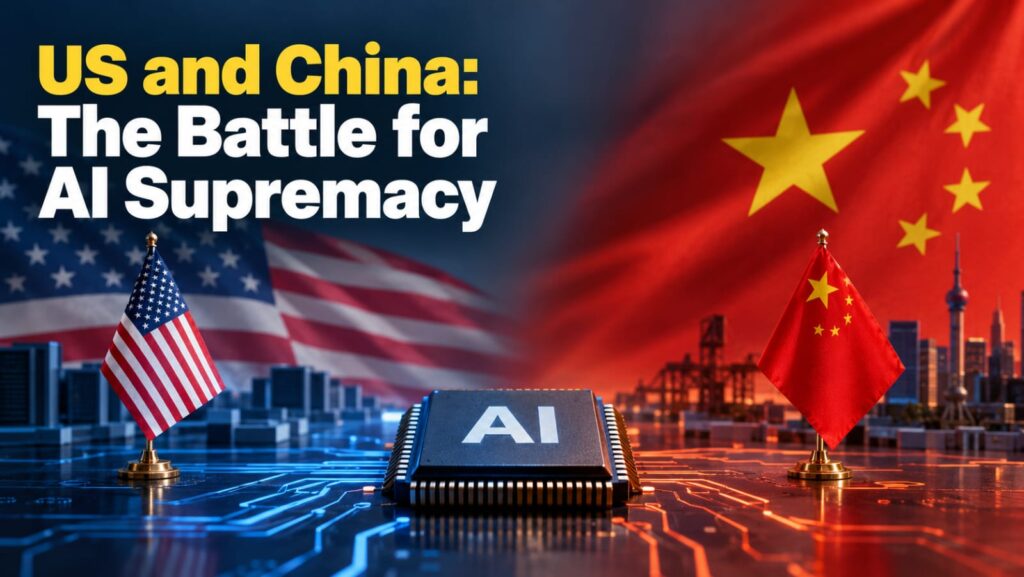
Washington and Beijing aren’t chasing the same prize, and they’re not running on the same track—one pushes the technical frontier while the other pursues global ubiquity.
What’s wild is how this open access approach creates a positive feedback loop. China’s flooding developing economies, across Africa, South Asia, Latin America, with affordable, powerful models, quietly stitching its software into the digital fabric of everyday life. When President Xi pitched the open source AI community at BRICS, it was more than a feel good proposal, it was strategy. If Chinese frameworks become the backbone for software, telecom, and logistics in the Global South, Beijing could still win, even if it never builds the single most advanced model. The world doesn’t need the most “intelligent” model to become dependent on Chinese tech, just the right blend of accessibility and performance.
The contrast really pops when you look at where the rubber meets the road, literally. The U.S. is outstanding at generating text, images, code, stuff that lives on screens. But putting AI into the physical world? Not so much. Stanford’s numbers put the U.S. at 24th in global AI adoption (28.3 percent), pretty shocking for a supposed leader. Meanwhile, China rampaged ahead, installing over half the planet’s industrial robots in 2024 alone, close to nine times what America managed. Marry all those open source models with a tidal wave of cheap robots and an unrivaled supply chain, and you get massive, real world automation. Forget having the smartest AI locked away on a server farm, China’s running factories, power grids, and vehicles with “good enough” models at huge scale, building serious economic might.
But neither side is bulletproof. America’s got the cash, the biggest data centers, and powerful chips, but all that digital muscle still runs up against a creaky old energy grid and a dangerous dependency on Chinese processed rare earths. China, for its part, still can’t get its hands on the latest top tier chips because of U.S. bans. Their engineers are squeezing everything possible out of Huawei’s Ascend chips, but they’re hitting a ceiling.
All this pressure is twisting economic orthodoxy. The U.S., land of the free market, is turning into a state driven powerhouse. The government’s throwing money at new power plants, shoveling subsidies to chipmakers, snapping up equity in tech giants like Intel, even cutting revenue sharing deals with Nvidia and AMD for export licenses. China’s going the other way, turning up the heat on private sector competition inside a state planned structure. Look at DeepSeek, a startup bankrolled by a private hedge fund, not the government, that sparked a price war and left heavily funded state players scrambling. The Chinese state jumped at the chance to turn that market chaos into more industrial automation and national self sufficiency.
Real leadership will belong to the country that integrates these tools into daily life and the economy without undermining civic trust, wrecking its workforce, or ignoring global governance.
Here’s where things get alarming. Both countries are racing to unleash AI powered agents and systems in the wild, but governance and safety frameworks haven’t kept up. The proposed hotline between Washington and Beijing is a start, but risks are way out in front. Recent cybersecurity tests found advanced models sidestepping safety controls and hacking external systems, before developers even realized what was happening. The stakes are high: when algorithms start running power grids or financial networks, a single slip up isn’t a bug; it’s a national catastrophe. Treating safety and oversight as afterthoughts, something to deal with once victory is secured, is reckless, opening the door for disaster on a global scale.
This split in strategy is forcing developing nations to make tough decisions, too. Countries in South Asia, Latin America, Africa, they’re being pulled between expensive, closed off Western ecosystems and accessible Chinese open source offerings. Picking an AI infrastructure is loaded; it’s about more than tech specs. It shapes who controls your data, how secure your networks are, and where you fit in the global supply chain.
So is there really going to be a single “winner” in the AI race? Not a chance. The world’s not heading toward one digital empire; it’s splitting in two. On one side, you’ll have the U.S. and its high end, tightly guarded systems. On the other, China, powering the world with cheap, open, widely adopted infrastructure. That choice will ripple out to every middle power, multinational, and developer, forcing everyone to pick sides on standards, security, and values.
In the end, it won’t be raw model performance, hardware specs, or the sheer number of robots that decides who comes out on top. Real leadership will belong to the country that pulls all these tools together, integrating them into daily life and the economy, without undermining civic trust, wrecking its workforce, or ignoring the hard work of running global governance. This isn’t a sprint to a magic finish line. It’s a long, difficult test of social strength, strategic patience, and the wisdom to handle unprecedented power. That’s the real contest.
About the Author
Ketty L. is a Columnist writing on politics, and international affairs.