
By Daniel Frost
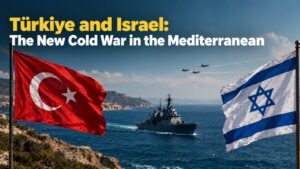
The head to head standoff between Ankara and Tel Aviv at the 81st United Nations General Assembly was more than just another diplomatic spat, it was a turning point that exposed just how deep and lasting the divisions in Eastern Mediterranean security have become. For years, Turkey and Israel kept things practical, even friendly when it came to business and defense. They traded with each other, swapped intelligence, worked together on military projects, and used quiet diplomatic channels to handle disagreements. It wasn’t perfect, but it worked. Both sides learned to set aside their ideological differences and occasional flare ups in the interest of stability and profit.
Now, that entire framework has unraveled. Under President Erdoğan, Turkey isn’t just keeping its distance from Israel; it’s actively pushing to cut Israel off from global diplomatic circles. What started as a rivalry on paper has now morphed into a real struggle over regional influence. Turkey wants to shape and stabilize the region on its own terms, while Israel’s expanding military footprint makes it clear it has no plans to step back. This isn’t just talk anymore, it’s a fight that’s changing how the entire West Asian and Mediterranean security order works.
Things came to a head with the Israeli military’s interception of the Global Sumud Flotilla in international waters. That single event snapped whatever was left of their official ties. The controversy didn’t just play out in the international press; it triggered a full blown legal war. Statecraft gave way to courts and arrest warrants. Turkey’s Justice Minister, Akın Gürlek, led the charge, pushing for legal action against top Israeli leaders and even asking Interpol for red notices on serious charges: genocide, piracy, and crimes against humanity. That move changed the game. Dozens of Israeli officials and commanders ended up in the crosshairs. With these legal cases pending, the old system of backchannel diplomacy is effectively dead, neither side can talk to the other the way they used to.
With financial warfare and legal battles running parallel, lawfare, economic decoupling, and direct military moves have replaced the old backchannel diplomacy.
The rift only widened once Ankara decided to decouple economically from Israel. This wasn’t a bluff. Turkey shut down a trade relationship worth billions, closed its airspace to Israeli aircraft, and made sure no official or military flights could pass through. All those contingency plans and loopholes that once let the countries do business, even when politics soured, are gone. Israel shot back with lawsuits in international arbitration courts, demanding massive compensation for canceled deals, blocked maritime lanes, and outright trade embargoes. Now, with legal battles and financial warfare running parallel, neither side has any space to de escalate.
But the conflict isn’t just about lawsuits and canceled flights. It’s moved onto the battlefield, with both sides squaring off in other hotspots. In Syria, for instance, Israel carries out airstrikes near Turkish controlled zones, sending a not so subtle message that Ankara shouldn’t expand its footprint further south. Turkey, for its part, keeps building influence in northern Syria, taking over supply routes and local administration. It’s obvious Tel Aviv sees these moves as a direct risk to its own operational freedom. The two militaries are now locked in a real competition, each pressing up against the other’s interests along the border.
Israel is also working hard to box Turkey out on the global stage. In NATO and the U.S. Congress, Israeli officials consistently lobby against Turkey’s access to cutting edge fighter jets and advanced defense technologies. They’ve made it clear: Turkey’s push for self sufficient arms production, especially with drones, rings alarm bells in Tel Aviv. The worry is, Turkey could soon challenge Israel’s traditional air superiority over the Eastern Mediterranean and Levant. Israel is even more inflexible when it comes to post war peacekeeping in Gaza or southern Lebanon, blocking Turkish involvement at every turn. To Israel, Turkish participation isn’t about bringing peace; it’s viewed as a new source of instability and a direct threat.
Israel is no longer treating Ankara as a complicated partner, but as a rival that needs to be checked and contained.
To push back against Turkey, Israel has tightened its alliances, especially with Greece and the Greek Cypriot Administration. Together, they’ve built a close knit security triangle, sharing intelligence, energy resources, and military capacity. The “Achilles Shield” deal, worth billions, anchors this setup, lining Greek islands and Cyprus with Israel’s top missile defense and radar technology. On top of that, they run regular joint naval exercises and set up live intelligence exchanges, keeping an eye on Turkey’s every move. Israel is no longer pretending Ankara is a complicated partner. It’s treating Turkey as a rival, one that needs to be checked and contained.
All this spells the end for middle power give and take in the region. Now, it’s about picking sides and digging in. The old safety nets, mutual business interests, intelligence sharing, trade corridors, and Western backstops, just aren’t there anymore. Instead, lawfare, economic warfare, and direct military moves dominate. Where Turkey and Israel once managed their differences quietly, now those differences drive everything. The region has hardened into something resembling a new cold war, each side wary, each side arming, and nobody willing to blink first. In this new reality, ongoing rivalry and confrontation aren’t brief interruptions; they’re the new baseline for how security, alliances, and politics will work in the Eastern Mediterranean and West Asia for years to come.
About the Author
Daniel Frost is a Foreign affairs columnist specializing in global geopolitics, European security, and strategic policy.