
By Ketty L.
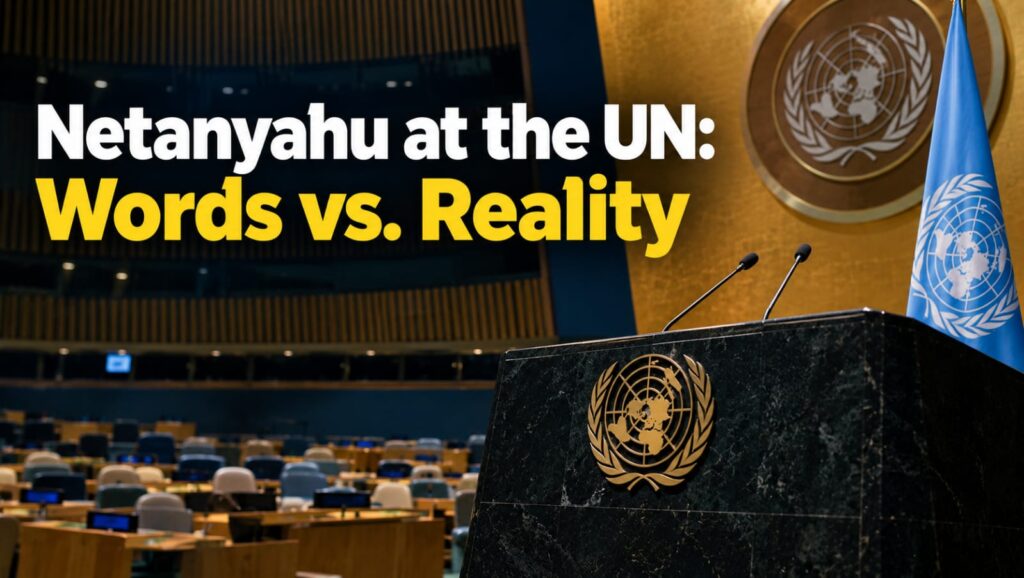
When world leaders step up to the United Nations General Assembly podium, you can almost feel the tension, it’s not just a speech; it’s like arguing your case in front of the entire planet. This is where government talking points crash up against sharp, international scrutiny. For years now, Israeli Prime Minister Benjamin Netanyahu has stood in the UN spotlight, using his time to defend his government’s military campaign in Gaza and the growing security presence across the West Bank. But strip away the official language, and you see something else taking shape: a widening gap between what leaders say and what’s really happening on the ground. It’s not just public relations, when statements from the podium fly in the face of reports from international courts, UN watchdogs, humanitarian organizations, and even leaked intelligence, you’re looking at a serious problem. It’s about global accountability, or maybe the lack of it, right out in the open.
Look at the way Netanyahu pushes back against accusations of genocide. He didn’t hedge his words, he called those allegations ‘the greatest lie of the century’ right to the faces of world leaders. To prove his point, he rattled off examples: evacuation warnings to civilians, polio vaccination campaigns, and food convoys entering Gaza. In his telling, these are proof of Israel’s good intentions. But legal experts and international investigators have a completely different take. The UN’s Independent International Commission of Inquiry found solid reasons to believe Israeli authorities and forces have committed acts that fit the legal definition of genocide. The International Court of Justice didn’t just share concerns, it issued binding orders, telling Israel to stop genocidal acts and actually enable meaningful humanitarian aid. The thing is, by spelling out all the ways Israel controls aid and civilian survival, Netanyahu’s defense actually highlights a key reality: Israel decides nearly every aspect of life or death for millions stuck inside Gaza. A few shipments of supplies filtering in, while electricity, water, and basic services collapse under missiles, doesn’t wash away legal or moral questions. It just makes them more glaring.
And then there’s his talk about military precision. Netanyahu told the world that Israel has been more careful than any modern army to avoid killing civilians, arguing that their ratio of civilians to combatant deaths is supposedly less than two to one. Yet documents from inside the Israeli military paint a totally different picture. Investigative outlets like The Guardian, +972 Magazine, and Local Call got their hands on a classified database from Israeli intelligence. Their findings were stark: about 8,900 named Palestinian fighters killed or presumed dead, while overall Palestinian deaths by mid-2025 hit over 53,000. That’s eighty-three percent civilians, one of the highest rates ever seen in a modern urban war. And right now, Gaza’s Ministry of Health reports more than 73,000 Palestinians dead and 175,000 injured. The idea that this is what restrained military action looks like simply can’t hold up against those numbers.
A few shipments of supplies filtering in, while electricity, water, and basic services collapse under missiles, doesn’t wash away legal or moral questions.
On humanitarian aid, the story isn’t much different. Netanyahu claimed that Hamas seizes most of the relief that enters, insisting Israel has let in two million tons of food, supposedly about a ton for every Palestinian in Gaza. But the numbers just don’t add up. An internal US Agency for International Development review combed through 156 documented cases of aid theft or loss and didn’t find any real evidence that Hamas is systematically hijacking relief. Even senior Israeli military officials, off the record, said distribution mostly works, despite brutal wartime conditions. Still, letting aid into Gaza doesn’t mean it actually gets to the people who need it. Ground realities, destroyed roads, airstrikes on supply centers, closed borders, cripple distribution. At multiple points, Israel blocked all humanitarian deliveries for weeks at a time. The UN’s food security monitors say that famine levels hit northern Gaza, with 1.4 million people facing catastrophic hunger. Touting millions of tons of food delivered just rings hollow if so many go without a single meal.
Then there’s the West Bank, Netanyahu’s speeches barely touch on what’s really happening there. He brushes off Israeli settler violence as the work of about 150 ‘juvenile delinquents,’ claiming little harm was done. The facts show something much worse. UN humanitarian officials counted over 1,330 separate settler attacks in a single year, with Palestinians hurt or their property destroyed nearly every day. On top of that, military checkpoints and movement restrictions have forced people out of their homes across 121 Palestinian communities. Calling this ‘juvenile delinquency’ barely scratches the surface; it erases a pattern of state-backed displacement and violence holding entire communities hostage. Downplaying those acts doesn’t just paint the wrong picture, it helps shield the perpetrators, and leaves the victims completely exposed.
This growing chasm between what leaders say at global summits and what’s actually happening isn’t just a PR problem, it corrodes the trust the world needs to solve big crises together. The whole point of the UN General Assembly is to share real information and build policies grounded in law and reality. When speeches get packed with cherry-picked numbers or outright denials, they stall peace efforts and chip away at international order itself.
Without honesty, diplomacy becomes little more than theater. As long as leaders keep dodging the truth, there’s no room for lasting peace, just more empty words.
Real oversight is more than a formality, it’s how the world holds powerful people accountable. Official stories that fall apart the second you check them against the facts force everyone to make a choice. Are we just going to nod along with talking points, or demand evidence and stick to the law? Without honesty, diplomacy becomes little more than theater. As long as leaders keep dodging the truth, there’s no room for lasting peace, just more empty words.
About the Author
Ketty L. is a Columnist writing on politics, and international affairs.