
By Ketty L.
The fundamental rule of modern American political warfare states that all foreign conflicts eventually transform into domestic economic grievances. As the 2026 midterm elections approach, the theoretical barrier separating foreign policy from home economics has dissolved entirely. A distant campaign in the Persian Gulf under Operation Epic Fury has evolved into a tangible strain on American households, turning a strategic engagement into a central legislative argument across the nation.
The financial ledger of military engagement is notoriously difficult to calculate in real time, yet institutional estimates provide a stark baseline. A nonpartisan assessment from the Congressional Budget Office estimates that direct operations against Iran consumed roughly $38 billion through August 1. That baseline excludes standard baseline payrolls and administrative overhead, focusing strictly on combat consumption, increased flight hours, lost equipment, and accelerated fuel usage. With low-intensity operations adding an estimated $2 billion monthly and higher-intensity surges requiring $3 billion or more, the Treasury faces an ongoing, relentless financial drain that complicates long-term federal spending projections.
Yet financial accounting captures only a fraction of the structural burden being borne by the nation’s defense apparatus. The continuous deployment of complex defense systems has severely depleted key national reserves, creating long-term strategic vulnerabilities. Advanced interceptors, including Patriot, THAAD, Standard Missile-3, and Standard Missile-6 variants, account for over $13 billion of the expended munitions bill alone. With CBO estimating that up to two-thirds of specific missile-defense inventories have been consumed, restoring strategic stockpiles will take half a decade. Rebuilding these complex, highly specialized stockpiles cannot be accomplished overnight, creating a lingering capacity deficit that persists well beyond the immediate theater of conflict. Paying to reorder advanced munitions does not instantly place them back into active silos, leaving defense planners with acute operational choices.
With CBO estimating that up to two-thirds of specific missile-defense inventories have been consumed, restoring strategic stockpiles will take half a decade.
For ordinary citizens, however, abstract defense inventories matter far less than immediate operational costs at home. Foreign military operations intersect with daily life primarily through global energy networks and consumer price indices. Maritime friction in the Strait of Hormuz, the vital maritime artery through which roughly a fifth of global petroleum flows, combined with shipping diversions across the Red Sea and regional refining disruptions, has pushed international energy benchmarks sharply upward. These supply shocks ripple through consumer supply chains long before military operations conclude, impacting everything from manufacturing to routine household budgeting.
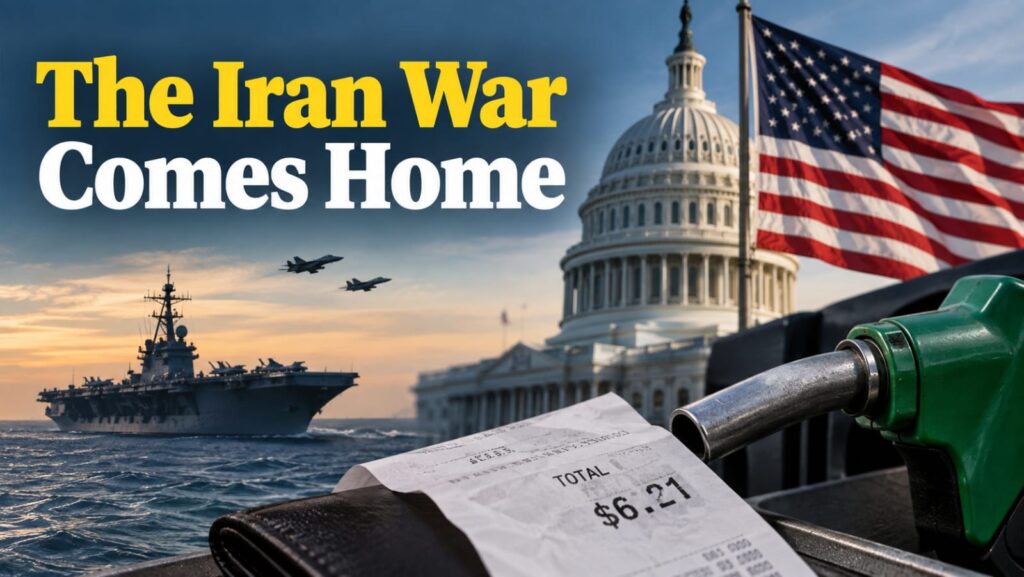
Commercial transportation provides a clear demonstration of this transmission mechanism from foreign waters to American main streets. When diesel prices climb past $6.00 a gallon during peak harvest periods, the pressure falls directly on agricultural producers, industrial distributors, and nationwide logistics networks. Elevated fuel costs dramatically increase the expense of harvesting crops, running heavy farm equipment, and moving freight to regional distribution hubs. Because commercial freight contracts adjust over extended cycles, these input costs migrate slowly but steadily into retail supply chains. CBO forecasts that this persistent pressure will push the Personal Consumption Expenditures price index up by roughly 0.5 percentage points in early 2027, stretching the inflationary tail of the conflict well into subsequent quarters and eroding wage growth.
This dynamic creates a profound political challenge for the administration and its allies on Capitol Hill. Central banks and economic planners often separate core price indices from volatile energy markets, but working households make no such technical distinction when paying for groceries and utilities. When energy costs drive up baseline logistics, the cost of living becomes an overarching political issue that overshadows administrative policy achievements in other areas.
Legislative debates over the federal debt ceiling and domestic discretionary programs are now inextricably linked to the monthly operational burn rate in the Gulf.
Congress finds itself caught between constitutional oversight and electoral self-preservation. The legislative record already reflects this institutional tension as representatives face mounting pressure from vocal constituencies. The recent 220-204 House vote on a war powers resolution directing the removal of unapproved forces from active hostilities highlights a widening divide over executive authority and open-ended military deployments. While a single House resolution does not instantly alter military deployments or recall troops, it creates an unambiguous public record. Lawmakers heading into tight reelection campaigns must now defend both the broader strategic rationale of the overseas conflict and its localized economic side effects.
The institutional framework of the United States ensures that these economic and strategic pressures converge directly on Capitol Hill. Members of Congress hold the constitutional power of the purse and the responsibility of statutory oversight over the executive branch. They must evaluate massive emergency defense requests, including the administration’s $87.6 billion supplemental funding request, while their constituents simultaneously absorb higher prices for basic commodities and transport.
This intersection of budget appropriations and voter sentiment forces lawmakers to confront the stark trade-offs of modern power projection. Demands for domestic fiscal restraint clash directly with the immediate cash requirements of sustaining naval task forces, conducting regular flight sorties, and procuring replacement hardware. Legislative debates over the federal debt ceiling and domestic discretionary programs are now inextricably linked to the monthly operational burn rate in the Gulf, forcing members to publicly weigh foreign strategic commitments against domestic investment priorities.
Furthermore, domestic defense manufacturers face structural bottlenecks that prevent rapid replenishment of depleted arsenals. Industrial supply chains, long tuned to lean production models, cannot instantly expand output to meet emergency orders for complex missile components, microelectronics, and specialized propellants. This manufacturing lag means that even if Congress grants the full $87.6 billion supplemental request, defense readiness will remain compromised for years, leaving the military with constrained flexibility to respond to other potential global crises.
Voters going to the polls will not be casting a simple binary ballot on foreign policy or diplomatic doctrine. They will be balancing complex, competing priorities ranging from taxation and border security to local economic health and personal job security. Yet the persistent background noise of foreign conflict, measured in depleted defense reserves, expanding federal outlays, and stubborn transportation costs, guarantees that overseas commitments remain a defining element of the domestic landscape. The incoming Congress will not simply debate the abstract merits of international strategy; it will inherit the substantial fiscal, material, and political bill for a war that ultimately came home to the American economy.
About the Author
Ketty L. is a Columnist writing on politics, and international affairs.