
By Adam Reed
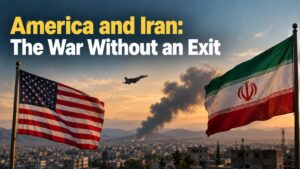
Six months into America’s second war with Iran, Washington’s stuck, caught in the same old strategic mess. The U.S. and its allies have unleashed overwhelming firepower, tearing up huge parts of the Middle East. But even with all that destruction, political victory is nowhere in sight. The White House keeps trying to play down the fighting, calling it “small potatoes,” but the facts on the ground tell a different story. The war’s price, financially, politically, and in human lives, just keeps rising, proving that military might by itself doesn’t force your opponent to surrender.
Let’s talk numbers. The campaign’s brutality is hard to argue with. By June, Iran’s Ministry of Health said 3,468 people had died and over 26,500 more were wounded. The damage goes way beyond casualties. The Iranian Red Crescent counted more than 125,000 civilian buildings damaged in the relentless waves of airstrikes, a hundred thousand homes among them. They recorded hits on 134 historic and cultural sites. And it gets uglier: a school bombing in Minab in February, a wedding targeted in September. Civilian life in Iran just keeps getting shattered.
Iran isn’t fighting to defeat the U.S. in an open battle. Its playbook is simple: survive, keep enough weapons to hurt the coalition, and make the war so painful and expensive that no one wants to stick around.
But busting up infrastructure and hardware isn’t the same as ending a war. Even after losing top leaders and watching its nuclear, missile, and naval bases take repeated hits, Iran’s government hasn’t collapsed. Washington seems to be making the same old mistake, confusing devastation with victory. Iran isn’t fighting to defeat the U.S. in an open battle. Its playbook is simple: survive, keep enough weapons to hurt the coalition, and make the war so painful and expensive that no one wants to stick around. That’s what winning looks like for Tehran.
And Iran’s been surprisingly effective at holding on. Its forces struck back at 15 U.S. bases scattered around the region, hitting fuel depots, command centers, radars, and air defenses. Central Command tried to downplay the extent of the damage, but when missiles and drones rain down day after day, the weakness of fixed American positions becomes obvious. The war has turned the Strait of Hormuz into a pressure point for global energy supply, sending shipping costs and oil prices climbing and making the Pentagon scramble to keep up.
Why hasn’t the campaign worked? U.S. planners fell into a familiar trap: underestimating their adversary. Harrison Mann, a campaign director at Win Without War and a former Army intel officer, pointed out that officials convinced themselves they could quickly neutralize Iran’s military, only to discover that wasn’t the case. Coalition pilots couldn’t knock out the bulk of Iran’s drones and mobile missiles. They couldn’t get air supremacy, either; Iran’s air defenses, while not cutting edge, kept a real bite. Fighting on Iranian home turf means America can’t shield its own people from the bloody, expensive price tags of war anymore.
People back home are feeling it. Eighteen American troops are already dead, over 750 wounded. The direct bill for taxpayers? $37.5 billion and counting, and that’s just for what’s easy to see. Fuel prices, everyday inflation, everything’s on the rise, and voters are getting fed up. It’s becoming a top issue as the country barrels toward midterm elections.
For the first time in 65 years, Congress might not even pass a defense budget at all—a sign of deep strategic dysfunction and growing constitutional pushback.
This backlash is hitting Capitol Hill at full force. The administration’s eye popping $1.5 trillion defense spending request has lawmakers balking, especially with $1.15 trillion set aside for day to day defense costs. The House managed to squeak through its piece of the annual defense bill, but the usual Washington consensus is cracking. Dylan Williams from the Center for International Policy calls it unprecedented resistance. For the first time in 65 years, Congress might not even pass a defense budget at all, a sign of deep dysfunction. More and more lawmakers are realizing their power over the purse strings, as Article I of the Constitution puts it. If Congress wants to stop this war, it can just say no to more funding.
It’s not just Washington that’s paralyzed. The whole region is shifting. In Yemen, the Houthis, supported by Iran, launched a sweeping offensive and seized the Red Sea coast by the Bab al-Mandeb strait. Within weeks, they targeted Saudi Arabia with missile strikes, attacking oil infrastructure and threatening energy supply lines. The Saudi backed government called for more U.S. help, but this time, Washington said no, caught by shrinking budgets and running low on munitions. Instead, the administration started talking with Houthi leaders, hoping for some side assurance rather than defending long standing allies. That move has shaken America’s security commitments throughout the Gulf.
Diplomacy isn’t offering much shelter, either. The White House keeps refusing to engage, even as Iran signals that it’s open to talks, but only if its main demands are considered. For Tehran, this war is existential. They’re willing to suffer massive damage if it means holding out for something better. Their leaders, like Parliament Speaker Mohammad Bagher Ghalibaf, laid out those terms: stop the fighting everywhere, end the oil blockade, and release frozen assets. Iran hasn’t shut the door, using channels in Qatar and Pakistan to show they’d negotiate if Washington takes them seriously.
Smart bombs turn buildings to rubble but never deliver peace. When you keep fighting with no definition of what ‘victory’ even looks like, you just add to a string of expensive, blood-soaked failures.
By pushing for military dominance and ignoring chances to talk, the administration’s just digging in. Smart bombs turn buildings to rubble but never deliver peace. When you keep fighting with no definition of what “victory” even looks like, you just add to a string of expensive, blood soaked failures in the Gulf. At this point, it’s clear, throwing more money and firepower at Iran won’t get the U.S. what it wants. The real problem isn’t on the battlefield, and force alone won’t solve it.
About the Author
Adam Reed is an International affairs analyst focusing on geopolitics, defense strategy, and global security trends.