
By Adam Reed
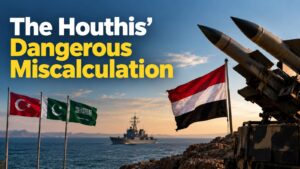
The Houthis, officially known as Yemen’s Ansar Allah movement, have tossed a bold new challenge into the Middle East’s already volatile mix. Senior Houthi leader Mohammed al Bukhaiti didn’t mince words when he threatened a “decisive and painful response” against Türkiye and Pakistan if they backed Saudi Arabia militarily. This isn’t just talk; it’s a signal that the Houthis want to expand their influence far beyond Yemen or the Red Sea. They’re out here promising to “strike them with an iron fist,” as if warning two heavyweight states they shouldn’t even think about getting involved. Still, if you look past the tough talk and measure real power, the Houthis’ threats feel like classic overreach. It’s a reminder that sometimes groups try to pump up bravado, hoping it alone will carry the day.
What’s really fueling this escalation? It goes deeper than fiery speeches. Saudi Arabia, Pakistan, and Türkiye recently formalized their security alliance through the Makkah Joint Defence Agreement. That’s a big deal in the region, three influential countries making it official that they’ll watch each other’s backs. When the Houthis ramped up their missile and drone attacks, hitting Saudi cities and infrastructure again, Turkish foreign minister Hakan Fidan voiced full support for Riyadh. Türkiye and Pakistan made it clear: any threat to Saudi Arabia, and especially its holy cities, is going to get their attention. The Houthis are worried that this new alliance could soon shift from diplomatic words to real action, so they’re trying to scare Ankara and Islamabad before things get serious.
Saudi Arabia, Pakistan, and Türkiye recently formalized their security alliance through the Makkah Joint Defence Agreement, signaling a major strategic shift in the region.
But here is the thing: by threatening direct military action against Pakistan and Türkiye, the Houthis ignore some brutal facts. Both countries have real muscle. Türkiye fields NATO’s second largest military, with cutting edge drones, guided weapons, electronic warfare, and naval reach from the Mediterranean to the Red Sea. Pakistan brings its own formidable force, an army of over 600,000, solid air defenses, years of experience in Gulf conflicts, and, let’s not forget, nuclear weapons. Meanwhile, the Houthis operate mostly out of northern Yemen. They control a stretch of land, sure, but they are up against two established military juggernauts. Claiming they’ll mete out discipline to Ankara and Islamabad isn’t just a leap; it’s a headscratcher.
All that said, you can’t completely discount the Houthis’ ability to cause trouble. Set up near the Bab al Mandeb Strait, a vital shipping route, they’ve already shown they can disrupt shipping, deploy sea drones, and fire anti ship missiles. Past attacks on commercial vessels have killed civilians, including foreigners. Their Iranian designed, cheap drones turn million dollar defense systems into targets, costing big powers serious money for every intercept.
Still, making life difficult for shipping is one thing. Taking on state militaries, especially ones with sophisticated air defense, satellites, intelligence networks, and the capacity for rapid strikes, is another. If the Houthis push too far, targeting Turkish or Pakistani flagged ships or personnel, the response won’t be limited to defensive maneuvers. Ankara and Islamabad could launch sweeping counterattacks aimed at command centers, launch pads, and supply chains, stuff the Houthis haven’t really faced before from a united coalition.
Threatening big militaries crosses the line from smart deterrence to reckless overreach, risking responses that dwarf anything faced so far.
There’s a bigger danger here for the Houthis, by threatening major states, they risk triggering exactly the kind of response they are trying to avoid. Historically, both Türkiye and Pakistan have played their cards carefully in the region. Pakistan balances ties with Iran and Saudi Arabia, avoiding getting dragged into prolonged conflicts. Türkiye focuses on its immediate neighborhood, steering clear of messy entanglements in Yemen. But public threats could change the game, transforming limited defense help into full blown military action. Intimidation rarely breeds caution; it usually strengthens resolve and speeds up preparations.
Let’s not overlook the broader politics. The Houthis lean on support from Iran, but Tehran tries to keep things balanced with both Türkiye and Pakistan. Iran shares a long border with Pakistan and has complex trading dynamics with Ankara, the last thing it needs is two neighbors embroiled in a new war in Yemen or the Gulf of Aden. If the Houthis start jeopardizing Turkish or Pakistani interests, you can bet Tehran will step in, preferring quiet restraint over chaotic escalation.
Inside Yemen, fiery Houthi rhetoric serves another purpose, it rallies locals, recruits fighters, and distracts from economic hardship and governance troubles. Painting their fight as a struggle against big foreign powers helps the Houthis look strong. But when propaganda shifts into foreign policy, the risk of crossing lines grows. If the Houthis misread political noise in Ankara and Islamabad as weakness, they might trigger responses that dwarf anything they’ve faced so far.
In the end, real diplomacy is about knowing your strengths, and your limits. Asymmetric tactics give the Houthis some leverage, especially in maritime choke points. But threatening big militaries crosses the line from smart deterrence to reckless overreach. Sustainable security in the region depends on alliances, rebuilding efforts, and dialogue, not endless escalation. By issuing sweeping ultimatums to Ankara and Islamabad, the Houthi movement is not projecting genuine strength, but rather misinterpreting the structural balance of power in the region. Recognizing the realities of one’s weight class remains a fundamental prerequisite for long-term survival in complex geopolitics, and stepping beyond those boundaries risks inviting a level of collective containment that no non-state actor is built to absorb.
About the Author
Adam Reed is an International affairs analyst focusing on geopolitics, defense strategy, and global security trends.