
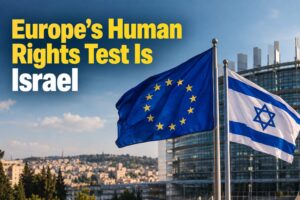
By Daniel Frost
It’s hard to recall a time when the difference between Europe’s ideals and its real actions looked quite so stark. For decades, Brussels has framed its relationship with Israel as built on international law and human rights. EU policy documents almost ritualistically point to the 1980 Venice Declaration, which supported Palestinian self-determination and called Israeli settlements illegal. On paper, the principles seem ironclad. In practice, though, Europe’s leaders have shown a real reluctance to follow through, even on their own rules. It’s a lot more comfortable, politically speaking, to announce sanctions against a few celebrated extremist settlers than to harness the EU’s real leverage over Israel itself. This approach lets European officials sleep more easily at night, while systematic violations go on without interruption.
The legal grounds for action aren’t up for debate; they’re written into agreements. Article 2 of the EU-Israel Association Agreement spells out that relations must rest on respect for human rights and democracy. These aren’t vague aspirations, they’re essential terms of the deal. Not long ago, member states like Spain and Ireland forced Brussels to review whether Israel was holding up its end of the agreement. The Commission’s own findings pointed to clear, ongoing breaches. Treaty law says that such findings should mean a review or even suspension of trade privileges, right away.
And trade isn’t some side issue here. The EU is Israel’s single biggest trading partner, buying over a quarter of Israel’s exported goods, a relationship worth tens of billions of euros a year. Israeli universities and companies also receive major funding through the Horizon Europe program, hundreds of millions of euros, for everything from tech to research. Europe isn’t powerless. It holds cards that matter.
Naming a notorious settler as a rights abuser lets governments claim they’re upholding EU values, without ever touching the economic engine that keeps everything running.
You’d never know it from the EU’s real-world response. Instead of using its economic strength, Brussels has opted for the line of least resistance. The EU imposed sanctions, sure, to a point. It blacklists a few violent individuals and marginal groups under its Global Human Rights Sanctions regime. These moves cost the EU almost nothing politically. They look good on press releases. Naming a notorious settler as a rights abuser lets governments claim they’re upholding EU values, without ever touching the economic engine that keeps everything running. It pretends the problem comes from a few bad apples, rather than a system that enables and sustains them.
That’s not just misleading, it’s convenient. Settlements don’t materialize alone in the desert. Government ministries fund security for illegal outposts, civil bureaucracies approve their plans, soldiers protect construction work. When Europe singles out just the settler, while ignoring the state structures propping them up, it’s separating the act from the machinery behind it.
In Brussels, defenders of the current approach point to the “burden of consensus”, the EU’s rule that foreign policy requires unanimous agreement. It’s true that countries like Hungary and the Czech Republic have blocked moves to restrict trade or toughen up policy. But focusing only on veto-wielders hides a deeper truth: there’s little appetite among heavyweights like Germany or France to do what the law, and their own rhetoric, would demand.
Germany still shapes its Israel policy around the trauma of its history. France wants to juggle domestic politics with its broader interests in West Asia. Neither is eager to risk even minor friction with Washington or Jerusalem, so they push for symbolic gestures and avoid anything substantive.
With Israel, European leaders go out of their way to keep trade and human rights separate, issuing statements but keeping all the economic doors open.
Contrast this with Europe’s reaction after Russia invaded Ukraine. European leaders moved with exceptional speed, reshaping energy policy, rolling out sanctions, breaking decade-old dependencies. In that crisis, trade and law were clearly linked. With Israel, they go out of their way to keep trade and human rights separate, issuing statements but keeping all the economic doors open.
That double standard isn’t lost on the rest of the world. Across the Global South, there’s growing skepticism when Europeans talk about a “rules-based order”. It’s easy for Brussels to enforce international law on rivals, much less so when close partners are involved. And so, European credibility takes a hit every time officials plead for agreement at global summits but refuse to act when their own rules should apply.
Some European countries, frustrated by the stalemate, are starting to act alone. Norway and Britain have looked at banning imports from illegal settlements. Ireland is pushing national legislation to criminalize trade with occupied territories. These moves show that, when there’s political will, national governments do have tools to act, even if the EU as a whole stays frozen.
Still, even these efforts don’t get to the heart of the matter. Goods from settlements make up only a tiny slice of overall Israel-EU trade. The big mechanisms, the sweeping Association Agreements and research funding, keep flowing as if nothing is wrong. Unilateral steps look bold, but they leave the main system untouched.
The real problem isn’t a shortage of legal instruments. Europe has those in abundance. What’s missing is the willingness to pay the diplomatic price that genuine accountability brings. Sanctioning a handful of settlers gives politicians an easy win at home, but changes nothing for people living with the consequences in the West Bank or Gaza.
Unless Brussels is ready to tie economic privileges to actual respect for human rights, its declarations won’t move anyone.
If the EU wants to reclaim any shred of moral leadership, it can’t keep papering over the gulf between its official language and its real-world choices. Article 2 isn’t meant to be window dressing. Unless Brussels is ready to tie economic privileges to actual respect for human rights, its declarations won’t move anyone. So here’s the question Europe faces: Does it want the comfort of smooth diplomatic ties, or the reality of standing up for the rules it claims to uphold? That answer, more than any statement, will define what kind of global actor Europe becomes.
About the Author
Daniel Frost is a Foreign affairs columnist specializing in global geopolitics, European security, and strategic policy.