
By Adam Reed
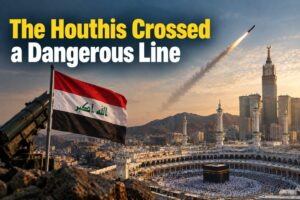
The blare of emergency sirens across western Saudi Arabia, reaching all the way to Taif and prompting rare air defense alerts in Makkah, signals something we haven’t seen before. The West Asian conflict, already fraught, just hit a turning point that’s difficult to ignore. Ansar Allah’s efforts to control the Bab el-Mandeb Strait have always made a grim kind of sense geopolitically. But to bring the fight to the doorstep of Islam’s holiest city? That crosses a line. This is more than a tactical move; it’s a reckless gamble that threatens to recast a largely regional proxy war as a clash laced with religious overtones. And that, in this part of the world, is a formula for disaster.
For years, the Houthi movement tried to justify their actions as acts of national and regional resistance, standing up, at least in their own eyes, for Yemen’s sovereignty and a broader axis allied against outside influence. But firing missiles and drones so close to the Hijaz throws that entire argument into the dust. To Muslims around the world, Makkah isn’t just another Saudi city; it’s sacred ground, a sanctuary that stands apart from the politics of who happens to govern it. Even the perception that its safety is in jeopardy, whether due to bad targeting or by design, alienates millions who may have sympathized with Yemen’s cause, but draw the line at threats to the holy sites. It’s a miscalculation that could cost the Houthis dearly and push previously neutral Muslims to side firmly against them.
To Muslims around the world, Makkah isn’t just another Saudi city; it’s sacred ground, a sanctuary that stands apart from the politics of who happens to govern it.
All this comes at a time when the United States and Israel are shifting their approach, trying to cut Iran off and unravel its network of proxy groups. If you’re sitting in Washington or Tel Aviv, a Houthi rocket campaign endangering Makkah is a diplomatic gift. Suddenly, efforts to build a broader coalition seem justified, even urgent. The crisis gives America and its partners an opening to extend their security umbrella, roping in countries far outside the usual Western defense circles.
Let’s be blunt: if the so-called “axis of resistance” wanted to scare off Western intervention or flex its long-range capabilities, threatening Makkah achieves the reverse. Instead of intimidating Washington, it unites rivals across the Islamic world into a single front. States that have tried to balance dialogue with Iran are now forced to rethink their choices, as no one wants to be seen as indifferent to possible attacks on such a revered site.
This is where the Mecca Joint Defence Agreement comes into play. Signed in 2026 by Saudi Arabia, Pakistan, and Turkey, the pact is the region’s attempt at collective defense, echoing international alliances like NATO in spirit, if not in scale. If the Houthis keep targeting the city that lends this alliance its name, they risk seeing that treaty kick in, possibly bringing major military and technological assets from these regional powers onto Saudi soil. The scope of the conflict could widen dramatically, setting the stage for a confrontation that no one can easily walk back.
Signed in 2026 by Saudi Arabia, Pakistan, and Turkey, the pact is the region’s attempt at collective defense, echoing international alliances like NATO in spirit, if not in scale.
The most troubling aspect here, though, is what this means for Iran. If Tehran is perceived as giving a green light, or even just tolerating, strikes that endanger Makkah or Taif, it stands to lose everything it’s tried to build. Faced with a coalition poised for a counteroffensive, Iran risks finding itself boxed in from all sides, with its military and political capital stretched painfully thin. Instead of anchoring itself as the region’s heavyweight, Iran could end up weakened, isolated, and dangerously exposed to American pressure.
Back in Yemen, the Houthis can boast about tactical wins, like grabbing the Hanish islands off the Red Sea coast. These “victories” are fleeting. Hung on the demographic realities of the south and west, where support for the Houthi movement is lukewarm at best, the idea of long-term control is frankly unsustainable. A missile campaign against Saudi Arabia, on top of trying to govern hostile terrain, is the sort of overreach that drains everything: a movement’s finances, its legitimacy, and the very fabric of Yemeni civil life. Yemen, already battered, edges ever closer to total exhaustion and economic ruin, with little to show for it.
So who stands to gain from the chaos? Strip away the slogans and battlefield dust, and the answer is painfully clear. Israel, whose security doctrine focuses on keeping rivals divided, benefits from a splintered region that can’t form a consistent military or diplomatic bloc. Should Iran be isolated, Yemen incapacitated, and the tier-one states of the Mecca Pact locked in a draining southern campaign, the regional balance tips even further in favor of Tel Aviv. With everyone else distracted, Israel gets a freer hand to shape Middle Eastern security on its own terms.
There’s a global dimension, too. Taking hostilities into the spiritual heartland doesn’t just upset the local balance, it shakes the pillars of global energy and trade security. Any closure of routes like Bab el-Mandeb, coupled with attacks near Saudi infrastructure, sends shockwaves through the markets. Suddenly, what some saw as a “Yemen problem” has morphed into a threat with worldwide implications, and outside powers just can’t pretend it doesn’t concern them anymore.
Let’s not forget the domestic front across the Arab and Muslim world. Public opinion, which is often skeptical of Western involvement, draws a hard line at threats to holy sanctuaries. Governments from North Africa to South Asia, already walking a tightrope in their own countries, will respond forcefully the moment people believe Makkah is at risk. Suddenly, their hands are untied, and launching robust military or intelligence operations against the Houthis becomes a political necessity, not just a strategic choice.
If Iran continues to hedge, it will only hasten the formation of a coalition against it, something its leaders have tried for years to avoid.
Tehran needs to wake up to what’s at stake. The Iranian leadership can’t stay ambiguous or silent while air raid sirens sound so close to the heart of Islam. The time for strategic ambiguity is over. If Iran doesn’t rein in the Houthis or speak clearly against attacks near the holy cities, it plays directly into the narrative that regional proxies are now unmoored, acting on reckless instincts, not strategy.
Where does all of this lead? Far beyond the immediate firefights in Yemen or the blockades in the Red Sea. We’re witnessing moves and countermoves that put the unity and security of the Islamic world’s holiest sites in the crosshairs. If Iran continues to hedge, it will only hasten the formation of a coalition against it, something its leaders have tried for years to avoid. Time is running out for clarity. For everyone involved, the stakes are rising fast, and the next decisions could shape the region for years to come.
About the Author
Adam Reed is an International affairs analyst focusing on geopolitics, defense strategy, and global security trends.