
By Ahan S. Prakash
The idea of a powerful, multipolar world order was on full display at the 18th BRICS Summit in New Delhi. On paper, it was supposed to mark a breakthrough, a moment when the Global South, long sidelined by the West, took center stage and spoke with one voice. India, as the host, grabbed the limelight, touting words like “inclusive governance” and “anti-hegemonic cooperation.” Yet, if you look closer, you find something different: a persistent disconnect between public promises and what really goes on behind the scenes. India’s foreign policy, for all its talk about multilateralism, justice, and human rights, keeps circling back to exclusion and power politics, sometimes subtly, sometimes with surprising boldness.
One of India’s core contradictions sits squarely in its domestic policies. Prime Minister Narendra Modi’s summit speech hit familiar notes: the Global South, he said, always occupies the front row during crises but gets shuffled to the back when decisions are made. It’s a line that resonates, especially with countries that have been left out for decades. But at home, reality tells a different story. India’s minorities, over 200 million Muslims, along with Dalits and Christians, navigate a daily landscape shaped by marginalization, restrictive citizenship laws, and economic obstacles that seem targeted and, often, state-sanctioned.
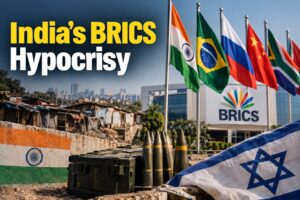
Nothing illustrated this divide quite like the summit’s preparations. In posh South Delhi, just days before the event, authorities set up enormous ten-foot screens to hide the Coolie Camp slum along Nelson Mandela Marg from the eyes of visiting dignitaries. Slum residents, people who keep the city functioning through their work, voiced frustration and anger. They wondered why, every time an international summit comes to town, their existence had to be erased. Instead of addressing poverty, officials went for window dressing; political optics won out over the dignity and rights of citizens. It’s a pattern: appearances matter more than tackling root issues.
Instead of addressing poverty, officials went for window dressing; political optics won out over the dignity and rights of citizens.
Even the summit hospitality reflected India’s top-down approach to national identity. Every official meal was totally vegetarian, a move presented as a marker of tradition and heritage. But surveys like the National Family Health Survey consistently show that most Indians, possibly as many as 70 percent, eat meat, fish, or eggs. So the choice wasn’t about tradition for the majority; it was the imposition of a minority’s preferences as the face of the nation. At a summit meant to showcase diversity and inclusion, the very opposite happened, with a curated, homogeneous narrative taking over.
On the international stage, India’s selective morality stands out most in its partnership with Israel. While the Indian government is happy to sign BRICS communiqués expressing worry for civilians in Gaza, its actions send a very different message. Amnesty International found that, between late 2023 and 2025, Indian firms sent over 2,500 military shipments to Israel. We’re talking about weapons and components, artillery shell casings, drone parts, small arms, that have been used directly in the Gaza conflict. In the same breath, India is championing the India-Middle East-Europe Economic Corridor (IMEC), a mega-project running right through zones devastated by war and violence. Government speeches in global forums celebrate ties with Israeli leaders but rarely mention Palestinian lives lost along the way. Claiming the moral high ground abroad and exporting arms to a state facing genocide investigations at the International Court of Justice, this isn’t diplomatic ambiguity. It’s complicity.
Claiming the moral high ground abroad while exporting arms to a state facing genocide investigations isn’t diplomatic ambiguity—it’s complicity.
In South Asia, India’s exclusionary instincts are clearest in its approach to Pakistan. BRICS was built around the idea of a shared, equal voice in setting a new world order. But when Pakistan formally applied to join, an application even Russia supported, India used procedural rules to block it. This means 240 million people in a strategically vital country remain outside the tent, stripping the group of any real claim to inclusivity. And it’s not just BRICS. India has gutted regional efforts at cooperation through platforms like SAARC by refusing to participate, forcing a shift toward groupings like BIMSTEC that notably leave Pakistan out. The same pattern repeats in the Shanghai Cooperation Organisation (SCO): India deploys its veto, blocks regional mediation, and solidifies divisions, while Pakistan, for all its faults, at least pushes for dialogue and connectivity.
This tendency to sideline others is so open, international guests no longer play along with Indian media’s narratives. During BRICS, for instance, Indian news outlets tried to frame foreign leaders as supporters of New Delhi’s anti-Pakistan stance. But those efforts fell flat. Malaysia’s Prime Minister Anwar Ibrahim set his own diplomatic course, going out of his way to meet India’s opposition leaders, Rahul Gandhi and Priyanka Gandhi Vadra. The message was clear: International diplomacy doesn’t revolve around the host’s domestic propaganda, and foreign dignitaries still respect democratic engagement, even if it runs counter to the ruling party’s script.
The future of the Global South will hinge on whether countries like India are willing to confront their own contradictions, and stop confusing regional hegemonic designs for real, legitimate global leadership.
What the summit ultimately revealed is that you can’t lead the Global South just by winning headlines, giving grand speeches, or hosting lavish state dinners. You lead by living up to the values you promote, at home and with your neighbors. When a government spends more effort hiding the poverty of its people than solving it, imposes narrow identities on a diverse country, sends arms to conflict zones while calling for peace, and blocks regional dialogue to maintain power, it forfeits any claim to moral leadership. The future of the Global South will hinge not just on external pressures but on whether countries like India are willing to confront their own contradictions, and stop confusing regional hegemonic designs for real, legitimate global leadership. History’s judgment will not be kind if those double standards persist.
About the Author
Ahan S. Prakash is a Geopolitical analyst and columnist covering South Asian affairs, strategic security, and international relations.