
By Daniel Frost
When the U.S. and Israel unleashed their military campaign against Iran, most foreign policy thinkers in Beijing and Moscow did not expect Tehran to hold it together. The opening strikes were brutal, precision airpower, high tech weapons, deep intelligence reach, leaving Iranian defenses in shambles. More than a few Western experts predicted a quick and decisive collapse of Iran’s military, with the regime not far behind. Instead, the conflict has dragged on, morphing into a grinding war of attrition neither side can easily end.
Yet, even as economic blockades bite, critical infrastructure smolders, and the military absorbs huge losses, Iran’s core leadership and strike capabilities have stayed intact. That resilience says something that military planners often overlook: destroying infrastructure and killing soldiers is not the same as forcing a government to surrender. Sure, the U.S. can deal enormous damage, but that alone does not let Washington rework political realities on the ground, especially in a region as complex as West Asia.
Destroying infrastructure and killing soldiers is not the same as forcing a government to surrender.
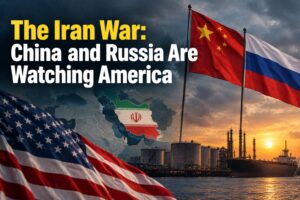
For China and Russia, this increasingly is not just a Middle Eastern crisis. It is a real time experiment showing just how much American military and economic power can actually get done. Beijing and Moscow both know if the U.S. manages to break Iran, one of the loudest anti Western voices, the message will not stop at Tehran. It will echo from the Mediterranean to the Pacific: American unipolarity gets another lease on life.
Because of that, the war has become a laboratory. In both capitals, officials and analysts watch every aspect of U.S. operations, and not just the strikes. They study supply chains, missile supplies, interception rates, in other words, what happens when U.S. forces face a determined, well armed opponent in a major, multi front combat scenario. They are asking: Where are the seams? How long before the Pentagon’s logistical brilliance hits a wall?
China’s interests are complicated here. The chaos is already shaking its economy and energy security. With the Strait of Hormuz in flux, China’s oil imports have taken a nosedive: August 2026 data shows seaborne crude down to 7.14 million barrels per day, a nearly 40% drop from before the shooting started. That hits independent Chinese refineries hard, especially those that banked on cheap Iranian crude, now suddenly much scarcer.
Seeing the Pentagon stretch its munitions stockpiles and squeeze industrial production drives home realities that cannot be captured in war games.
But Beijing’s bigger fear is an American victory that sets Iran back permanently. Iran is an important partner, plugging China into wider Eurasian trade and giving it a foothold that does not run through Western dominated routes. If Washington redraws the map, China’s options tighten, and the U.S. cements its primacy over a region that still matters for global energy and commerce.
So, Beijing is not sending troops, but it is hardly passive. Chinese buyers keep absorbing sanctioned Iranian crude, thumbing their noses at Washington’s pressure campaign and challenging how far secondary U.S. financial sanctions really reach. Technical equipment still trickles in, some with military applications, keeping Iran’s domestic defense production going. And at the UN, China’s diplomatic muscle blocks efforts to fully isolate Tehran. It is not guns on the ground, but it keeps Iran in the game, and teaches Beijing a lot in the process.
For Chinese strategists, watching the U.S. grind through another protracted war offers invaluable lessons, especially as tensions simmer over Taiwan. Seeing the Pentagon stretch its munitions stockpiles and squeeze industrial production drives home realities you just cannot capture in war games or modeling. It is a stress test, and every failure or delay gets filed away in Beijing for future reference.
Russia is playing a different game. With the West locked on Ukraine, Moscow sees Iran as a useful pressure point, drawing American attention, resources, and bandwidth away from Europe. The deeper the mess in West Asia, the more breathing room for Russian ambitions closer to home.
Out of this shared interest, Russian Iranian cooperation has only deepened. The partnership is not just rhetoric, either. According to investigative reporting, the two states have worked together on covert military programs, take the C430L project, launched in late 2023, where Russian experts helped Iranian engineers develop better propulsion for cruise missiles, including designs that threaten U.S. carrier groups. Add alternative financial networks to bypass SWIFT, and you have a tangible, multi layered effort to shield both regimes from future Western economic offensives.
What is happening here is not just a regional spat, it is global power politics. China and Russia’s joint vetoes on the UN Security Council, blocking Western moves around the Strait of Hormuz, signal a growing willingness to openly defy Washington, not just quietly undermine it. And yet, there is no formal alliance with Iran, no binding military guarantees. Instead, we see something looser, a patchwork of economic connections, tech transfers, and diplomatic blocking that raises the cost of U.S. unilateral actions without forcing Moscow or Beijing into an unwinnable shooting war.
The global system is moving away from straightforward U.S. dominance toward something a lot messier, harder to manage, and more resilient in the end.
Looking at Iran’s survival, you have to admit: there is a gap between America’s power to destroy and its power to shape outcomes. While Tehran absorbs the blows and keeps its regime intact, officials in Beijing and Moscow take notes, and the “new world order,” if there is one, looks less like the return of a U.S. led century, and more like a stubborn, evolving contest. Countries learning how to outlast, to adapt, and to sap the costs of American intervention. That is what is pulling the global system away from straightforward U.S. dominance, and toward something a lot messier, harder to manage, and, perhaps, more resilient in the end.
About the Author
Daniel Frost is a Foreign affairs columnist specializing in global geopolitics, European security, and strategic policy.