
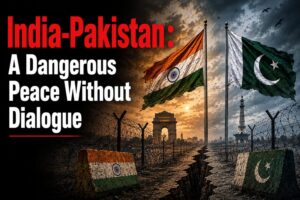
There’s an old saying that you can choose your friends, but you can’t choose your neighbors. India and Pakistan seem determined to test just how far that logic can be stretched. When one hundred and seventeen prominent activists and former officials from both countries recently sat down to write an open letter to Narendra Modi and Shehbaz Sharif, their plea was straightforward. Restart formal engagement. Both countries are facing massive economic strain, security crises, and environmental emergencies that genuinely need joint attention. But nobody actually expects that letter to change anything. The freeze in ties isn’t an accidental oversight or a temporary lag in diplomacy. It’s become a deliberate, rigid policy choice.
For years, critics have pointed out that even when New Delhi and Islamabad were talking, not much ever really shifted. The relationship has long felt inoculated against genuine friendship.
Since Narendra Modi took office in 2014, the tone has hardened into something entirely unprecedented, infusing Pakistan policy with an unyielding hostility that breaks completely from historical norms.
This modern posture is deeply tied to domestic political strategy. Populism thrives on grievance, fear, and constantly manufacturing an external enemy to point at. By blending legitimate national security concerns with old communal mistrust, political messaging in India has successfully hardened public opinion against its western neighbor over time. Refusing to talk actually serves a specific domestic purpose here. It maintains a permanent state of tension that keeps yielding political dividends, keeping the nationalist narrative energized and focused on a perpetual threat.
At the same time, this silence helps mask some uncomfortable regional truths. New Delhi has long tried projecting a picture of undisputed hegemony across South Asia, treating smaller neighbors as essentially subordinate states. But Pakistan has consistently refused to accept that subordinate status. When military flashpoints flare up, like the multi domain clashes during Operation Sindoor, they underscore a harsh reality, a smaller neighbor can’t simply be coerced into submission through force or diplomatic isolation alone. The complete absence of a diplomatic channel helps bury these complexities, letting leaders sustain an illusion of absolute regional command while avoiding the messy compromises real negotiation actually requires.
Beyond the bilateral friction, this silent treatment has severe practical consequences on the ground too. The Indus Waters Treaty is increasingly treated not as a technical pact meant to be managed cooperatively, but as a political pressure point instead. Water flows and environmental security get weaponized, while official platforms and global op eds get used to pin every regional breakdown entirely on Pakistani intransigence.
This institutionalized deadlock doesn’t exist in a vacuum either. It beats to the heavy drum of competitive global geopolitics. With the escalating rivalry between Washington and Beijing looming large over both countries, and shifting security alignments stretching from South Asia to the Middle East, the stakes are higher than ever.
A local conflict between two nuclear armed neighbors isn’t just a bilateral headache anymore—it’s a volatile node in a messy, fragmenting world order where the margin for error keeps getting thinner.
The structural gridlock defining the South Asian subcontinent remains one of the most entrenched diplomatic puzzles of the modern era. While bilateral channels stay severed, the real cost gets paid by millions of ordinary citizens on both sides of the border, denied the peace dividends of trade, cultural exchange, and collaborative resource management. Climate change doesn’t respect international boundaries, and shared ecological disasters like severe smog, erratic monsoons, and glacial melt threaten populations regardless of state lines. Yet despite these glaring planetary imperatives, political expedience keeps trumping common sense.
The domestic packaging of foreign policy in India has also evolved into an elaborate exercise in electoral mobilization. Every cross border skirmish or diplomatic snub gets meticulously broadcast to reinforce a narrative of strength and unyielding resolve. This leaves very little political oxygen left for moderation or compromise. Any leader who suggests talking or easing tensions risks getting branded weak or accused of appeasing the adversary. So the whole architecture of hostility becomes self sustaining, locking successive administrations into a posture that’s politically dangerous to retreat from.
On the Pakistani side, the internal political landscape presents its own complex set of challenges, ranging from persistent economic volatility to intense domestic polarization. Yet despite these internal distractions, successive civilian and military leaders have repeatedly signaled at least a theoretical willingness to engage in dialogue without preconditions, largely recognizing that perpetual friction drains precious resources that desperately need to go toward human development and economic stabilization instead. But these overtures frequently run into an immovable wall of Indian indifference, leaving Islamabad stuck in a perpetual loop of just reacting to New Delhi’s diplomatic cold shoulder.
The international community watches this ongoing standoff with growing unease. Western capitals, eager to court New Delhi as a strategic counterweight in the Indo Pacific, often turn a blind eye to the worsening bilateral freeze, treating the South Asian stalemate as a localized nuisance rather than a critical global flashpoint. But the presence of two nuclear arsenals hovering over the dispute means a minor miscalculation could trigger catastrophic regional escalation with real global consequences. Outsiders frequently issue routine calls for restraint, but deep engagement is largely missing, leaving the two neighbors to stew in their mutual grievances alone.
History teaches us that intractable conflicts eventually find resolution either through catastrophic exhaustion or through visionary statesmanship. Unfortunately, the current trajectory points toward the former rather than the latter.
Until leaders find the courage to look past short term populist gains, the region is going to stay trapped in a cycle where talking gets treated as weakness and silence gets mistaken for strength.
About the Author
Ahan S. Prakash is a Geopolitical analyst and columnist covering South Asian affairs, strategic security, and international relations.