
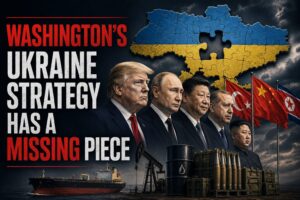
Washington is discovering the hard way that shuttle diplomacy can’t force an end to the war in Ukraine just by leaning on the immediate combatants. The emerging Witkoff Kushner framework relies on a familiar, bilateral playbook. It squeezes Kyiv by threatening cuts to vital military aid while waving economic sticks at Moscow. But this narrow approach misses the underlying architecture actually keeping the Russian war machine afloat.
Pressuring the Kremlin while ignoring its external lifelines is bound to fall short.
The core flaw here is that Russia isn’t fighting this war on domestic resources alone. Beijing acts as a massive economic anchor, purchasing roughly 1.8 million barrels of Russian oil daily at a steep discount. That arrangement funnels about thirty billion dollars a year into Moscow’s budget, completely cushioning the blow of Western sanctions. Meanwhile, North Korea supplies crucial ammunition and thousands of frontline troops. Until any peace strategy actually addresses these external pillars of support, Putin has every incentive to keep talking while maintaining his relentless military campaign underneath it.
Using tools like the Graham Act to threaten China with secondary tariffs creates necessary friction, sure, but pressure without an attractive diplomatic alternative goes nowhere in practice. Beijing currently enjoys a nearly free geopolitical ride, absorbing cheap commodities while Western attention stays tied down in Europe. To change that calculus, Western capitals need to offer constructive pathways rather than just punitive walls.
An effective strategy requires looking far beyond Washington and Kyiv alone. Türkiye, for instance, represents an immensely powerful and largely neglected diplomatic asset in all this. Ankara controls the Turkish Straits under the Montreux Convention, maintains deep cultural ties to the Crimean Tatar community, and runs a thriving defense partnership with Ukraine through drone production.
Offering Turkey a formalized leadership role in regional Black Sea security, guaranteed autonomous rights for Crimean Tatars, and a genuine path toward revived European Union engagement could easily tilt Ankara toward active alignment with Ukraine rather than staying on the sidelines.
At the same time, dealing with China requires a transactionally sophisticated approach that balances pressure with real commercial incentive. Instead of treating Beijing solely as an adversary, a comprehensive strategy would tie tariff relief on consumer goods to verifiable reductions in Russian energy imports, while offering Chinese firms structured participation in postwar Ukrainian infrastructure reconstruction. This addresses legitimate economic interests without crossing critical strategic red lines that would make Beijing dig in further.
Ultimately, treating this conflict as a simple two party dispute ignores reality entirely. Real security isn’t going to emerge from hurried flights between capitals or lopsided loyalty oaths demanded from one side only. Only a broad, multilateral coalition, one that systematically closes sanctions loopholes, engages key regional players like Turkey, and actually alters Beijing’s economic incentives, can build something resembling lasting peace. Anything less is just an incomplete blueprint bound to repeat past mistakes.
The broader geopolitical reality of the twenty first century demands a much more sophisticated understanding of multipolar leverage than Washington seems to be applying right now.
Traditional diplomatic frameworks, forged during eras of simpler bilateral alignments, frequently falter when applied to complex modern conflicts sustained by vast transnational supply chains.
When major regional powers maintain independent economic and strategic agendas of their own, coercive measures applied in isolation often provoke counter balancing behavior rather than actual compliance. This dynamic is clearly visible in the ongoing European security crisis, where economic sanctions and diplomatic reprimands have routinely collided head on with the pragmatic commercial interests of non Western nations who simply aren’t playing by Washington’s rulebook.
The mechanics of modern military supply chains extend far beyond national borders too. Mobilizing the industrial capacity required to sustain high intensity conventional warfare relies heavily on secondary markets, covert transshipments, and alternative financial clearing mechanisms that operate largely outside Western oversight. By treating Moscow’s external support networks as peripheral concerns rather than central pillars of the conflict, Western peacemaking initiatives risk becoming structurally irrelevant. A sustainable diplomatic architecture has to account for the economic gravity of major manufacturing and energy hubs across Eurasia, integrating targeted incentives with credible deterrence rather than relying on threats alone.
Bringing regional actors like Ankara and Beijing into a coherent diplomatic strategy changes the entire calculus of negotiation. Turkey’s unique geographic position at the crossroads of Europe, Asia, and the Middle East grants it unmatched leverage over regional maritime corridors and diplomatic channels that Washington simply doesn’t have on its own. Similarly, China’s vast economic footprint provides both the primary sustenance for Russia’s wartime economy and the necessary key to any long term stability framework. Crafting policy that actually recognizes these realities requires moving past ideological posturing and into the realm of transactional realism, uncomfortable as that might feel for some in Washington.
As international discussions evolve, the need for comprehensive, multi layered diplomacy is only becoming more urgent. The human and economic costs of prolonged conflict keep mounting across Eastern Europe and beyond, underscoring just how badly narrow, two party containment models have failed so far. Real resolution is going to require the international community to abandon simplistic assumptions about diplomatic pressure and embrace a broader, more inclusive architecture capable of addressing the actual root causes of this sustained instability, not just its surface symptoms. Widening this diplomatic scope is what ensures future negotiations don’t just repeat the same oversights all over again, and it’s ultimately what paves the way toward a settlement that could actually hold.
About the Author
Adam Reed is an International affairs analyst focusing on geopolitics, defense strategy, and global security trends.