
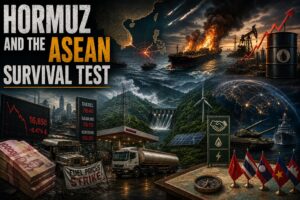
When the Strait of Hormuz effectively locked down under missile fire back in March 2026, global media immediately turned its gaze toward Indonesia. The rupiah took a severe beating, plunging past thresholds not seen since the legendary 1997 Asian financial crisis. Bangkok earned the old tom yum kung nickname back in the late nineties, but this time Jakarta dominated the headlines instead. Analysts scrambled to write the obvious script. A closed strait meant spiking crude prices, a ballooning import bill, and an economy bleeding foreign reserves. It felt like a classic textbook currency crash unfolding in real time.
While Indonesia grabbed the scary charts and the panicked commentary, it wasn’t actually the ASEAN nation that suffered the deepest structural damage from the energy shock.
But reality has a funny habit of defying easy headline narratives. While Indonesia grabbed the scary charts and the panicked commentary, it wasn’t actually the ASEAN nation that suffered the deepest structural damage from the energy shock. Jakarta had enough financial cushion and domestic reserves to absorb the brutal balance of payments adjustment. It weathered the storm bruised, but fundamentally intact.
The real casualty of the Hormuz crisis slipped quietly past international attention, partly because it happened to be the second most populous nation in the region. The Philippines took the brunt of the regional energy trauma, exposing a chilling vulnerability no currency chart could ever capture. Manila didn’t just face a pricing squeeze. It faced an outright structural dependency crisis. With near total reliance on Gulf crude and next to no commercial fuel buffers or strategic petroleum reserves of its own, the country hit a brick wall by late March.
Without a strategic reserve or a modernized power grid capable of absorbing renewable energy, Manila found itself facing a brutal economic climb, completely alone in the storm.
The fallout came fast and hit hard. The Philippine president declared a national energy emergency under a one year mandate, trying desperately to clamp down on fuel hoarding and price gouging while scrambling together transport support packages. Jeepney drivers took to the streets in angry strikes, unable to absorb diesel prices that had soared to roughly double what motorists were paying in Malaysia, Vietnam, or Thailand. By midyear, the emergency order had bought some breathing room, but it did nothing to fix the underlying rot. Without a strategic reserve or a modernized power grid capable of absorbing renewable energy, Manila found itself facing a brutal economic climb, completely alone in the storm, lacking both domestic buffers and a dense web of neighborly favors to lean on.
Down in mainland Southeast Asia, the crisis played out through an entirely different script, producing one of the most surprising survival stories of the year. Laos is landlocked, has fewer than eight million people, and runs one of the smallest economies in the region. When the Hormuz crunch hit, Laos had zero domestic oil production of its own. By March, hundreds of fuel stations pulled down their shutters, diesel prices skyrocketed by well over a hundred percent in a single month, and schools had to slash their operating weeks short. For a brief moment right before the traditional New Year festivities, Vientiane looked like a textbook regional casualty headed for a permanent economic limp.
Laos was never just a helpless supplicant begging for fuel. Its rivers gave Thailand something genuinely indispensable, proving that active business relationships and cross border integration count for a lot more than sheer GDP size.
Yet a quiet reprieve materialized behind the scenes. Even as Thai authorities absorbed a devastating fifty percent cut to their own crude supplies from the Middle East, they deliberately chose to keep fuel flowing across the border into Laos. Bangkok didn’t do this out of pure charity. Its relationship with Vientiane is anchored in reciprocal energy interdependence. Thai energy planners rely heavily on hydropower imported from Lao dams, a vital green asset Bangkok has been aggressively trying to expand as it diversifies its power mix. Laos was never just a helpless supplicant begging for fuel. Its rivers gave Thailand something genuinely indispensable, proving that active business relationships and cross border integration count for a lot more than sheer GDP size once an actual emergency hits.
By June, Vientiane and Thai energy companies had signed formal supply agreements, and Laos calmly reinstated the fuel taxes it had temporarily suspended during the worst of it. Vientiane even managed to diversify its survival channels further, with reports emerging that Russia was exploring its first ever petroleum exports to Laos via Vietnamese ports. A country that should have been crushed on paper bounced back because it had spent years quietly weaving a resilient network of mutual obligations.
This complex undercurrent of regional connectivity reaches well beyond oil pipelines and power grids too. The energy crisis can’t really be separated from the broader geopolitical jockeying shaping the mainland right now. Thailand has spent the past year quietly building up its military hardware through Beijing, acquiring tanks, missiles, and naval assets even as simmering border tensions with Cambodia bubble under the surface. China has stepped into a delicate balancing act here, supplying arms commercially to both sides while positioning itself as a diplomatic mediator trying to disincentivize outright conflict.
The cascading effects of the strait’s closure rippled outward, testing the institutional resilience and cooperative fabric of ASEAN in ways few policy planners had actually anticipated. For decades, regional integration got measured in tariff reductions, free trade agreements, and manufacturing supply chains. The Hormuz shock brutally refocused attention on the hard currency of actual survival, energy security, structural redundancy, and diplomatic goodwill. Nations that had invested solely in financial metrics found themselves scrambling, while those rooted in reciprocal regional dependencies discovered unexpected lifelines instead.
Consider the stark contrast in public administrative responses across the maritime and mainland regions. While Jakarta managed its currency slide through disciplined central bank intervention and anchored macroeconomic fundamentals, Manila got forced into reactive firefighting instead. The declaration of a national energy emergency highlighted the severe policy constraints facing a nation that imports nearly all of its liquid fuel without maintaining any strategic inventory buffer. When transport sectors paralyze because of unchecked fuel inflation, the economic contagion spills over fast into domestic consumption, food distribution, and broader social stability. Manila’s predicament serves as an urgent cautionary tale for import dependent emerging economies operating without domestic cushions of their own.
The Vientiane experience, on the other hand, underscores the real value of strategic resource sharing. Laos leveraged its geographic abundance in renewable hydro generation to secure vital fossil fuel imports from a stressed neighbor. This symbiotic exchange shows that small economies can carve out vital safety margins if they control commodities larger neighbors urgently need for their own green transitions. And the willingness of outside actors like Russia to explore niche export routes via Vietnamese ports shows just how quickly global energy flows can adapt around chokepoints when the commercial incentives line up.
The overarching lesson of the Hormuz crisis is pretty clear. Strategic reserves matter enormously, and Indonesia proved that financial depth helps a nation absorb a shock without collapsing. But the countries that sailed through the turbulence with the least visible long term damage weren’t necessarily the economic giants. They were the nations equipped with enduring relationships, diversified partnerships, and reciprocal utility. Manila learned this lesson the hard way. When the tankers stopped moving through the strait, the Philippines had neither reserves nor a safety net of neighborly favors to fall back on. As the global energy landscape grows increasingly volatile, the nations that survive are going to be the ones smart enough to build bridges before the storms actually hit.
About the Author
Daniel Frost is a Foreign affairs columnist specializing in global geopolitics, European security, and strategic policy.