
By Daniel Frost | Foreign Affairs Columnist
There’s a line from novelist Lois McMaster Bujold that keeps coming to mind lately, that the dead can’t cry out for justice, so it falls to the living to do it for them. Gaza gave the world a brutal reminder of exactly that last week. One hundred and twelve people, including forty four children from two extended families, were laid to rest in a single mass funeral. These weren’t casualties of some fresh skirmish. They were the long delayed victims of Israeli airstrikes that flattened the Sabra neighborhood in Gaza City nearly three years ago. Their bodies had stayed buried under crushed concrete for weeks, recovered only after painstaking digging through makeshift mass graves. Wiping out entire family lines across three generations in an instant isn’t collateral damage. It’s a terrifying picture of industrial scale violence that keeps defining daily life in the besieged strip, denying even the dead any dignity, safety, or peace.
On paper, the enclave was supposed to be moving toward quiet. The United States and international mediators hailed an October 2025 ceasefire framework and the diplomacy that followed as a historic turning point. But peace never actually arrived. Since that agreement was announced, Israeli forces have kept up an unrelenting barrage of airstrikes, killing over 1,200 Palestinians, including more than 300 children, and wounding nearly 4,000 others. More than ninety percent of Gaza’s population remains displaced, packed into shrinking coastal dunes and canvas tent camps. Even these designated safe zones get bombed routinely, leaving displaced families with nowhere safe left to sleep.
The diplomatic charade collapsed entirely when Netanyahu formally rejected the US backed fifteen point peace plan. Unveiled as part of a framework meant to move Gaza toward Palestinian administration and eventual self determination, the proposal demanded a phased Israeli military withdrawal alongside the disarmament of Hamas. Trump publicly praised the deal as a monumental step toward peace, noting Hamas had committed to implementing the terms under international monitoring. But Netanyahu shattered that illusion during a cabinet meeting, declaring flatly that Israel does not accept the document. He insisted his forces won’t pull back a single inch until Hamas is totally and verifiably destroyed.
“Agreements, ceasefires, and international proposals function mainly as tactical stalling mechanisms, designed to absorb diplomatic pressure while the slow work of starvation and military destruction keeps grinding on underneath.”
That rejection was entirely predictable, honestly. Facing upcoming Knesset elections and trailing opposition blocs in the polls, a beleaguered prime minister clinging to power alongside far right extremists was never going to make meaningful concessions. Far right ministers like Bezalel Smotrich and Itamar Ben Gvir demand permanent military reoccupation of the entire Gaza Strip, openly attacking any transitional peacekeeping force or international oversight proposal. For Netanyahu, personal political survival depends on keeping the war machine running. By walking away from a proposal touted by his closest ally in Washington, Israel has once again shown that its diplomatic commitments carry little weight. No peace framework is going to get honored when political self preservation keeps demanding further bloodshed.
Rejecting the peace plan goes well beyond military positioning too. It’s also an explicit endorsement of engineered humanitarian deprivation. The fifteen point proposal explicitly called for the immediate, unrestricted entry of food, life saving medicine, fuel, and electricity. By walking away from the framework, Netanyahu tore up the baseline obligations designed to halt Gaza’s slow death. Despite occasional aid trickling in, strict bureaucratic rationing ensures no Palestinian receives adequate daily caloric intake. UN food security monitors report that over 1.4 million people remain trapped in acute food insecurity, surviving on meager, substandard rations while lacking clean drinking water. By blocking power grids and fuel for desalination plants, Israel is using starvation and biological attrition as permanent levers of military control.
The explicit rejection of these fifteen points makes the underlying policy pretty unmistakable at this point. Physical destruction and humanitarian attrition go hand in hand here. By refusing to pull out troops and reiterating that no Palestinian state will ever emerge under his watch, Netanyahu has stripped away any lingering diplomatic pretense. His stance makes clear that agreements, ceasefires, and international proposals function mainly as tactical stalling mechanisms, designed to absorb diplomatic pressure while the slow work of starvation and military destruction keeps grinding on underneath.
For the two million people trapped inside the strip, all this political posturing translates into daily agony. While diplomats debate phased frameworks and disarmament thresholds somewhere far away, parents are left burying their children after strikes hit makeshift tent camps. The mass funeral for the Abu Sharia and Al Hassayna families isn’t some tragic relic of 2023. It’s a preview of Gaza’s present reality under an unchecked military strategy. As long as impunity and far right coalition math keep dictating policy in Israel, starvation is going to remain a weapon, and the bloodshed is going to continue unabated.
“The idea that slaughtering the innocent can ever become accepted routine is something we have to resolutely refuse to accept.”
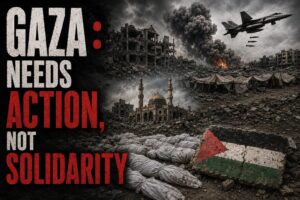
Solidarity in words alone isn’t enough anymore. The international community needs to move past stale statements and enforce real accountability before there’s nothing left of Gaza to save. That means immediate, coordinated action across multiple fronts. Arab, Muslim, and allied governments need to leverage international platforms, invoking mechanisms like the Uniting for Peace resolution to bypass Western vetoes, pushing for binding sanctions, and implementing a universal arms embargo. Civil society and grassroots organizations worldwide need to pressure their own governments to sever diplomatic, economic, and military ties with Israel until it actually complies with international law. International legal bodies need to speed up their proceedings, pushing the International Criminal Court to execute arrest warrants for senior leadership while the International Court of Justice enforces provisional measures around violations of the Genocide Convention. Independent media outlets need to counter state sponsored propaganda, keeping public attention fixed on the systematic displacement of Gaza’s population. And international aid agencies need to bypass Israeli obstruction entirely to establish protected humanitarian corridors, making sure massive quantities of food, water, and medical supplies actually get into Gaza immediately. The idea that slaughtering the innocent can ever become accepted routine is something we have to resolutely refuse to accept.
About the author:
Daniel Frost is a Foreign affairs columnist specializing in global geopolitics, European security, and strategic policy.