
By Ahan S. Prakash | Geopolitical Analyst & Columnist
For six years after the brutal Himalayan clashes of 2020, New Delhi operated under a pretty rigid economic and political premise. The core assumption was simple, if a country is economically dependent on a rival power across a contested frontier, that’s an intolerable strategic risk. In response, the Indian government tightened restrictions, heavily scrutinized Chinese investments, restricted business travel for technical experts, and slow walked critical commercial approvals. The signal was unmistakable. India was willing to absorb serious short term economic pain if it meant breaking China’s grip on sensitive domestic sectors.
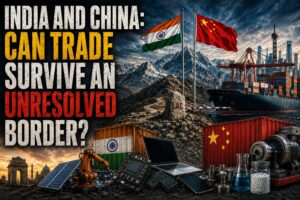
That hardline strategy has undergone a quiet, pragmatic revision since then. During the 36th round of the Working Mechanism for Consultation and Coordination on border affairs, held in New Delhi, officials from both sides sat down for structured diplomatic talks. That engagement follows a broader pattern already underway, easing business travel, cautiously unfreezing select investment rules, and letting regional trade resume. But reading these developments as some comprehensive strategic reset or lasting peace is a fundamental misreading of Asian geopolitics. What’s actually unfolding is more like a calculated supply chain truce, born from the realization that fully decoupling from the world’s manufacturing powerhouse is an illusion, one that hurts domestic growth more than it actually curbs a rival.
The hard numbers driving this shift are impossible to ignore. India imported nearly 132 billion dollars in goods from China during the last fiscal year, pushing total bilateral trade past 151 billion dollars with a massive deficit exceeding 100 billion. And this trade isn’t dominated by superficial consumer novelties either. It consists of essential industrial machinery, advanced electronics, chemical precursors, and core components that keep Indian factories actually running. New Delhi discovered an awkward truth after imposing post 2020 visa restrictions, local manufacturers couldn’t secure the specialized Chinese technicians needed to install, maintain, and repair critical industrial machinery. Estimates suggest those visa bottlenecks cost the domestic electronics sector roughly 15 billion dollars over four years. By eventually loosening those entry rules, New Delhi essentially admitted that trying to starve Beijing of access was quietly strangling its own manufacturing ambitions instead.
“The guiding idea here is pretty simple, use today’s economic interdependence to build tomorrow’s industrial independence.”
Investment policy has shifted to reflect this same pragmatic realization. New Delhi has introduced structured pathways allowing minority investments with up to ten percent Chinese ownership to secure faster approvals, specifically targeting high priority sectors like electronics and clean energy batteries. Rather than pursuing a blunt, total decoupling, India has adopted a strategy of selective access instead. It lets capital and machinery flow where domestic alternatives don’t yet exist, while keeping tight regulatory control over core ownership. The electric vehicle industry is a pretty textbook example here. While direct equity investment from Chinese firms still faces heavy political resistance, Indian automotive giants are actively licensing advanced Chinese EV platforms to stay competitive, picking up the necessary technology without handing over corporate control.
Still, this economic pragmatism doesn’t mean New Delhi has given up on self reliance. In a parallel push, the Indian government has earmarked over 50 billion dollars in critical imports for targeted domestic substitution, rolling out heavy production incentives for solar polysilicon and advanced manufacturing to systematically reduce long term reliance on Beijing over time. This dual track approach isn’t actually contradictory. It reflects a mature understanding that a country can’t just legislate away structural dependence overnight. Forcing local industries onto inferior or significantly more expensive substitutes too early only damages the very manufacturing base needed to eventually challenge China’s dominance down the road. The guiding idea here is pretty simple, use today’s economic interdependence to build tomorrow’s industrial independence.
Beijing has readily accommodated this tactical opening. Facing rising trade barriers and deepening political skepticism across Western markets, Chinese manufacturers have every incentive to hold onto a strong foothold in India’s expanding consumer and industrial base. But this relationship remains deeply asymmetrical either way. India’s structural reliance on China’s vast manufacturing ecosystem far outweighs Beijing’s reliance on Indian market demand. That very imbalance is exactly why New Delhi is focused on recalibrating the terms of engagement here rather than cutting ties altogether.
Crucially, this economic thaw exists right alongside persistent, sharp geopolitical friction along the actual frontier. Even as trade talks move forward, the reality of the border dispute hasn’t changed at all. Recent tensions flared around Arunachal Pradesh, where India formally identified 27 geographical locations and features by their standard names on official maps, pushing back against repeated Chinese renaming attempts. Beijing reacted predictably, condemning the move through state media and official channels as illegal and a violation of its territorial claims over what it calls Zangnan. Meanwhile, reports of localized troop friction near the Line of Actual Control underscore just how fragile the reality on the ground still is.
In response to all this, New Delhi’s Ministry of External Affairs reiterated that peace and tranquility along the border remain of utmost importance and directly reflect the health of the broader bilateral relationship. This friction really highlights the exact limits of the current rapprochement. The territorial dispute hasn’t thawed an inch, and large military deployments remain firmly entrenched across the frontier.
“New Delhi has simply accepted that real self reliance doesn’t come from prematurely cutting economic cords. It comes from strategically managing dependence.”
At the end of the day, neither New Delhi nor Beijing needs mutual trust for this functional arrangement to keep working. What they need is predictability. By separating economic necessity from an unyielding territorial dispute, both capitals have carved out a workable space for themselves. India secures the machinery, technical expertise, and capital it needs to fuel its industrial goals, while China holds onto access to a vital neighboring market. The border stays tense, strategic competition continues unabated, and sovereignty claims get defended with just as much resolve as before. New Delhi has simply accepted that real self reliance doesn’t come from prematurely cutting economic cords. It comes from strategically managing dependence.
About the author:
Ahan S. Prakash is a Geopolitical analyst and columnist covering South Asian affairs, strategic security, and international relations.